
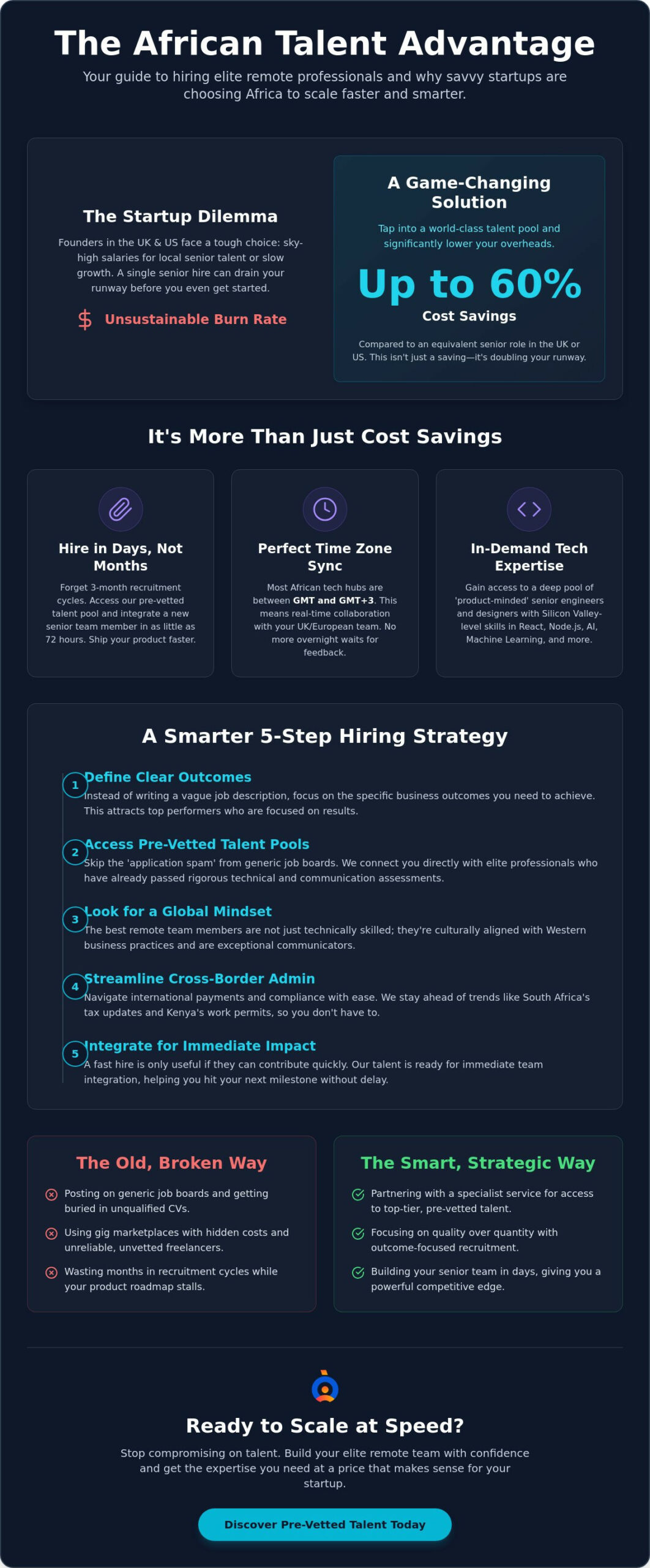
Did you know that hiring remote talent from Africa can lead to cost savings of up to 60 per cent compared to equivalent senior roles in the UK or US? For many founders, the constant struggle to find affordable, high-level developers is the biggest hurdle to hitting their next milestone. You are likely tired of seeing your burn rate skyrocket while recruitment cycles drag on for months, leaving your product roadmap at a standstill. It is a common challenge to want top-tier expertise without the local price tag or the headache of vetting candidates in unfamiliar markets.
The good news is that you don’t have to settle for mediocrity to save money. This guide reveals how to hire African talent for startups by tapping into an elite pool of pre-vetted professionals who bring both technical precision and a global mindset to your team. We will explore the latest 2026 hiring trends, including South Africa’s tax updates and Kenya’s new work permits. You will discover exactly how to secure senior-level designers and engineers in a matter of days, allowing you to scale your operations with total confidence and speed.
Key Takeaways
- Understand why elite startups are pivoting to the African tech hub to find senior professionals who often outperform local candidates.
- Discover how to hire African talent for startups to gain top-tier technical skills that align perfectly with UK and European time zones.
- Learn how to manage the 2026 cross-border payroll landscape and international payments without the usual administrative headaches.
- Master a five-step sourcing strategy that replaces generic job ads with outcome-focused recruitment for faster, better results.
- See how to cut recruitment cycles from months to days by accessing pre-vetted talent pools ready for immediate team integration.
Why Startups are Pivoting to Africa for Remote Talent in 2026
The global hiring map has been completely redrawn. By mid-2026, the “Global South” has transitioned from a secondary option to the primary source for elite remote professionals. Founders in tech hubs like London and San Francisco are facing a harsh reality. Local senior talent is no longer just expensive; it is becoming unsustainable for early-stage companies. When a single senior engineer in the UK costs as much as a small team elsewhere, your burn rate becomes your biggest enemy. This “Startup Struggle” is forcing a pivot toward regions where the talent is world-class but the overheads are manageable.
Africa’s tech boom is at the heart of this shift. Over the last few years, the continent has seen a massive explosion in VC-backed tech hubs. Cities like Lagos, Nairobi, and Accra are now home to thousands of senior software engineers and designers who have been trained in global environments. This isn’t just about finding people to fill seats. It’s about accessing a sophisticated hire African talent for startups strategy that allows you to move at a high velocity. In 2026, the ability to complete a 72-hour hire is the new competitive advantage. While your competitors are stuck in three-month recruitment cycles, you can integrate a pre-vetted expert and ship your product faster. As your brand scales globally at this pace, you may also want to visit WhoRatesMe to ensure your online reputation remains as strong as your development team.
The Problem with Traditional Remote Hiring for Startups
Traditional hiring methods are broken. Posting a role on a general job board in 2026 usually results in “application spam”. You end up sifting through hundreds of unqualified resumes, which wastes precious founder time. Gig-based marketplaces aren’t much better. They often hide the true cost of unvetted freelancers who might disappear mid-sprint or deliver sub-par code. To scale strategically, high-growth teams are moving away from these platforms. They now prefer a specialised remote talent placement service that focuses on quality over quantity.
The African Advantage: Quality Meets Affordability
It’s time to break the myth that remote talent means “cheap labour”. The economic landscape in Africa has produced a generation of high-value experts who bring elite skills to the table. When you hire African talent for startups, you are tapping into a workforce that is highly fluent in English and culturally aligned with Western business practices. The financial impact is undeniable. You can achieve a 60 per cent reduction in hiring costs compared to the US or UK. This isn’t just a saving; it’s a way to double your runway and give your startup the breathing room it needs to reach profitability.
The Strategic Benefits of Hiring African Talent for Early-Stage Teams
Hiring for an early-stage startup is an exercise in resource management. You need the highest possible quality with the lowest possible risk. When you hire African talent for startups, you aren’t just filling a vacancy. You are gaining access to “Silicon Valley” level expertise without the inflated Silicon Valley price tag. This isn’t a compromise on quality. It’s a strategic move to leverage high-growth Africa’s startup ecosystems, where technical training is rigorous and the competition for top roles is fierce.
One of the most immediate benefits is time zone synergy. Most African tech hubs operate between GMT and GMT+3. For UK and European founders, this means your remote team is working while you are working. There is no waiting twelve hours for a response or dealing with the “hand-over” friction common with South Asian teams. You can have real-time Slack discussions, attend the same stand-ups, and solve bugs as they happen. This alignment allows you to scale your team from a single hire to an entire product department in under a week. To make the most of this, try scheduling your core “collaboration hours” between 10:00 and 14:00 GMT. This ensures your entire team is online at the same time regardless of their specific location.
Elite Tech Skills in High Demand
The depth of the talent pool is staggering. Whether your stack (the collection of technologies used to build your app) relies on React and Node.js or you are pushing the boundaries of AI and Machine Learning, the expertise is there. Senior engineers in Nigeria and Kenya often have a unique edge. They are incredibly “product-minded”. Because they often work in lean, high-growth environments, they don’t just write code; they understand how that code impacts your user experience and business goals. If you are looking for specialists, checking out our guide on hiring remote developers from Africa is a great next step.
Business and Design Talent: Beyond the Code
While developers are in high demand, startups are increasingly looking for UI/UX designers and Product Managers within the region. There is also a significant rise in growth-focused SEO and content experts who understand how to capture global audiences. Integrating these roles into your workflow is straightforward. Treat them as a core part of your team from day one. Use shared project management tools and clear outcome-based goals to ensure everyone is pulling in the same direction. If you want to see how quickly you can match with these professionals, you can explore our vetted talent pool today.
Finally, don’t overlook diversity of thought. A global team builds better products. By bringing in perspectives from different markets, you ensure your software or service is ready for a global audience, not just a local bubble. This cultural richness leads to more creative problem-solving and a more resilient company culture. It’s about building a team that reflects the world you want to serve.
Overcoming Common Hurdles in Remote Hiring for Startups
Founders often hesitate to expand globally because of perceived risks. When you decide to hire African talent for startups, your mind might jump to complex labour laws or unreliable internet. By 2026, these concerns are largely outdated. The infrastructure exists to make international hiring as smooth as hiring someone from the next town over. The key is moving from a “freelance” mindset to a structured, managed approach. This shift allows you to focus on your product while the logistics of global employment are handled in the background.
The Vetting Process: Eliminating the Risk
How do you know if a candidate is actually good? Technical tests are necessary, but they aren’t enough for a remote setup. High-growth teams need to assess “remote readiness”. This includes self-management, reliability, and proactive communication. A rigorous remote talent vetting process filters out the noise. It ensures you only meet candidates who have already proven they can thrive in a fast-paced environment. Actionable tip: Always include a paid, three-day “test project” that mimics a real-world task to see how a candidate handles feedback and deadlines before making a full offer.
Legal and compliance issues are another common worry. Each country has its own rules, from Nigeria’s 2026 tax reforms to Kenya’s specific payroll remittance dates. Navigating this alone is a administrative nightmare. Using a managed placement service removes this burden. It handles the local contracts and social security contributions, so you don’t have to worry about creating a “permanent establishment” or facing unexpected tax liabilities in foreign jurisdictions. This protection is vital for maintaining a clean cap table for future funding rounds.
Infrastructure and Connectivity: Reality vs Myth
The idea that African developers are constantly battling power cuts is a myth. Elite professionals in the region manage their own infrastructure with clinical precision. They invest in solar power, high-capacity inverters, and redundant internet connections like Starlink. Major tech hubs have seen massive investment as governments work to support startup tech ecosystem growth across the continent. In 2026, high-speed fibre is the standard in cities like Lagos, Nairobi, and Cape Town.
Finally, focus on building a “one-team” mentality. Don’t treat your remote hires as an “outsourced” department. Integrate them into your Slack channels, invite them to all-hands meetings, and use video calls to build rapport. Building this culture early on ensures that distance doesn’t lead to a disconnect in your product vision. When everyone feels like a core part of the mission, the results speak for themselves. You aren’t just hiring a pair of hands; you are adding a strategic partner to your journey.
5 Actionable Steps to Building Your Team with Elite African Professionals
Moving from the decision to hire African talent for startups to actually onboarding your first engineer requires a tactical plan. You cannot afford the forty-five-day hiring cycles that plague traditional companies. In the 2026 market, top-tier talent moves fast. If you don’t have a streamlined process, you will lose the best candidates to competitors who do. These five steps ensure you move with the precision and speed necessary to scale your startup effectively.
Step 1: Audit Your Current Resource Gaps
Start by identifying which roles are blocking your immediate growth. Most founders find that almost every role, from backend engineering to business development, is perfectly suited for remote African talent (spoiler: it’s almost all of them). Calculate your potential runway extension. By reducing hiring costs by up to 60 per cent, you can often afford two senior hires for the price of one local junior developer. Prepare your internal team by defining exactly what success looks like for these new roles in terms of weekly outcomes rather than just hours logged.
Next, choose your sourcing strategy carefully. Searching through LinkedIn is often a “black hole” of unvetted profiles and outdated information. To move at high velocity, you need a specialised remote African talent platform. This approach bypasses the noise and puts you directly in front of professionals who have already cleared rigorous technical and communication hurdles. It changes the dynamic from “searching” to “selecting.”
Implement a “Speed-to-Hire” interview process. We recommend a maximum of three rounds: an initial screening, a technical or portfolio deep-dive, and a final culture-fit chat with the founder. Anything more than this risks losing elite talent to faster-moving offers. Secure your choice quickly, then move immediately into integration.
Step 4: The 2026 Onboarding Checklist
Successful integration depends on the first thirty days. You need a stack of essential tools to bridge the distance. Slack is for immediate communication, Loom is for asynchronous updates, and Notion serves as your central source of truth. Set a “Success Milestone” for the end of week one. This could be a small code commit or a drafted marketing plan. Achieving this builds trust early and proves the value of the hire. For a deeper dive into these processes, check out our guide on building a remote team in Africa.
Finally, optimise for long-term growth. Don’t just treat these professionals as temporary fixes. Transition them into managed team members with clear paths for advancement within your startup. This commitment to their professional development ensures high retention and a loyal, high-performing core team. If you are ready to stop searching and start scaling, book a consultation to find your next senior hire today.
Scaling at Speed: How IMO Talent Streamlines Your Growth
Speed is the primary currency of the startup world. While traditional recruitment agencies often take four to six weeks to even present a shortlist, high-growth founders don’t have that kind of time. Choosing to hire African talent for startups is a brilliant strategic move, but the execution is what determines your success. IMO Talent acts as the “Master Matchmaker” in this space, bridging the gap between elite African professionals and global scale-ups with clinical precision. We don’t just find people; we facilitate rapid growth by removing every friction point in the hiring process.
Our 72-hour promise is built on a foundation of readiness. We maintain a living pipeline of pre-vetted experts who are ready to integrate into your workflow immediately. This means that while your competitors are still drafting job descriptions, you are already interviewing the top 3 per cent of talent on the continent. We take full responsibility for the end-to-end management of the placement. This includes everything from initial vetting to ongoing support and retention strategies, ensuring your new team members stay motivated and productive for the long haul.
Our Vetting Rigour: Your Peace of Mind
We take a “quality over quantity” approach that most general platforms simply cannot match. Every candidate undergoes a multi-stage assessment that covers technical proficiency, cultural alignment, and remote-work maturity. We look for professionals who don’t just follow instructions but proactively solve problems. This rigour ensures that when you hire through us, your new team members are ready to “hit the ground running” on day one. Actionable tip: When you start your search, prepare a list of your three most critical technical blockers. This allows us to match you with a specialist who has solved those exact challenges before. You can learn more about this high-performance approach in our guide on managing remote African developers.
Ready to Scale? Your Next Steps
Scaling your startup shouldn’t feel like a gamble. We provide a transparent fee structure that allows you to remain lean while accessing world-class expertise. There are no hidden costs or complex administrative hurdles to jump over. We handle the heavy lifting of compliance and payroll, allowing you to focus entirely on your product roadmap and investor relations.
The process is simple and direct. You can book a discovery call today to discuss your specific resource gaps and view our current talent pool. We will help you identify the best roles to move remote and show you exactly how to hire African talent for startups without the usual risks. Don’t let slow recruitment cycles stall your momentum. Start your 72-hour hiring sprint today and see how quickly the right talent can transform your burn rate into a growth rate.
Secure Your Global Competitive Edge Today
The landscape of remote work has shifted, and the most successful founders are those who adapt quickly. You now have the blueprint to access world-class expertise while reducing your burn rate by up to 60 per cent. By moving beyond local hiring constraints and tapping into high-growth tech hubs, you gain a team that is product-minded, culturally aligned, and ready to scale.
Choosing to hire African talent for startups allows you to build a resilient, diverse team without the traditional recruitment headaches. You don’t need to wait weeks for a shortlist or worry about vetting quality. With a dedicated partner, you can access the top 3 per cent of pre-vetted professionals who are ready to integrate into your workflow immediately. This isn’t just about saving money; it’s about gaining the technical precision your product deserves.
Stop letting slow hiring cycles delay your product launches. Hire your next elite remote professional in 72 hours with IMO Talent and start scaling your operations with total confidence. The talent you need to hit your next milestone is waiting. It’s time to build faster.
Frequently Asked Questions
Is it safe to hire remote workers from Africa for my startup?
It is exceptionally safe to hire African talent for startups when you use a managed platform that prioritises compliance and data security. As of early 2026, 44 African countries have enacted robust data protection laws to safeguard intellectual property. Professional remote workers in the region are highly accustomed to international security standards and use encrypted tools to protect your company’s assets.
How much can I save by hiring African talent instead of UK/US developers?
You can typically reduce your hiring costs by 40 to 60 per cent without any drop in technical quality. Research from 2026 shows the average salary for a remote software engineer in Africa is approximately $53,333 per year. This allows you to secure senior-level expertise for a fraction of the cost of a mid-level developer in London or San Francisco.
What are the best countries in Africa to hire tech talent from in 2026?
Nigeria, Kenya, South Africa, and Rwanda are currently the leading hubs for elite tech talent. Nairobi is a world-renowned tech centre, while Kenya’s 2026 Class N Digital Nomad Work Permit has made the region even more attractive for global professionals. South Africa also offers a deep pool of senior engineers who are well-versed in working with Western startups.
How do I handle time zone differences when working with African professionals?
Time zone management is simple because most African hubs sit between GMT and GMT+3, offering perfect alignment with UK and European teams. You don’t have to deal with the massive delays common in other remote regions. A practical tip is to set “core collaboration hours” between 10:00 and 14:00 GMT, ensuring your entire team can attend stand-ups and solve problems in real time.
What is the typical ‘time-to-hire’ when using a platform like IMO Talent?
You can expect to review pre-vetted candidates and make a placement within 72 hours. Unlike traditional recruitment agencies that take weeks to find a match, we maintain a pipeline of the top 3 per cent of talent ready for immediate integration. This high-velocity approach allows you to hire African talent for startups and start shipping code while your competitors are still writing job ads.
Do I need to set up a local entity in Africa to hire talent there?
No, you do not need to establish a local legal entity or office to hire professionals in Africa. Managed placement services and Employer of Record (EOR) providers handle all local payroll, taxes, and social security remissions for you. This removes the administrative burden and ensures you remain fully compliant with local labour laws from day one.
How does IMO Talent ensure the quality of the professionals on its platform?
We use a rigorous multi-stage vetting process that only accepts the top 3 per cent of applicants. This includes deep technical assessments, live coding challenges, and comprehensive interviews to evaluate “remote readiness”. We focus on professionals who demonstrate high-level self-management and proactive communication skills, ensuring they can contribute to your team immediately without constant hand-holding.
Can I hire non-technical roles, like Product Managers or UX Designers, in Africa?
Yes, the African talent pool is rich with senior-level Product Managers, UI/UX designers, and growth-focused marketing experts. These professionals often bring a unique “product-minded” perspective from working in high-growth, lean ecosystems. Integrating these non-technical roles is straightforward using standard remote tools like Figma for design or Notion for project management.