

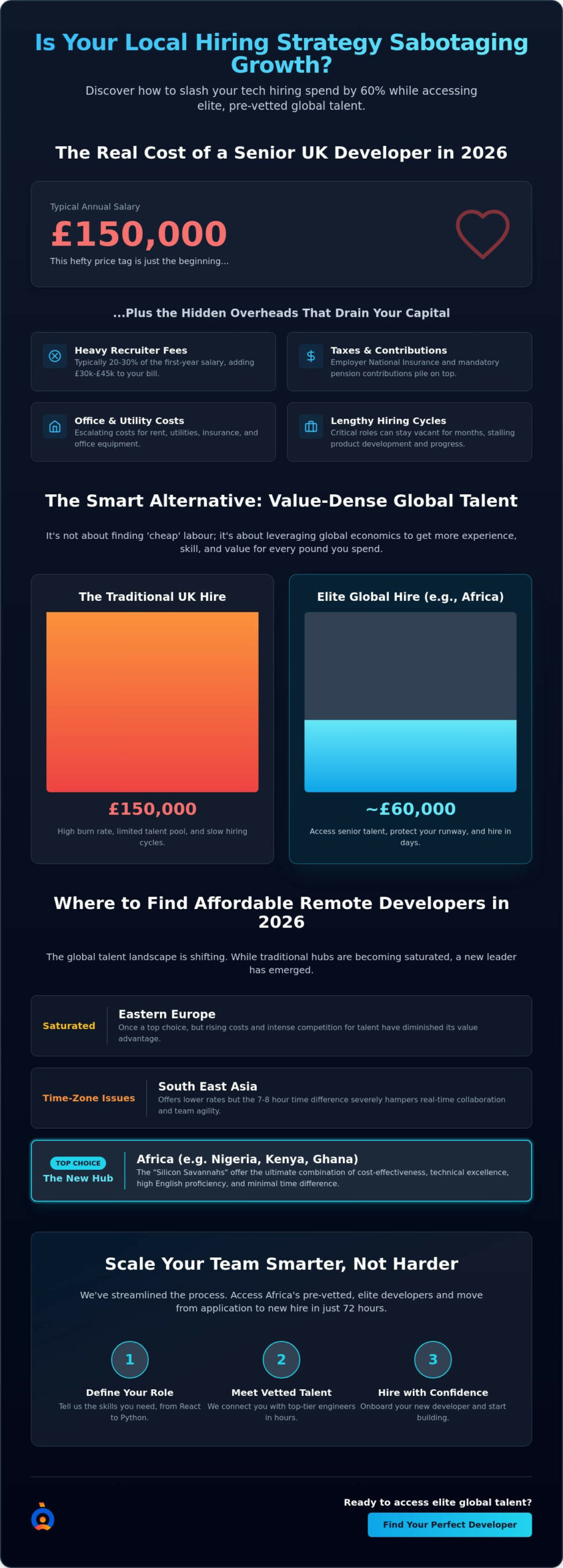
Is your local hiring strategy actually sabotaging your growth? Paying £150,000 for a senior developer isn’t just a heavy investment. In 2026, it’s often an unnecessary drain on your company’s capital. You’ve likely felt the frustration of recruitment cycles that drag on for months, only to end with a salary demand that spikes your burn rate. It’s natural to worry that seeking affordable remote developers might mean sacrificing code quality for a lower price tag, but that is a myth we are ready to bust.
You don’t have to choose between technical excellence and your bottom line. This guide reveals how to slash your hiring spend by 60% while accessing elite, pre-vetted talent from the world’s fastest-growing tech hubs. We will provide a clear framework to navigate the 2026 UK Data Act changes and show you how to hire a senior specialist in days, not months. You’ll learn exactly how to optimise your team for high-velocity development without the traditional overheads that slow down modern scale-ups.
Key Takeaways
- Learn how to use global economic differences to hire senior tech talent at a 60% discount without ever compromising on code quality.
- Discover why Africa has become the leading hub for untapped, high-level engineers who offer exceptional English proficiency and technical rigour.
- Compare the three most effective models for hiring affordable remote developers to determine which strategy best protects your product and your budget.
- Master our vetting checklist to identify engineers who possess real-world architectural thinking and the proactive communication skills essential for remote success.
- Find out how to streamline your recruitment process to move from an initial application to an elite hire in just 72 hours.
Redefining Affordable: Why High-Quality Remote Developers Cost Less in 2026
When most tech leaders hear the word ‘affordable’, they immediately worry about cut corners and buggy code. In 2026, that mindset is outdated. Affordability isn’t about finding the lowest bidder; it’s about leveraging purchasing power parity. A senior developer in Lagos or Nairobi can enjoy a premium lifestyle on a salary that would barely cover a studio flat in London. This economic reality allows you to secure affordable remote developers who possess the same technical rigour and architectural expertise as their UK counterparts, but without the inflated price tag of a Western postcode.
We call this ‘Value-Density’. Instead of overpaying for a local mid-level dev because the market is tight, you can hire a top-tier senior engineer in an emerging market for the same budget. You are getting more years of experience, better problem-solving skills, and a higher level of autonomy for every pound spent. By focusing on value rather than just cost, you avoid the ‘cheap talent’ trap that leads to technical debt (the future cost of fixing quick, messy code) and missed deadlines. You get senior-level thinking at a price point that protects your runway.
Local hiring also comes with heavy baggage that often stays hidden until the first invoice arrives. Consider these common drains on your capital:
- Recruiter fees that typically cost between 20% and 30% of the hire’s first-year salary.
- Employer National Insurance contributions and pension matchings.
- The escalating cost of office space, utilities, and insurance.
- Hardware logistics and local benefit packages.
When you remove these overheads, your budget goes significantly further without compromising on the quality of your product. Companies that proactively reduce hiring costs with remote talent are consistently outpacing those still relying on traditional local recruitment models.
The Shift from Local to Global Talent Pools
Restricting your search to local postcodes is a massive bottleneck for 2026 scale-ups. The widespread adoption of remote work has completely decoupled talent from geography. This shift has led to a global standardisation of high-level skills. Developers in Africa are now working on the same modern stacks and for the same tech giants as those in Silicon Valley. For smaller startups, global hiring is the ultimate equaliser. It allows you to compete for elite talent that was previously the exclusive domain of companies with massive venture capital backing.
Calculating the Real Cost of a Developer
To understand the true impact on your burn rate, you must look at the cost of hiring senior developers in Africa compared to the UK. It isn’t just about the monthly pay cheque. Retention is a huge factor. Remote talent in emerging markets often shows higher loyalty because you are providing them with world-class opportunities that aren’t always available locally. Think about the ‘Opportunity Cost’ too. If a critical role stays vacant for six months while you hunt for a local ‘bargain’, your product development stalls. Hiring affordable remote developers from a pre-vetted pool means you can close that gap in days, not months.
The Best Regions for Affordable Remote Developers: A 2026 Global Comparison
Finding affordable remote developers usually leads hiring managers to look at Eastern Europe or South East Asia. However, by 2026, the landscape has shifted. Traditional hubs in Poland and Romania have seen costs climb as the market reached saturation. Meanwhile, South East Asia offers lower rates but suffers from a seven to eight-hour time difference that often cripples real-time collaboration. This is why savvy tech leaders are turning to Africa, specifically hubs like Lagos, Nairobi, and Accra. These “Silicon Savannahs” are producing elite talent that combines technical depth with a massive cost advantage.
The economic benefits of this shift are supported by U.S. Bureau of Labor Statistics research. Their data indicates that wage differentials in remote work can drastically reduce operational costs while maintaining high output levels. Africa is currently the final frontier for this kind of value-density. You can hire affordable remote developers who are at the top of their game without the bidding wars common in more established markets. For a detailed breakdown of how these savings compare to North American hiring budgets, the cost of hiring developers in US vs Africa makes a compelling case for why global leaders are rapidly shifting their recruitment strategies.
Why Africa is Winning the Talent War
The continent has seen a massive surge in tech infrastructure and education. Multinational giants have poured investment into training programmes, creating a pipeline of engineers who are experts in modern stacks. One of the biggest hurdles in remote hiring is communication, but Africa holds a distinct advantage here. Many of these tech hubs are in countries where English is a primary language. This native proficiency ensures that your new hire can jump into Slack or a Zoom call and contribute immediately. They aren’t just writing code; they are participating in agile ceremonies, which are simply the regular team meetings like daily stand-ups or sprint reviews that keep a project moving, and refining your product roadmap with the same cultural alignment you’d expect from a local hire.
Timezone Synchronicity: The UK Advantage
For a UK-based CTO, the timezone overlap is a total game-changer. Most African tech hubs operate on GMT or WAT, meaning there is often zero to two hours of difference between your team and your developer. This eliminates the “delayed response” trap where a bug found at 2 pm doesn’t get addressed until the next morning. You get real-time collaboration, instant feedback, and a cohesive team spirit that is impossible to maintain with a team on the other side of the world.
Actionable Tip: Even with close timezones, it’s smart to be precise. Use World Time Buddy to map out your “golden hours”. These are the four to five-hour blocks where everyone is online simultaneously for meetings and pair programming. If you want to skip the hunt and get straight to the talent, you can start matching with elite developers today.
3 Proven Models for Hiring Affordable Tech Talent
Choosing the right recruitment model is just as important as choosing the right region. In 2026, there are three primary ways to secure affordable remote developers, and each comes with a different level of risk and reward. Understanding these paths helps you avoid the common pitfalls that lead to wasted capital and broken codebases.
Model 1: The Gig Marketplace. Platforms like Upwork or Fiverr are often the first stop for founders. They’re excellent for small, one-off tasks like fixing a CSS bug. However, building a core product here is a gamble. You’re often dealing with unvetted talent, and the “bidding war” culture encourages developers to rush. This usually results in messy code and significant technical debt that costs more to fix later.
Model 2: Direct Hiring. Scouring LinkedIn or local job boards in hubs like Lagos gives you total control. It can be high reward, but it’s incredibly high effort. You’ll need to handle the vetting yourself and navigate complex international tax laws. For many, the admin burden and the risk of misclassifying workers outweigh the initial savings.
Model 3: Vetted Talent Platforms. This is the sweet spot. By using a specialist partner, you get the speed of a marketplace with the quality of a headhunter. This efficient remote talent placement model removes the hiring burden from your internal team, allowing you to focus purely on product strategy. You get the benefits of affordable remote developers without the recruitment headache.
The Freelance Trap: Why “Cheap” Often Costs More
Open marketplaces are full of “cheap” talent, but the hidden time-costs are staggering. You’ll spend dozens of hours interviewing candidates who look great on paper but fail basic architectural tests. There are also genuine security risks and IP protection concerns when working with unvetted individuals on open platforms. If a developer “ghosts” you mid-sprint, the cost of finding a replacement and onboarding them from scratch will quickly dwarf any savings you made on their hourly rate. Understanding how to optimize hiring costs through strategic remote talent placement is the key to avoiding these expensive mistakes.
The Managed Talent Advantage
This is where IMO Talent changes the game. We act as a “Master Matchmaker,” connecting you with Africa’s tech elite who have already passed rigorous technical and communication assessments. We don’t just find a dev and disappear; we provide ongoing support to ensure the integration is seamless. In a market where traditional recruitment takes months, our 72-hour placement window has become the new industry standard for scale-ups. It’s about moving at high velocity while maintaining the highest standards of engineering excellence.
How to Vet for Value: A Checklist for Hiring Remote Engineers
Vetting is where most founders get it wrong. They focus 90% of their energy on a coding test and 10% on how the person actually works. If you’re hiring affordable remote developers, technical competence is just the baseline. You need to look for “Remote-First” traits that ensure they won’t become a bottleneck for your team. Real value isn’t just a low hourly rate; it’s an engineer who can move a ticket forward at 11 pm without needing a Zoom call to explain the requirements.
Technical rigour must go beyond a simple “hello world” test. You need to see real-world architectural thinking. Can they explain why they chose a specific database structure over another? Do they consider scalability, or are they just trying to make the code pass the test? Senior talent should possess a “Product Mindset,” meaning they understand how their code impacts the end-user and the business’s bottom line.
The “Proactive Communication” Test
Communication is the most common point of failure in remote teams. Don’t just ask if they speak good English. Instead, test for “Over-communication.” Ask candidates a specific question: “How do you handle a blocker when your lead is offline for the next six hours?” An elite hire will describe how they document the issue, move to a different task, and leave a structured update for the lead to see later. They don’t just sit and wait.
Look for structured thinking in every written response. If their emails or Slack messages are messy and vague, their code and documentation will be too. A great actionable tip is to conduct a small, paid “Trial Project.” Give them a real task from your backlog that takes 3 to 5 hours. This reveals their actual workflow, how they handle feedback, and whether they meet deadlines under pressure. It’s the only way to see if they truly fit your company’s pace.
Vetting for Technical Ownership
You want an engineer who takes ownership of the solution. Move your interview questions from “Can you code this?” to “How would you scale this if we hit 100,000 users tomorrow?” This forces them to show their depth. A senior developer should also be able to explain complex technical debt to a non-technical founder. If they can’t explain why a certain shortcut will hurt the product in six months, they aren’t senior enough for a remote-first role.
Documentation habits are also a non-negotiable. In an asynchronous environment, code that isn’t documented is code that’s broken. Ask to see examples of how they document their work. If you want to skip the guesswork and access talent that has already passed these rigorous hurdles, you can hire a pre-vetted senior developer in just 72 hours.
Finally, assess their cultural alignment. This isn’t about whether you’d like to grab a beer with them. It’s about whether they share your team’s values regarding speed, transparency, and accountability. Remote work requires a high degree of trust. If you don’t feel that certainty during the vetting process, they aren’t the right fit for your scale-up.
Scaling with IMO Talent: Accessing Africa’s Elite Developers in 72 Hours
IMO Talent isn’t just another recruitment agency. We act as the elite bridge between your scaling requirements and the “Silicon Savannahs” of the African tech market. While traditional hiring routes often leave you sifting through hundreds of CVs for months, we operate at a much higher velocity. By partnering with us, you can access affordable remote developers who have already passed a vetting process more rigorous than most local firms. This allows you to slash your hiring costs by 60% without ever compromising on the technical excellence your product demands.
Our 4-step streamlined process is designed for maximum efficiency:
- Discovery: We dive deep into your tech stack and team culture.
- Matching: We scan our pre-vetted pool for the perfect technical and personality fit.
- Interviewing: You meet the top 5% of candidates who are ready to hit the ground running.
- Onboarding: Your new developer joins your team and starts contributing in days.
This methodical approach ensures that you aren’t just filling a seat; you are building a remote team in Africa that is engineered for long-term growth.
The 72-Hour Promise: How We Move This Fast
We maintain a curated pool of professionals across Tech, Business, and Design. Because we’ve already pre-vetted these individuals for technical rigour and proactive communication, we don’t start from scratch when you reach out. We match skills and personality to your specific team culture, ensuring a seamless integration from day one. Our “Vetting Guarantee” means we only ever show you the top 5% of applicants. You don’t have to worry about the “cheap talent” trap because we’ve already verified their architectural thinking and problem-solving abilities. This speed is essential for scale-ups that can’t afford to let a role stay vacant for six months while the burn rate climbs.
Beyond the Hire: Ongoing Talent Management
The work doesn’t stop once the contract is signed. We handle the administrative headache of international payroll and compliance, ensuring you stay on the right side of the 2026 UK Data Act and local regulations. We also focus heavily on retention. By keeping your new affordable remote developers engaged and performing, we protect your investment and ensure stability. We act as your active partner, managing the logistics so you can focus purely on product development and scaling your business.
Actionable Tip: To get the most out of your 72-hour hire, prepare a “Quick-Start” guide for your new developer. Include links to your documentation, a brief overview of your current sprint, and clear instructions on how your team uses Slack or Jira. Providing this clarity on day one helps your remote hire reach full productivity much faster.
Ready to scale? Book a consultation and meet your next developer in 72 hours.
Build Your High-Performance Engineering Team Today
The tech landscape in 2026 belongs to the companies that can scale with speed and precision. You’ve seen how the shift towards emerging hubs like Lagos and Nairobi has rewritten the rules of recruitment. By focusing on value-density and remote-first soft skills, you can move past the limitations of local talent pools. Finding affordable remote developers is no longer a budget compromise; it is a strategic advantage that allows you to outpace competitors while protecting your capital.
At IMO Talent, we specialise in integrating Africa’s top 5% into UK and US scale-ups. We facilitate a 60% reduction in hiring costs and deliver pre-vetted, high-performing engineers in just 72 hours. We handle the administrative headaches and compliance so you can stay focused on shipping features. Start by auditing your current tech debt to identify exactly where a senior specialist could have the biggest impact within their first month. This clarity ensures your new hire can deliver immediate value.
Hire your next remote developer from Africa today and stop letting recruitment bottlenecks slow down your innovation. Your product roadmap deserves elite talent. We are ready to help you find it. Stay optimistic about your growth; the global talent pool is now within your reach.
Frequently Asked Questions
How much can I actually save by hiring remote developers in Africa?
You can typically reduce your hiring spend by up to 60% compared to local UK or US senior salaries. These savings are driven by the lower cost of living in emerging tech hubs, not a reduction in skill. This allows your business to access the same level of technical rigour while significantly lowering your monthly burn rate.
What technical stacks are most common among African remote developers?
Our network of affordable remote developers is highly proficient in modern, high-demand stacks. You will find deep expertise in JavaScript frameworks like React and Node.js; Python for backend and AI development; and mobile specialisms like Flutter and React Native. These engineers are trained on the same global standards used by the world’s leading tech giants.
How do you handle the legal and payroll aspects of hiring in Africa?
We manage the entire administrative lifecycle, including international payroll and local tax compliance. This removes the legal complexity from your internal team’s workload. We also ensure all contracts are fully compliant with the 2026 UK Data Act, protecting your intellectual property and ensuring data security standards are met across borders.
Is there a significant language barrier when hiring from Nigeria or Kenya?
Language barriers are virtually non-existent in these regions because English is the official language of business and education. Developers in Nigeria, Kenya, and Ghana are native-level speakers. They integrate into your Slack channels and video calls with the same ease as a local hire, ensuring no friction in your team meetings.
What happens if the developer is not a good fit for my team?
We provide a replacement guarantee to ensure your project stays on track. While our rigorous vetting process makes mismatches rare, we understand that team dynamics are unique. If a developer isn’t the right fit, we move at high velocity to find a suitable replacement, often within our standard 72-hour window.
Can I hire a full team of developers, or just individuals?
You have the flexibility to hire individual specialists or entire cross-functional teams. Whether you need a single DevOps expert (a specialist who combines software development and IT operations to shorten the systems development life cycle) to fix a bottleneck or a full squad of affordable remote developers to build a new product from scratch, we can facilitate the placement.
How do African developers handle the “always-on” culture of UK startups?
The GMT and WAT timezone overlap makes real-time collaboration effortless. African developers are accustomed to the high-velocity environment of global scale-ups and participate in daily stand-ups without any timezone lag. They share almost your entire working day, which eliminates the delays common with other outsourcing regions.
Are these developers available for full-time roles, or just project-based work?
We specialise in full-time placements to ensure long-term stability and deep product knowledge. While project-based work is an option, our model prioritises integrating talent into your core team. This focus on full-time roles leads to better retention and ensures your developers are fully invested in your company’s long-term success.