

IMÒ vs Remote Platforms vs Recruitment Agencies: Which to Choose
Right, let’s cut through the noise straight away. If you’re stuck choosing between IMÒ, a remote job portal, or a traditional recruitment agency, the honest answer is: it depends entirely on how fast you need someone, how much you’re willing to spend, and how much vetting you’re prepared to do yourself. There’s no universal winner here. I’ve watched founders burn six weeks and a small fortune on the wrong model simply because they picked whatever was trending on LinkedIn that month, and I’d rather save you from that.
Here’s the thing nobody tells you upfront: every hiring route trades something for something else. Speed for cost. Cost for quality assurance. Quality assurance for flexibility. Once you accept that trade-off exists, choosing gets a lot less painful.
IMÒ Talent
IMÒ sits in a curious spot in the remote staffing world. It’s neither a sprawling job portal where anyone can apply, nor a full-blown agency running six-week search projects. It’s a curated, niche platform that pre-vets candidates before they ever reach your inbox, charging a flat monthly rate rather than a percentage-based placement fee.
Best for: startups and small-to-medium businesses that want pre-screened remote professionals without wading through hundreds of resumes themselves.
Cost model: flat monthly subscription, which tends to work out cheaper than agency commissions once you’re hiring more than once a quarter.
Key limitation: it doesn’t come with native Employer of Record compliance built in, so if you’re hiring across borders, you’ll still need a separate payroll or legal solution stitched on top. As the folks at IMÒ Talent themselves note in their own comparison of remote platforms and recruitment agencies, the model works best when speed and vetting depth matter more than an all-in-one legal wrapper.
Remote Recruitment Platforms
These are the job portals and marketplaces most people think of first. Think broad databases, searchable filters, and self-serve access to thousands of job seekers scattered across every time zone imaginable. You post, you search, you filter. The platform doesn’t do the thinking for you.
Best for: companies that already have internal recruiting muscle and just need volume access to a wide talent market.
Cost model: low subscription fees or pay-per-post pricing, often a fraction of what an agency would charge.
Key limitation: the screening burden lands entirely on you. Nobody’s pre-vetting these applicants for cultural fit or technical competency. A comparison from Obra puts it plainly: online platforms hand you reach, not judgment.
Traditional Recruitment Agencies

This is the old guard, and frankly, it still works for certain roles. A recruitment agency assigns you a recruiter (sometimes a whole team of recruitment consultants) who sources candidates, screens them, and hands you a shortlist. Much of their value lies in passive candidate sourcing, reaching people who aren’t actively browsing job listings at all.
Best for: senior leadership hires, niche technical roles, or situations where you genuinely have no internal capacity to run a search yourself.
Cost model: typically 15-25% of the candidate’s first-year salary, sometimes higher for executive search.
Key limitation: the upfront fee risk is steep, and if the hire doesn’t work out within the guarantee period, you’re often left renegotiating or eating the cost. Recruitroo’s own breakdown of staffing agency versus platform models makes a similar point about the financial exposure baked into this route.
Freelance Marketplaces
Different beast entirely. Freelance platforms like Upwork exist for short-term, project-based work rather than long-term hires. It’s a volume game, an ocean of freelancers ranging from brilliant to barely competent, and you’re the one doing the fishing.
Best for: ad-hoc projects, testing a contractor before committing to something longer, or filling small, low-risk gaps quickly.
Cost model: hourly or per-project rates, usually with a platform service fee stacked on top.
Key limitation: quality control is inconsistent at best. You get exactly what you screen for, no more, and the onboarding often falls entirely on you.

Recruitment Process Outsourcing
RPO providers don’t just fill one role, they take over your entire recruitment process, or a meaningful chunk of it, acting almost as an extension of your internal HR function.
Best for: companies scaling fast, say hiring fifty developers or support staff within a year, who need standardised process rather than one-off placements.
Cost model: retainer-based rather than per-hire, which becomes noticeably cheaper at scale.
Key limitation: the setup takes time to bed in, and smaller companies with occasional hiring needs rarely see enough volume to justify the retainer.

Employer of Record Platforms
Deel and Remote.com fall into this bucket, and it’s worth being precise about what they actually do. An Employer of Record platform doesn’t source candidates. It legally employs the person you’ve already found, handling payroll, tax, and compliance across dozens of countries so you don’t need a local entity.
Best for: businesses that have already identified their hire and need to onboard them legally in a new country within days rather than months.
Cost model: monthly per-employee fee, often far cheaper than establishing a foreign legal entity.
Key limitation: these platforms aren’t sourcing tools. If you haven’t found your candidate yet, an EOR does nothing for you.

Premium Vetted Networks
Toptal is the obvious example here, built around rigorous, multi-week vetting processes that supposedly admit only the top few percent of applicants. You’re paying for certainty, not volume.
Best for: critical, high-impact projects like senior architecture work or platform re-builds where a bad hire genuinely costs you.
Cost model: premium hourly rates that sit well above general marketplaces.
Key limitation: the price tag rules it out for casual or low-stakes hiring, and the matching process, while excellent, still takes longer than a same-day job portal search.
Model | Speed | Cost Level | Vetting Depth |
|---|---|---|---|
IMÒ Talent | Fast | Low-Mid | High |
Remote Platforms | Fastest | Lowest | None (self-serve) |
Recruitment Agencies | Slow | High | High |
Freelance Marketplaces | Fastest | Lowest | Variable |
RPO | Slow to start, fast at scale | Mid (retainer) | High |
EOR Platforms | Fast (post-sourcing) | Mid | N/A |
Premium Networks | Moderate | Highest | Very High |
How Speed Requirements Should Shape Your Choice
If you need someone in the chair by next week, agencies are usually off the table. Their search cycles run weeks, sometimes months for senior roles. Remote platforms and freelance marketplaces move fastest because you’re accessing the database directly, no waiting on a recruiter’s shortlist. IMÒ tends to land somewhere in the middle: faster than an agency because the pre-vetting has already happened, but not instant like a raw job portal search.
How Budget and Fee Structure Should Shape Your Choice
Budget conversations get murky because people compare percentages against flat fees without adjusting for hiring volume. A 20% agency fee on one senior hire might sting less than a monthly subscription if you’re only hiring once a year. Flip that to monthly recruitment activity, and flat-rate models like IMÒ or self-serve job portals start winning on cost per hire almost immediately.
How Role Type and Seniority Should Shape Your Choice
Junior or mid-level remote roles rarely justify agency fees. Job portals and freelance marketplaces handle that volume just fine. Senior, technical, or genuinely scarce roles are where traditional recruiters and premium vetted networks earn their keep, largely because passive candidates (the ones not actively job searching) require relationship-based sourcing that a database simply can’t replicate.
How Compliance and Payroll Needs Should Shape Your Choice
Hiring across borders changes everything. If you’ve already found your remote team member but they’re sitting in a country where you have no legal entity, an Employer of Record platform becomes non-negotiable rather than optional. This is precisely where IMÒ’s own limitation matters, since it handles matching but not the compliance layer, meaning many companies pair it with a separate EOR for the legal side.
Which Model Fits Common Hiring Scenarios
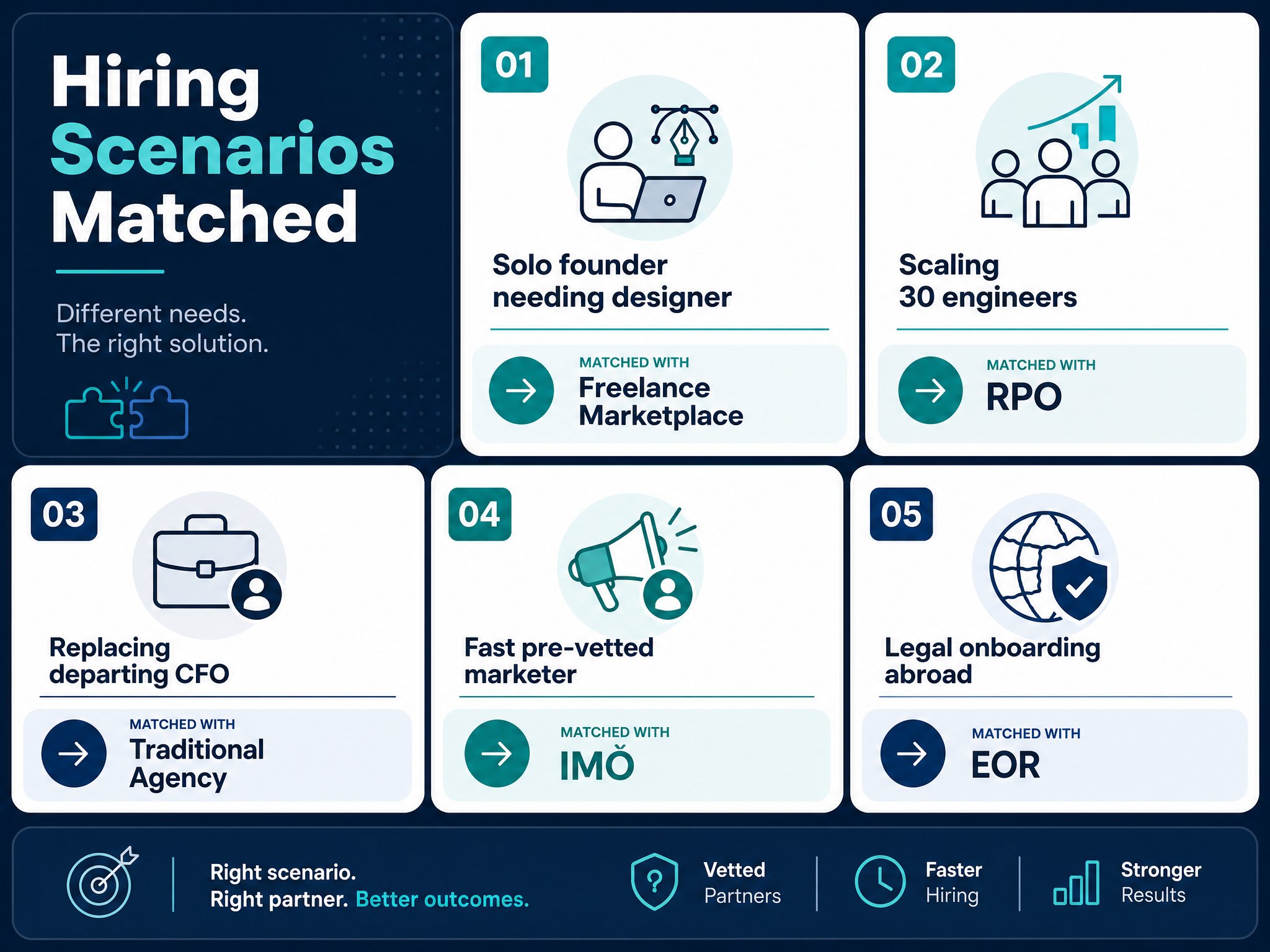
Solo founder needing a designer for one project: freelance marketplace.
Scaling startup hiring 30 engineers this year: RPO.
Replacing a departing CFO: traditional recruitment agency.
Hiring a pre-vetted remote marketer fast, flat fee: IMÒ.
Found a great candidate abroad, need legal onboarding: Employer of Record platform.
What Questions Should You Ask Before Committing to a Hiring Model
Before signing anything, ask how the provider handles a bad hire. Ask what the actual cost per hire looks like once fees, subscriptions, and internal time are added up. Ask whether the recruitment process includes any compliance support, or whether that’s left entirely to you. And honestly, ask for references from clients in a similar hiring volume bracket to yours, because a solution built for enterprise-scale hiring rarely translates well to a five-person startup.
What Red Flags Signal You Have Chosen the Wrong Model

Watch for recruiters who can’t explain their sourcing method beyond “we have a network.” Watch for platforms that bury fees until checkout. And watch, especially, for agencies that push candidates who don’t quite fit the brief but happen to be available right now, a classic sign the recruitment agency is optimising for their placement fee rather than your actual need.
Conclusion
None of these models is objectively better. IMÒ suits companies wanting pre-vetted remote talent without the agency price tag. Job portals suit companies with internal recruiting muscle and time to spare. Agencies suit high-stakes, low-frequency hires. RPOs suit scale. EOR platforms solve legal onboarding, not sourcing. Premium networks solve certainty, at a price. Match the model to the actual constraint you’re facing, whether that’s speed, budget, or compliance, rather than whatever’s fashionable this quarter.
FAQ
Is IMÒ a recruitment agency? No. It’s a curated matching platform charging flat monthly fees, distinct from agencies that charge placement-based commissions.
Can I use a job portal and an agency at the same time? Yes, plenty of companies run both simultaneously, using portals for volume roles and agencies for senior searches.
Do Employer of Record platforms replace recruiters? No. They handle legal employment and payroll only, not candidate sourcing.
Are freelance marketplaces suitable for long-term hires? Generally not ideal. They’re built for project work, not sustained employment relationships.