
What if you could slash your product leadership overhead by 60% while actually increasing your team’s ability to innovate for global markets? For many hiring managers in the UK, the struggle to find affordable, high-performing talent has turned into a months-long marathon of rising salary demands and stagnant pipelines. It’s frustrating to watch your product roadmap stall because the local talent pool is either too expensive or simply too small.
We agree that you shouldn’t have to choose between your budget and your product’s success. That’s why smart organisations are now prioritising remote product managers Africa to bridge the gap. This guide gives you the exact framework to source, vet, and hire elite African PMs who are uniquely battle-test in high-growth, mobile-first environments. You’ll learn how to navigate the 2026 legal landscape, including Kenya’s Digital Nomad visas and South Africa’s remote work regulations, so you can scale your team in days rather than months.
Key Takeaways
- Discover why Africa’s “mobile-first” tech scene produces product leaders who are uniquely equipped to handle complex, high-growth global challenges.
- Identify the top talent hubs across the continent, focusing on the specific specialisms found in Nigeria, Kenya, Egypt, and South Africa.
- Master a vetting framework that tests for both high-level product strategy and the technical literacy needed to lead engineering teams effectively.
- Learn how to source remote product managers Africa who align perfectly with European timezones, ensuring your collaboration stays fast-paced and efficient.
- Streamline your hiring process to just 72 hours by using a curated, pre-vetted pool of elite talent instead of traditional, slow-moving job boards.
Why Africa is the New Strategic Hub for Remote Product Managers
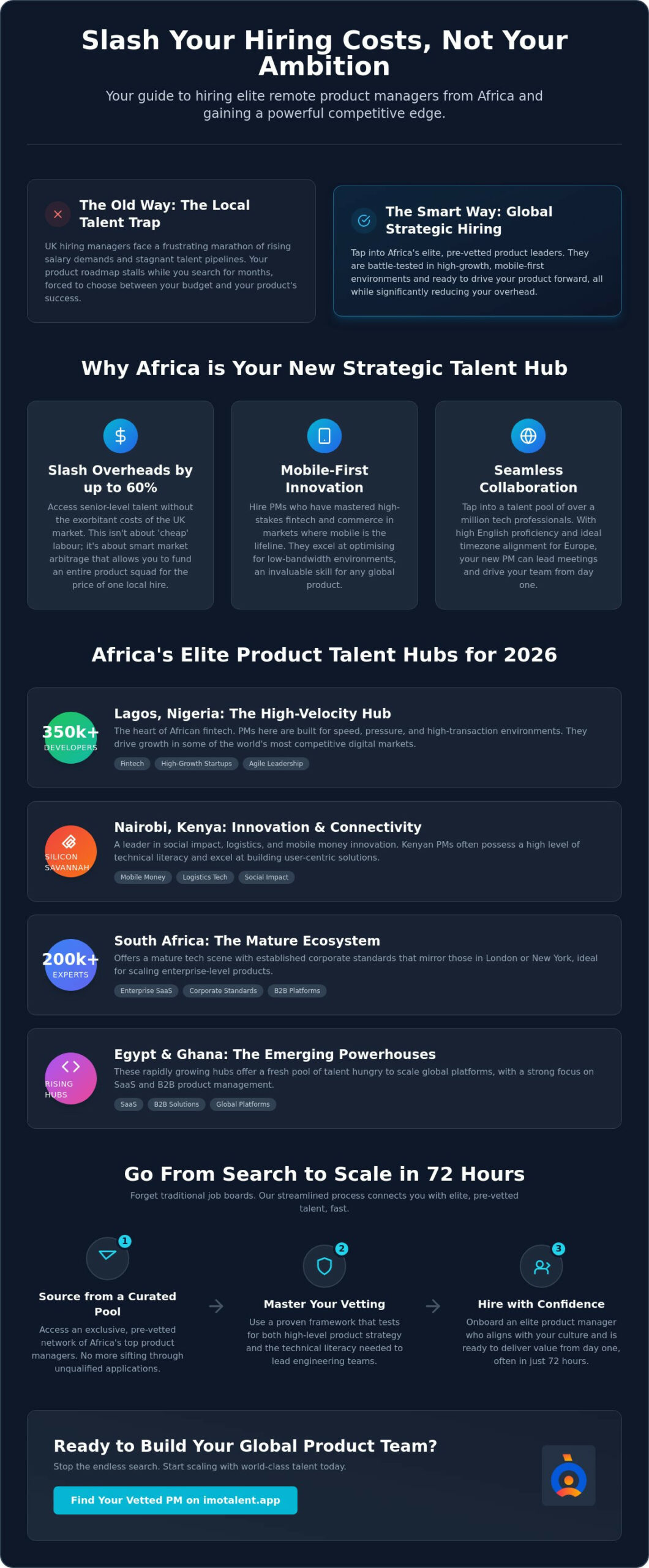
The tech landscape in Africa has undergone a radical transformation. It’s no longer just a region with potential; it’s a global powerhouse for high-end digital talent. As of April 2026, the continent boasts over 1 million professional software developers. This growth is concentrated in four major hubs: Nigeria, South Africa, Egypt, and Kenya. Nigeria leads the pack with over 350,000 developers, followed by South Africa’s 200,000+ experts. This massive technical foundation has birthed a new generation of strategic leaders. Hiring remote product managers Africa allows you to tap into a talent pool that is used to building for scale from day one.
English proficiency is a massive advantage here. In hubs like Lagos and Nairobi, English is the primary language of business and education. You won’t struggle with communication barriers or lost nuances. Instead, you get PMs who can jump into a Slack channel or lead a stakeholder meeting with total confidence. The rapid expansion of digital infrastructure has helped this. While Internet penetration in Africa continues to climb, the historical challenges of connectivity have actually created a unique breed of product leader.
The Mobile-First Innovation Advantage
African product managers are at the forefront of fintech and mobile commerce innovation. They don’t just build apps; they build lifelines. In markets like Kenya, where mobile money is the standard, PMs have mastered the art of high-stakes, high-volume transaction platforms. They understand how to optimise for low-bandwidth environments and older devices without sacrificing user experience. This experience is invaluable for global companies looking to expand into emerging markets or improve their app performance in “dead zones” in the West. African product managers are the ultimate problem solvers because they build resilient, high-impact solutions for markets where infrastructure constraints are the standard, not the exception.
Economic Efficiency Without Quality Compromise
Budget constraints often kill great products. By sourcing remote product managers Africa, you can reduce your talent overhead by up to 60% compared to local UK or US hires. This isn’t about “cheap” labour; it’s about market arbitrage. You’re accessing senior-level talent that has been trained at global-standard institutions and worked in high-pressure startup environments. These savings are transformative. Instead of hiring one PM in London, you can often fund an entire product squad in Lagos or Cape Town. This allows you to move twice as fast on your roadmap. You maintain the same high quality of output while significantly increasing your operational runway.
Key Regions for Sourcing Elite Product Talent in 2026
Africa isn’t a monolith; it’s a collection of specialised ecosystems, each with its own unique strengths. Knowing where to look for remote product managers Africa depends entirely on your product’s specific needs and your company’s stage of growth. The global tech talent shortage has forced companies to look beyond traditional borders, and Africa’s major hubs are stepping up to fill the void with highly skilled, English-speaking professionals.
While Nigeria and Kenya often steal the headlines, South Africa offers a mature ecosystem with established corporate standards that mirror those in London or New York. Egypt and Ghana are also rising rapidly as hubs for SaaS and B2B product management, offering a fresh pool of talent that is hungry to scale global platforms. If you’re looking for a smooth transition, you can easily source vetted product leaders who already understand the nuances of international business.
Lagos, Nigeria: The High-Velocity Hub
Lagos is the beating heart of African fintech. Product managers here are built for speed and high-transaction environments. They manage products that handle thousands of requests per second in a market that moves at a breakneck pace. If your startup needs a PM who can handle pressure and think on their feet, this is your primary source. The English-speaking culture is deeply ingrained, and the work ethic is notoriously intense. These PMs don’t just manage roadmaps; they drive growth in some of the world’s most competitive digital markets.
Nairobi, Kenya: Innovation and Connectivity
Known as the “Silicon Savannah,” Nairobi is the leader in social impact, logistics, and mobile money innovation. Kenyan product managers often possess a high level of technical literacy, frequently coming from engineering backgrounds themselves. This makes them exceptionally good at “speaking engineer” and translating complex technical requirements into user-centric features. For UK and European employers, Nairobi is a dream for integration. The timezone alignment is nearly perfect, usually sitting just two or three hours ahead of London, which allows for real-time collaboration throughout the entire working day.
Beyond these two, don’t overlook the established talent in Cape Town and Johannesburg. South African PMs often have experience in large-scale retail and banking, making them perfect for established firms looking to modernise their product suites. Each region offers a different flavour of expertise, but they all share a common thread: a deep understanding of how to build resilient products for a global audience.
The Vetting Framework: How to Identify Top-Tier Remote PMs
Hiring remote product managers Africa requires a shift from traditional CV scanning to a rigorous, performance-based vetting model. You aren’t just looking for someone who can manage a backlog; you’re looking for a strategic partner who can navigate the complexities of a global market. Relying on self-reported skills is a risk you don’t need to take. Instead, use a structured framework that tests for high-level logic, technical fluency, and the ability to lead without being in the same room as the engineering team.
The best hires demonstrate a mix of “product sense” and operational grit. They understand that a product’s success isn’t measured by how many features are shipped, but by the business value those features create. To find these elite candidates, your interview process must move beyond “tell me about a time when” questions and into real-world simulations.
Evaluating Strategic Product Sense
Start with a product teardown. Ask the candidate to critique a well-known app or, better yet, a specific feature of your own product. Don’t just listen for UI/UX feedback. You’re looking for an understanding of the underlying business model. A top-tier PM will identify why a feature exists, what metric it’s designed to move, and how they would measure its failure.
When reviewing their portfolio, look for outcomes rather than outputs. A “feature builder” will tell you they launched a new checkout flow. A “value driver” will tell you they reduced cart abandonment by 12% by simplifying the payment gateway. To find the latter, ask these specific questions during your case study review:
- How did you decide this problem was worth solving over other priorities?
- What specific data points did you use to validate your assumptions?
- If you had half the budget and half the time, what would you have cut first?
Technical literacy is your next hurdle. A PM doesn’t need to write code, but they must speak “engineer” fluently. They should understand API limitations, the concept of technical debt, and how to negotiate scope with a lead developer without causing friction. If they can’t explain a complex technical trade-off in simple terms, they’ll struggle to lead your dev team effectively.
Remote-First Communication Skills
In a remote setting, clear documentation is your most valuable currency. Test this early by moving part of the interview process to an asynchronous format. Ask the candidate to write a brief PRD (Product Requirements Document) or a Slack-style update for a hypothetical stakeholder. You’re looking for brevity, clarity, and the ability to anticipate questions before they are asked. This is a critical skill for managing remote African developers and ensuring that your global team stays aligned across different timezones.
Finally, assess their cultural adaptability. Elite African PMs are used to working with international teams and understand the nuances of Western business norms. They should demonstrate a “proactive communication” style; they don’t wait for a weekly sync to flag a blocker. They solve it in real-time, documenting the resolution as they go. This level of autonomy is what separates a standard hire from a high-performing product leader.
Addressing the Remote Gap: Culture, Timezones, and Collaboration
Logistical hurdles are usually the first thing on a hiring manager’s mind when considering remote product managers Africa. You might worry about missed deadlines due to power cuts or communication breakdowns caused by massive time differences. These concerns are understandable, but for top-tier talent in 2026, they are largely relics of the past. The infrastructure in major tech hubs has matured, and the cultural alignment with Western business standards is stronger than ever. Success in remote hiring isn’t about ignoring these gaps; it’s about using the right framework to close them.
Trust is the foundation of any product team. While general job boards like LinkedIn offer a high volume of applicants, they provide zero verification. This leaves you to do the heavy lifting of background checks and reliability testing. Using a specialised vetting platform acts as a strategic shortcut. It ensures that your new hire isn’t just skilled on paper but is also operationally ready to lead a global team from day one.
The Timezone Advantage for UK and EU Teams
If you’re based in the UK or Europe, you’ve likely felt the pain of “asynchronous-only” collaboration with teams in Asia or the Americas. You send a critical message at 4 PM and don’t get a reply until the next morning. With talent in Africa, that friction disappears. Lagos and London share the exact same clock for half the year, and Nairobi is only two hours ahead of Central European Time. This alignment allows for real-time standups, immediate feedback loops, and spontaneous problem-solving sessions. You get the financial benefits of international hiring without the “graveyard shift” fatigue that often plagues global teams.
Mitigating Infrastructure Risks
Let’s address the common myths about reliability. Elite professionals in Nigeria, Kenya, and South Africa aren’t working with unstable setups. They utilise high-end co-working spaces or home offices equipped with solar power inverters and redundant fibre-optic internet connections. Connectivity is no longer a barrier for elite African professionals. At IMO Talent, we ensure every candidate in our pool has the necessary hardware and backup systems to maintain 99.9% uptime. This level of readiness means your product roadmap stays on track, regardless of local infrastructure challenges.
Cultural fluency is another often-overlooked benefit. Many African product leaders have spent years working for startups backed by major global venture capital firms. They understand the “fail fast” mentality and the need for data-driven decision-making. They don’t just follow instructions; they challenge assumptions and drive the product forward in line with your business goals. If you want to skip the trial and error of unverified hiring, you can access our pool of vetted product managers and find your perfect match in record time.
Scaling with IMO Talent: Your 72-Hour Hiring Solution
Traditional hiring is broken. If you’ve ever posted a role on a general job board, you know the drill. You’re flooded with hundreds of unverified CVs, and your internal HR team spends weeks filtering through noise just to find one viable candidate. By the time you’re ready to interview, your top choice has already signed elsewhere. When you’re looking for remote product managers Africa, you can’t afford that kind of lag. You need a partner that moves at the speed of your product roadmap.
At IMO Talent, we’ve already done the heavy lifting. We don’t just “find” talent; we curate it. Our pool consists of the top 5% of African product leaders who have survived a rigorous, multi-stage vetting process. This isn’t a marketplace where anyone can sign up. It’s an elite circle of professionals who are ready to integrate into your team immediately. We handle the technical assessments, the communication checks, and the reference verification, so you only focus on the final cultural fit.
The 72-Hour Hiring Guarantee
Our process is designed for high-growth companies that need results yesterday. We follow a lean, four-step path to getting your new PM on board:
- The Request: You tell us your specific needs, tech stack, and product goals.
- The Match: We identify the perfect candidate from our pre-vetted pool within 24 hours.
- The Interview: You meet the talent to confirm the strategic and cultural alignment.
- The Hire: We finalise the details and get them started on your roadmap.
This streamlined approach saves your internal teams hundreds of hours of administrative work. Whether you need a PM or want to hire remote UI UX designers in Africa, we ensure the pipeline is always full of elite talent that is ready to ship.
Managed Talent Solutions for Long-Term Success
Hiring is just the beginning. The real challenge is retention and performance over the long haul. Our subscription model is built to support you long after the contract is signed. We act as your local partner on the ground, managing the administrative hurdles and compliance requirements that can often complicate international hiring. This ensures that your remote product managers Africa stay focused on what they do best: driving your product strategy and hitting your KPIs.
We provide ongoing performance monitoring and support to ensure your new hire remains a high-value asset. If you’re tired of slow hiring cycles and unverified talent, it’s time to switch to a model that values your time. Ready to hire? Browse our vetted Product Managers now and see the difference that elite, managed talent can make to your global growth.
Move Your Product Roadmap into the Fast Lane
The global race for product talent has changed. You no longer need to settle for slow hiring cycles or eye-watering local salaries. By focusing on remote product managers Africa, you gain access to a battle-tested pool of innovators who understand how to scale products in high-growth markets. You’ve seen the data. The combination of perfect timezone alignment and a 60% reduction in overhead costs makes this the smartest strategic move for your organisation in 2026.
Don’t let your growth stall while you sift through unverified CVs. We’ve already done the hard work by vetting the top 5% of talent and providing managed administrative support to handle the compliance side. You can move from a talent gap to a qualified candidate presentation with a 72-hour placement guarantee. It’s time to stop searching and start shipping with a partner that operates at your speed.
Hire a Vetted Remote Product Manager in 72 Hours
Your team deserves elite leadership that can drive real business value. Take the leap today and watch your global product strategy reach new heights with confidence.
Frequently Asked Questions
Is it difficult to manage a remote Product Manager in Africa from the UK?
Managing remote product managers Africa from the UK is remarkably straightforward because there is little to no timezone friction. Lagos is often on the same time as London, while Nairobi is just two or three hours ahead. This allows for real-time collaboration during your standard business hours. To make it even smoother, we recommend setting clear expectations for asynchronous communication to handle any minor overlaps during the day.
What is the average salary for a remote Product Manager in Africa?
Salaries vary by region and experience, but they are consistently more efficient than UK or US equivalents. In Nigeria, median base salaries sit around $75,753, while in Egypt, the median is approximately $59,827 according to 2026 market data. These rates allow you to secure elite leadership while reducing your overhead by up to 60%. Always check current local regulations, as some countries have specific rules for foreign currency remittances.
How does IMO Talent vet their product management candidates?
We use a rigorous, multi-stage framework that filters for the top 5% of talent. Our process includes deep-dives into product sense through case studies, technical literacy tests to ensure they can lead engineering teams, and communication audits. We don’t just look at a CV; we look for a proven track record of shipping successful products in high-growth environments. This ensures every candidate is ready to ship from day one.
Which African countries have the best Product Management talent?
Nigeria is currently the powerhouse for fintech and high-velocity startups, while Kenya leads in mobile money and logistics. South Africa offers highly mature product ecosystems that mirror Western corporate standards perfectly. If you’re building a SaaS or B2B platform, Egypt and Ghana are rapidly emerging as top-tier hubs for specialised product management talent. Each region offers a unique specialism depending on your specific product niche.
Can African Product Managers work in my timezone?
Yes, African PMs align perfectly with UK and European working hours. West African countries are typically in the same timezone as the UK or just one hour ahead, while East African hubs like Kenya are only a few hours ahead. This allows for a full day of real-time collaboration without the “graveyard shift” fatigue often associated with outsourcing to Asia or the Americas. It makes team integration feel seamless.
What tools do remote African PMs typically use for collaboration?
Remote African PMs use the same industry-standard stack as global teams in London or San Francisco. Expect them to be experts in Jira for backlog management, Slack for real-time chat, and Figma for design collaboration. They also lean heavily on tools like Loom for asynchronous video updates and Notion for documentation. This ensures they can slot into your existing workflows without any technical friction or a steep learning curve.
How quickly can I hire a Product Manager through IMO Talent?
You can expect to see qualified, pre-vetted candidates within 72 hours of your initial request. Our 72-hour placement guarantee is possible because we maintain a curated pool of professionals who have already passed our rigorous vetting process. This eliminates the weeks of filtering through unverified CVs that you’d experience on traditional job boards, allowing you to hire a remote product managers Africa in days, not months.
Are there any legal or tax complications when hiring from Africa?
While hiring internationally can seem complex, it’s easily managed through Employer of Record (EOR) services. These partners handle local tax, payroll, and compliance, such as South Africa’s Basic Conditions of Employment Act. Using an EOR typically costs between $299 and $599 per month, ensuring you stay compliant with local labour laws. This allows your new PM to focus entirely on your product roadmap while the administrative side is handled professionally.