You’ve posted the job on Upwork. Fifty applications rolled in within the hour, half of them from accounts with a portfolio that looks suspiciously identical to the next guy’s, and now you’re stuck sifting through bids ranging from £4 an hour to £80 an hour for the exact same task. That’s the moment most founders realise something’s off. Freelance marketplaces were built for short bursts of freelance work, not for finding someone who’ll show up every day for the next two years and actually care about your product roadmap.
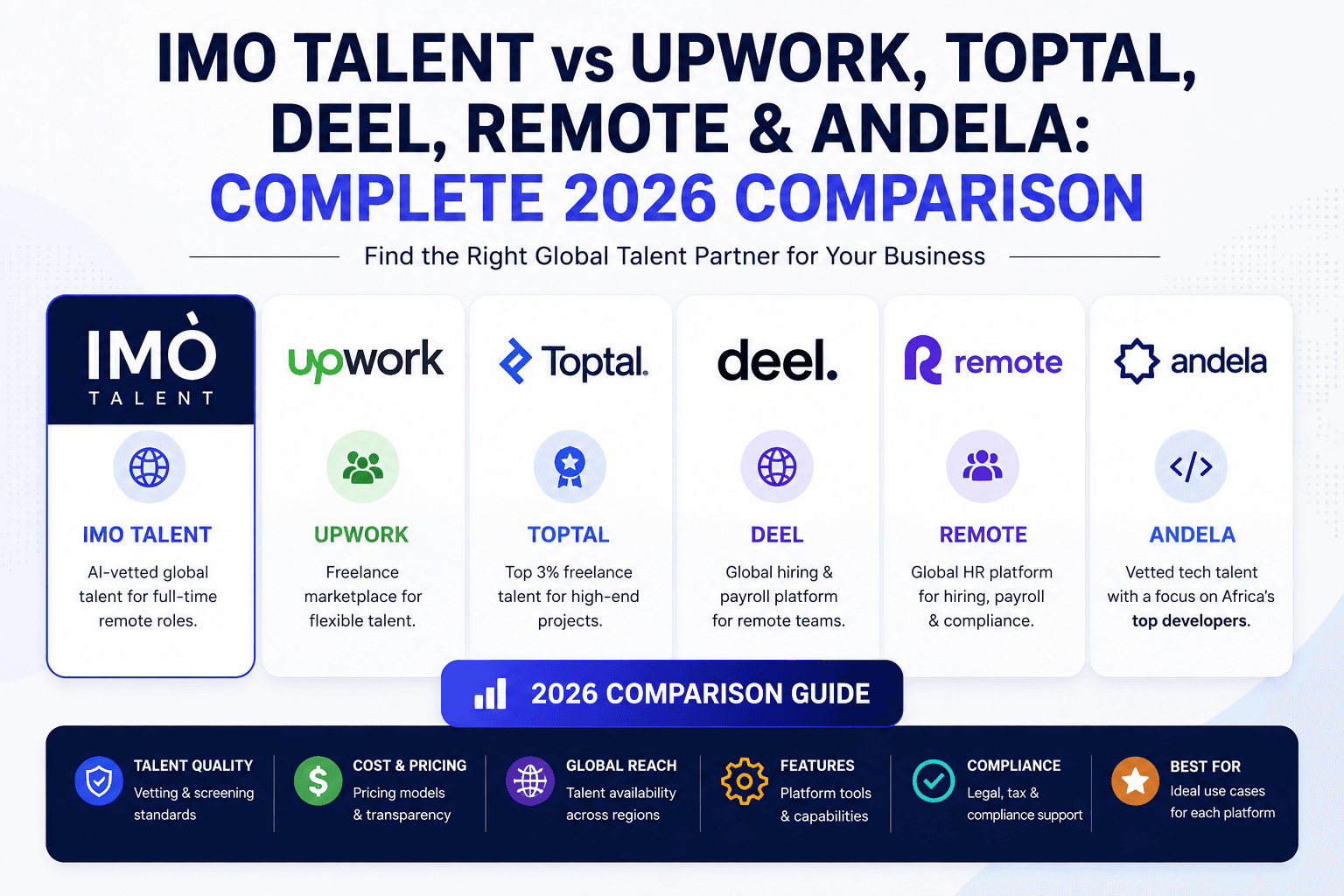
If you’re trying to make a full-time remote hire, the honest answer is this: skip the open marketplace model entirely and look at platforms built specifically for dedicated staffing, which fall into two camps. There’s the vetted talent network camp, where IMO Talent and Andela live, sourcing and screening candidates before you ever see a CV. And there’s the Employer of Record camp, where Deel and Remote operate, handling the payroll, tax and compliance mess once you’ve already found your person. Confusing the two is where most hiring managers waste months.
Comparison Table
Here’s the thing nobody explains clearly enough: these platforms aren’t competing with each other in the way Coke competes with Pepsi. They solve different problems in the hiring pipeline, and mixing them up costs real money and real time.
Platform | Core Function | Vetting Depth | Typical Time-to-Hire | Pricing Model | Best For |
|---|---|---|---|---|---|
IMO Talent | Vetted talent network | 72-hour bootcamp-style screening | 72 hours | Subscription, up to 60% cheaper than UK/US hires | Startups and SMBs needing fast, specialised hires |
Andela | Premium technical staffing | Multi-stage technical exams, live interviews | 2-4 weeks | Enterprise-tier, 6-12 month minimums common | Enterprises building AI and engineering teams |
Deel | Employer of Record, global payroll | None (client sources own talent) | Days, once candidate is found | From £49/month contractor, £599/month EOR employee | Companies with candidates already picked, needing compliance |
Remote | Employer of Record, HR infrastructure | None | Days | Comparable tiered EOR pricing | Distributed teams prioritising owned entities and data privacy |
Upwork/Toptal | Freelance marketplace | Variable, often self-reported | Hours to days, but ongoing churn risk | Hourly rates plus service fee and platform fees | Short-term projects, not full-time roles |
Why Freelance Marketplaces Fail For Full-Time Hiring
What Upwork And Toptal Are Actually Built For
Upwork grew out of the old Elance and oDesk merger, and its entire architecture still reflects that ancestry: it’s a bidding system, a place where a client posts a job and freelancers race to underbid each other on price. Toptal tightened the screening a notch, marketing itself as the “top 3%” of freelance talent, and frankly, its vetting is stronger than most job boards. But both platforms structure the relationship around discrete gigs, not headcount. You’re hiring a contractor for a sprint, a landing page, a bug fix. Nobody on either platform expects to still be working with you in eighteen months, and that expectation gap shows up everywhere, from communication cadence to code ownership.
Where Marketplace Vetting Falls Short
Here’s where the freelancer service fee model quietly punishes quality. Because freelancercom (yes, the old Freelancer.com website) and similar platforms reward high bid volume, top performers often get buried under a wall of price freelancercom bidding wars, where the loudest bidder, not the best developer, wins visibility. A profile with five-star reviews and a slick portfolio can still hide a contractor who’s mediocre at the actual craft, because reviews get gamed, and skill tests on these marketplaces are frequently multiple choice quizzes rather than real-world assessments. Compare that to IMO Talent’s structured vetting, which one blog aptly frames as a strategic advantage precisely because pre-vetting beats freelance marketplaces at filtering for genuine competence rather than marketing polish.
Hidden Costs Of Hourly Freelance Contracts
The sticker price on freelance job boards is never the real price. Platform fees stack on top of the freelancer’s rate, commission structures shift depending on lifetime billings with a given client, and payment processing eats another slice. Then there’s the invisible cost: onboarding a new contractor every few months because the last one moved on, re-explaining your codebase, re-establishing trust. A dedicated remote hire amortises that onboarding cost across years, not weeks, and that difference alone often justifies the higher entry price of a managed platform.
IMO Talent
Vetting Process And Time-To-Hire
IMO Talent runs candidates through what it calls a bootcamp, technical assessments, business-context interviews, and communication checks, before anyone lands in the pool you actually browse. What struck me looking into this is the 72-hour promise from search to signed contract, which sounds aggressive until you realise the vetting happens continuously in the background, meaning the pool is already curated before your request even lands. Roughly 1,000 vetted professionals sit ready across roles like React development, AI engineering, and backend work, with a stated 95% satisfaction rate across placements.
Pricing And Cost Savings
The pitch here is cost efficiency layered onto quality, not instead of it. IMO Talent advertises up to 60% savings against UK or US hiring costs, largely because the talent pool sources heavily from West African tech hubs operating in the GMT+1 timezone, which happens to overlap comfortably with UK and European business hours. That timezone alignment matters more than people give it credit for; a developer in Lagos working your 9-to-5 is a fundamentally different collaboration experience than one twelve hours out of sync.
Best Roles And Team Types
This platform suits founders and lean teams who need someone specific, a React developer, a data engineer, a UI/UX designer, without wading through enterprise sales cycles. It’s a fit explored in depth across resources comparing remote developer platform selection by company type, particularly for startups and SMBs that need speed without sacrificing the rigour of proper vetting.
Andela
Vetting Process And Time-To-Hire
Andela’s screening is famously gruelling, multi-stage coding exams, live technical interviews, and increasingly, assessments tied to production AI systems rather than textbook algorithms. This depth comes at a cost in speed. Where IMO Talent promises 72 hours, Andela’s process typically runs two to four weeks, reflecting its focus on senior developers and specialist roles like AI systems engineers or LLMOps architects rather than general software dev talent.
Pricing And Contract Terms
Andela sits firmly in the premium tier. Contract minimums of six to twelve months are common, and third-party reviews consistently flag this as a barrier for smaller teams testing the waters. You’re not just paying for a developer here, you’re paying for Andela’s own AI Academy training pipeline and its track record with enterprise clients like GitHub and Goldman Sachs, which shows up in the invoice.
Best Roles And Team Types
Andela makes sense for scale-ups and enterprises building genuinely advanced engineering capacity, AI model alignment, cloud architecture, agentic systems, the sort of roles where a mediocre hire could set a product roadmap back by quarters. It’s less sensible for a five-person startup that just needs a competent generalist developer for a modest sprint.
Deel
What Deel Actually Solves
Deel doesn’t source candidates, full stop. It’s an Employer of Record, meaning once you’ve found your remote hire (through IMO Talent, through a referral, through wherever), Deel handles the legal entity, the local tax filings, the compliant contract, the payroll run across 150-plus currencies. This is the part people conflate constantly with talent platforms, and it’s worth being blunt: if you don’t have a candidate yet, Deel can’t help you find one.
Pricing And Contract Terms
Contractor management starts around £39 a month per contractor, with full EOR employment closer to £470 a month per employee, numbers that climb fast once you’re managing a distributed team across a dozen countries. The trade-off is you’re not setting up foreign legal entities yourself, which for most companies is the entire point.
Best Roles And Team Types
Deel fits any remote-first business that’s already found its people and needs the compliance engine running underneath, particularly useful for companies juggling contractors and employees across wildly different jurisdictions.
Remote
How Remote Compares To Deel
Remote plays in the same EOR category as Deel but leans harder into owning its own local entities rather than relying on third-party partners in every country, a distinction that matters if data privacy or contract stability is a priority for your legal team. The core function, payroll, tax compliance, benefits administration, mirrors Deel closely enough that the decision often comes down to specific country coverage and support responsiveness rather than a dramatic feature gap.
Pricing And Contract Terms
Pricing sits in a similar tiered bracket to Deel, contractor management on the cheaper end, full EOR employment scaling with country complexity. Neither platform is meaningfully cheaper across the board; it depends entirely on which countries you’re hiring in.
Best Roles And Team Types
Remote suits companies that value entity ownership and want a single point of accountability for compliance, especially useful for businesses hiring employees (not just contractors) across markets with tricky labour law.
Pros & Cons
IMO Talent: fast, cost-efficient, strong for startups; smaller pool, less suited to enterprise-scale technical depth.
Andela: elite vetting, enterprise-grade; slow, expensive, restrictive contract minimums.
Deel: unmatched compliance infrastructure; zero sourcing capability, so you need talent lined up already.
Remote: strong entity ownership model; similar sourcing gap as Deel, pricing varies wildly by country.
How To Evaluate Alternatives By Cost, Vetting, And Specialisation
Cost isn’t just the hourly or monthly rate, it’s the total cost of a bad hire multiplied by how long it takes you to notice. Vetting depth should match role seniority, a junior generalist doesn’t need Andela’s four-week gauntlet, but a senior AI architect probably shouldn’t skip it. Specialisation matters more than most job listings admit; a platform strong in software development might be thin on marketing or business talent, so match the platform’s actual strength to your specific opening rather than assuming broad coverage.
Which Platform Fits Which Hiring Scenario
A startup needing a React developer next week fits IMO Talent. An enterprise building an internal AI team fits Andela. A company that already interviewed three great candidates and just needs someone to run payroll compliantly fits Deel or Remote. Mixing these up, say, expecting Deel to source you a developer, is the single most common mistake I see teams make.
Final Verdict
There’s no universal winner here, and pretending otherwise does readers a disservice. Choose IMO Talent if speed and cost efficiency matter more than enterprise pedigree. Choose Andela if you’re building serious engineering depth and can absorb longer contract terms. Choose Deel or Remote once your candidate search is already solved and compliance is the remaining headache.
Do You Need A Sourcing Platform Or An Employer Of Record?
Ask yourself one question honestly: do I have a person, or do I need to find one? If you need to find someone, sourcing platforms like IMO Talent and Andela are your answer. If you’ve already found them and just need to pay and employ them legally across borders, that’s squarely an EOR job, Deel or Remote territory.
Can You Combine These Platforms For One Remote Hire?
Absolutely, and honestly, this combination is underused. Source your developer through IMO Talent’s vetted pool, then run their contract and payroll through Deel or Remote for compliance coverage. This layered approach, discussed in resources around building resilient workforces with managed talent partnerships, tends to outperform trying to force one platform to do both jobs.
FAQ
Is IMO Talent better than Upwork for full-time hiring? Yes, for full-time roles specifically. Upwork’s bidding system rewards short gigs and low prices, not long-term fit, while IMO Talent’s vetting is built around dedicated placement from the outset.
Does Deel replace the need for a recruiting platform? No. Deel handles employment and payroll compliance after you’ve sourced a candidate; it has no vetting or matching function of its own.
How long does Andela’s hiring process typically take? Usually two to four weeks, given the depth of its technical screening and the seniority level of roles it typically fills.
Can small businesses afford Andela? Technically yes, but the six-to-twelve month contract minimums and enterprise pricing make it a harder fit for very small teams compared to leaner alternatives like IMO Talent.