

What if you could secure elite engineering talent while instantly slashing your department budget by 60%? In 2026, the average hourly rate for senior tech specialists in Africa is approximately $31. This isn’t about finding ‘cheap’ labour. It’s about a strategic move into high-performance tech hubs that offer world-class skills without the inflated price tag. Understanding the real cost of hiring senior developers Africa is the first step to scaling your team with total confidence.
You’ve probably noticed that local salary demands in cities like London or San Francisco have become completely unsustainable. It’s exhausting to deal with slow hiring cycles and the constant worry about hidden costs when looking at international markets. I’m going to show you exactly how to master this market effectively. You’ll get a clear, data-backed salary benchmark for 2026 and a practical framework for calculating the total cost of ownership. We’ll explore how to hire and manage remote talent across Africa’s top hubs, ensuring you get the quality you need without the usual friction or risk.
Key Takeaways
- Understand why current Western salary demands are breaking budgets and how to slash your engineering spend by 60% without compromising on quality.
- Compare 2026 salary benchmarks across top hubs like Lagos and Cape Town to determine the real cost of hiring senior developers Africa.
- Use our Total Cost of Ownership framework to account for the hidden ‘Recruitment Iceberg’, including compliance, international payroll, and local tax laws.
- Implement a ‘Golden Window’ strategy to synchronise time zones and ensure seamless daily collaboration between your local and remote engineering teams.
- Learn how to scale your tech team in just 72 hours by using a managed placement model that handles rigorous vetting and administrative management for you.
Why Western Senior Developer Costs are Breaking Budgets in 2026
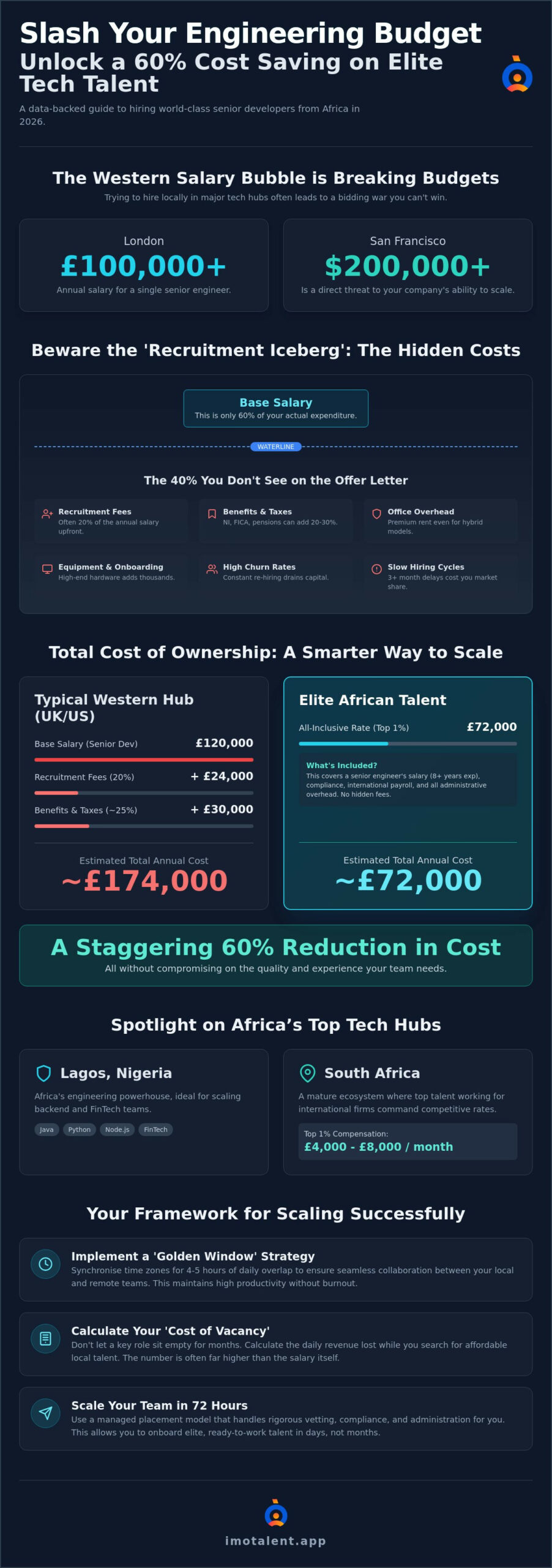
By 2026, the global tech talent market has reached a definitive tipping point. Paying £100,000 in London or $200,000 in San Francisco for a single senior engineer isn’t just expensive; it’s a direct threat to a company’s ability to scale. For mid-market organisations, these salary levels have become completely unsustainable. When you’re competing with the bottomless pockets of tech giants, trying to hire locally often leads to a bidding war that you simply can’t win.
We call this the Recruitment Iceberg. The salary you see on the offer letter is usually only 60% of your actual expenditure. Once you factor in recruitment fees, hardware, and the high churn rates common in Western hubs, your R&D budget vanishes before you’ve even shipped a feature. Constant re-hiring because a developer left for a slightly higher offer at a larger firm is a cycle that drains both morale and capital. Understanding the full cost of hiring senior developers Africa requires looking at the total picture of these hidden expenses.
To understand the cost of hiring senior developers Africa, you first need to know what you’re getting. In the African tech ecosystem, a ‘Senior’ isn’t just someone with a few years of experience. We define it as a professional with 8+ years of experience and a proven mastery of system architecture. Thanks to the rapid growth of Internet penetration in Africa, this talent pool is technically mature, highly mobile, and ready to integrate into global teams immediately.
The Hidden Burden of Statutory Benefits and Taxes
Base salary is just the start. In the UK, National Insurance contributions and pension matching add a heavy layer to your costs. In the US, FICA and health insurance premiums can bloat a budget by 20% to 30% instantly. Other hidden costs include:
- Office Overhead: Even with hybrid models, the cost of premium office space in tech centres is staggering.
- Recruitment Fees: Traditional agencies often charge 20% of a £120k salary as an upfront hit.
- Equipment and Onboarding: High-end hardware and training programmes add thousands before day one.
The Opportunity Cost of Slow Hiring Cycles
A three-month hiring window is the standard in the West, but it’s a silent killer for growth. Every day a role stays empty, your product launch slides further back. It isn’t that talent doesn’t exist; it’s that affordable talent in your specific postcode is scarce. This delay costs you market share and gives your competitors a head start.
Actionable Tip: Calculate your ‘cost of vacancy’ today. Take your expected annual revenue from a new product or feature, divide it by the number of developers needed, and then divide that by 250 working days. That is exactly what you lose every single day that seat remains empty. Often, this number is far higher than the salary itself.
Benchmarking Senior Developer Salaries Across Africa’s Top Tech Hubs
Africa is not a monolith. Each major tech hub across the continent has developed its own distinct specialisation and pricing structure. When you examine the cost of hiring senior developers Africa, you’ll find that while the continent offers massive savings compared to Western markets, the top 1% of talent often expects a ‘Remote Premium’. This means the most elite engineers typically have their salaries pegged to USD or GBP to protect against local currency volatility. This two-tiered system is essential to understand if you want to attract the best performers in 2026.
In South Africa, senior developers working for local firms might earn between £30,000 and £45,000 annually. However, those working for international companies can see their compensation rise to between £4,000 and £8,000 per month. Similar patterns exist in Kenya and Nigeria, where the highest-paid engineers are almost exclusively working for global startups. If you are looking for a clear comparison of where to find specific skills, exploring a vetted talent network can help you navigate these regional nuances quickly.
Lagos, Nigeria: Scaling Backend and FinTech Teams
Lagos has earned its reputation as Africa’s engineering powerhouse, particularly for backend and financial technology. The ecosystem here is defined by high-pressure, high-scale environments. Senior developers in Nigeria often specialise in Java, Python, and Node.js, with local senior salaries in the fintech sector ranging from ₦9.6M to ₦18M annually. Lagos remains the most mature VC-backed tech market in Africa, producing engineers who are accustomed to building robust systems for millions of users.
Nairobi and Cape Town: The Specialised Tech Hubs
Nairobi and Cape Town have carved out niches in mobile development, AI, and cloud infrastructure. Kenya’s ‘Silicon Savannah’ is world-renowned for its ‘Mobile-First’ approach, making it the ideal place to find senior Swift or Kotlin specialists. In Cape Town, you’ll find a heavy concentration of high-end UI/UX designers and Cloud Ops experts working with AWS and Azure. Both cities offer exceptional English proficiency and cultural alignment with UK and European teams, which significantly reduces communication friction.
- Nairobi Salary Benchmarks: Senior developers working for international firms can earn between KES 4M and 8M.
- Cape Town Salary Benchmarks: Senior hourly rates typically range from $40 to $55 for specialised roles.
- Egypt: A rapidly growing hub for full-stack talent with highly competitive rates for European time zones.
Actionable Tip: Don’t just hire based on the lowest price. Look to Nairobi if your product requires deep mobile integration and Cape Town if you need world-class user interface design. Matching the hub’s specific strength to your technical requirements is the fastest way to ensure a high return on your investment.
The Total Cost of Ownership (TCO): Africa vs. UK and US
Calculating the cost of hiring senior developers Africa requires a shift from looking at simple salary figures to understanding the Total Cost of Ownership (TCO). In the UK, a senior developer often commands a base of £110,000. Once you add National Insurance, pension contributions, and office costs, that figure easily hits £140,000. In contrast, an elite African senior developer with equivalent skills might cost you £45,000. This 60% savings framework isn’t just about the initial hire; it’s about the long-term impact on your engineering runway. The maths is clear: you can double your team size for the same price as a single local hire.
Long-term ROI is where the African market truly shines. High-churn tech hubs like London or San Francisco see developers move every 18 months, which forces you into a constant, expensive cycle of re-hiring. In Africa, remote roles with international firms are highly prestigious. You get significantly higher loyalty and lower re-hiring costs. When you project this over a three-year forecast, the lifetime value of an African remote hire far exceeds that of a local hire who is always looking for the next big pay rise.
Why Managed Platforms Beat Direct Hiring
Direct hiring through gig marketplaces is a gamble you don’t need to take. Senior talent avoids these platforms because they lack stability and professional growth, which often leaves you with lower-quality code. Using a dedicated remote talent placement service cuts your administrative overhead by 90%. You won’t have to navigate international tax laws or local compliance on your own; the platform handles the heavy lifting so your focus stays on your product.
Addressing the Infrastructure Gap
Success depends on addressing the infrastructure gap head-on. While internet speeds in major hubs are now world-class, power reliability can vary. We vet every candidate for ‘infrastructure readiness’ before they ever reach your desk. This includes verifying reliable backup power systems and secondary internet connections. Ensuring 99.9% uptime is a standard part of our process, not an afterthought. You’re hiring for performance, and that requires a stable environment.
Actionable Tip: Always include a ‘Remote Work Stipend’ in your TCO calculations. A small monthly allowance for high-speed fibre and a robust power backup system ensures your developer has the exact same uptime as a local office-based employee. It’s a tiny investment that guarantees consistent output and eliminates downtime excuses.
How to Secure High-ROI Senior Talent Without the Management Headaches
Securing a massive reduction in your engineering spend is a win, but it only stays a win if the talent actually delivers. The true cost of hiring senior developers Africa includes the time you spend managing them. If you’re bogged down in friction, those savings evaporate. High-ROI hiring means looking beyond a CV to find ‘Remote Readiness’. This involves assessing a developer’s ability to communicate complex architecture asynchronously and their mastery of self-management.
One of the biggest advantages of African tech hubs is the ‘Golden Window’ of collaboration. Most of the continent sits within UTC to UTC+3, which aligns perfectly with the UK and Europe. You can easily structure four to five overlapping hours every day. This synchronisation allows for real-time stand-ups and pair programming without forcing anyone to work at 3 AM. It’s a level of operational harmony that you simply won’t find in many other offshore markets.
Cultural integration is the final piece of the puzzle. If you treat your remote engineers like ‘outsourced help’, they’ll act like it. Make them core team members. Include them in company-wide Slack channels and strategic planning sessions. When you factor in the cost of hiring senior developers Africa, remember that high retention is what keeps that number low over time. When developers feel they have a clear career path and a stake in the product’s success, they stay longer and build better.
The 72-Hour Vetting Process
Waiting four weeks for an interview cycle is a luxury you can’t afford. We use pre-vetted talent pools to compress this process into just 72 hours. Our technical tests are designed to separate ‘Senior’ titles from actual ‘Senior’ skills, focusing on system design and problem-solving under pressure. For a deeper dive into these strategies, check out our guide on managing remote African developers.
Actionable Onboarding for Remote Success
A successful hire starts with a solid 30-60-90 day plan. The first month should focus on environment setup and low-stakes tasks; the second on contributing to core features; and the third on taking ownership of specific modules. Use tools like Slack for chat, Notion for documentation, and Jira for task management to keep everyone aligned.
Actionable Tip: Use a ‘Buddy System’. Pair each new remote senior developer with a local developer for their first month. This speeds up knowledge transfer and helps the new hire understand the ‘unwritten rules’ of your engineering culture much faster.
Ready to build your team? You can hire elite tech talent today and start scaling your engineering capacity immediately.
Scaling Your Engineering Team in 72 Hours with IMO Talent
We’ve established that the cost of hiring senior developers Africa provides a massive competitive advantage, but the real challenge is execution. You don’t just need a developer; you need a high-performance engineer who integrates into your culture without missing a beat. IMO Talent bridges the gap between unsustainable Western overheads and the elite talent pools in Africa’s top tech hubs. We don’t just find people; we build the infrastructure that allows your engineering team to scale at high velocity.
Our 4-step process is designed for speed and precision. First, we define your specific technical requirements and team culture. Second, we tap into our pre-vetted network of senior professionals. Third, we present the top candidates to you within 72 hours. Finally, we handle the entire onboarding and integration process. This methodical approach removes the friction of traditional recruitment, allowing you to move from a vacancy to a successful hire in just three days.
Our role doesn’t end once the contract is signed. We stay involved as an active partner, handling ongoing performance monitoring and all administrative support. From international payroll to local tax compliance, we manage the ‘Recruitment Iceberg’ so your CTO can focus on building the product. If you’re looking to test the waters, starting a pilot project is the most effective way to see how that 60% budget saving works in a real-world environment.
The IMO Talent Difference: Elite Matchmaking
We act as master matchmakers rather than a simple job board. We understand that senior engineers at this level are looking for prestige and growth, which is why we curate our network so carefully. One UK-based scale-up recently saved £250,000 in their first year alone by building a remote backend team in Nigeria through our platform. They didn’t just save money; they increased their shipping frequency because they finally had the capacity they needed. For more insights on this approach, check our 2026 strategic guide to hiring remote developers.
Ready to Optimise Your Hiring Budget?
The financial benefits of diversifying your talent search are immediate. By addressing the cost of hiring senior developers Africa today, you’re securing the long-term runway of your business. You can stop overpaying for local scarcity and start investing in global excellence. The next move is simple. You can book a discovery call with us to view our current pool of pre-vetted senior talent and discuss your specific needs.
Actionable Tip: Don’t wait until your current team is burnt out to start looking. Start a pilot hire for a non-critical but important module. This allows you to refine your remote workflows and see the quality of African senior talent firsthand before scaling further.
Don’t let high local costs stall your roadmap. Hire senior African developers with IMO Talent today and transform your engineering capacity.
Ready to Future-Proof Your Engineering Roadmap?
The tech landscape has shifted permanently. You don’t have to accept the unsustainable salary demands of local markets or the slow cycles that stall your product launches. By mastering the cost of hiring senior developers Africa, you’re choosing a path of high-velocity growth and financial efficiency. We’ve shown you the math behind the 60% savings and provided the framework for managing a high-performance remote team. Now, the only step left is to take action.
You can access a curated network of elite professionals and reduce your hiring costs instantly. Our process is built for speed, making placements achievable within 72 hours so you can get back to building what matters. It’s time to stop overpaying for local scarcity and start leveraging world-class talent that aligns with your strategic goals.
Scale your engineering team with vetted senior African developers in 72 hours
Building a global, resilient engineering department is entirely within your reach. We’re ready to help you make it happen and look forward to seeing your team thrive.
Frequently Asked Questions
What is the average salary for a senior developer in Africa in 2026?
In 2026, the average hourly rate for a senior developer in Africa is approximately $31. In South Africa, specialised senior roles typically command between $40 and $55 per hour. If you’re hiring for an international company, expect to pay between $5,000 and $10,000 per month for the top 1% of talent. These rates reflect the emerging two-tiered pay system where elite engineers earn significantly more than local market averages.
How much can I really save by hiring remote developers in Africa vs the UK?
You can expect to reduce your engineering budget by 60% compared to local UK hiring. While a senior developer in London might cost £110,000 plus National Insurance and benefits, an equivalent African senior professional often costs around £45,000. This massive reduction in the cost of hiring senior developers Africa allows you to double your engineering capacity without increasing your total spend. It’s a strategic move for any scale-up.
What are the hidden costs of hiring remote developers internationally?
The primary hidden costs involve infrastructure stipends and the ‘Recruitment Iceberg’ of administrative management. You should budget for high-speed internet backups and power solutions to ensure 99.9% uptime. Managed platforms typically include these considerations in their service fees. This approach prevents unexpected expenses from eroding your savings. Providing a small remote work stipend is a practical way to maintain consistent output and developer satisfaction.
Which African countries have the best software engineers for remote work?
Nigeria, Kenya, and South Africa are currently the leading hubs for remote engineering talent. Nigeria is the powerhouse for backend and Fintech, while Kenya’s ‘Silicon Savannah’ excels in mobile-first product development. South Africa offers high English proficiency and expertise in enterprise-level cloud infrastructure. Choosing the right hub depends on your specific technical stack and the level of scale your product requires to succeed.
How do you handle payroll and compliance for remote African talent?
Managed talent platforms handle all international tax laws and local compliance requirements on your behalf. This eliminates the legal risk and administrative burden of managing foreign payroll. It’s a vital part of managing the total cost of hiring senior developers Africa effectively. You pay a single invoice, and the platform ensures the developer receives their salary in their preferred currency, often USD or GBP. It’s a seamless system.
Is the technical quality of African senior developers comparable to US/UK devs?
African senior developers in our network possess technical skills that are fully comparable to their US and UK counterparts. We define ‘Senior’ as having 8+ years of experience and a proven mastery of complex system architecture. These professionals have often built systems for millions of users in high-scale environments like Lagos’s fintech sector. The quality is world-class; the only difference is the geographical location and the resulting cost advantage.
How do you manage time zone differences between London and Lagos or Nairobi?
Time zone differences are minimal, as most African tech hubs sit within one to three hours of London. This creates a ‘Golden Window’ of four to five overlapping hours for synchronous collaboration. You can hold daily stand-ups and pair programming sessions during regular working hours. It’s far more efficient than hiring from regions like Asia or Eastern Europe, where the time gap often disrupts the natural flow of development.
What happens if a remote hire doesn’t work out?
We provide ongoing performance monitoring to catch issues early and handle replacements if a hire isn’t the right fit. Our rigorous vetting process ensures a high success rate, but we maintain a readiness to act if expectations aren’t met. This reduces the risk associated with traditional hiring cycles. You get the security of a managed service that prioritises your project’s momentum and long-term engineering success.