Introduction
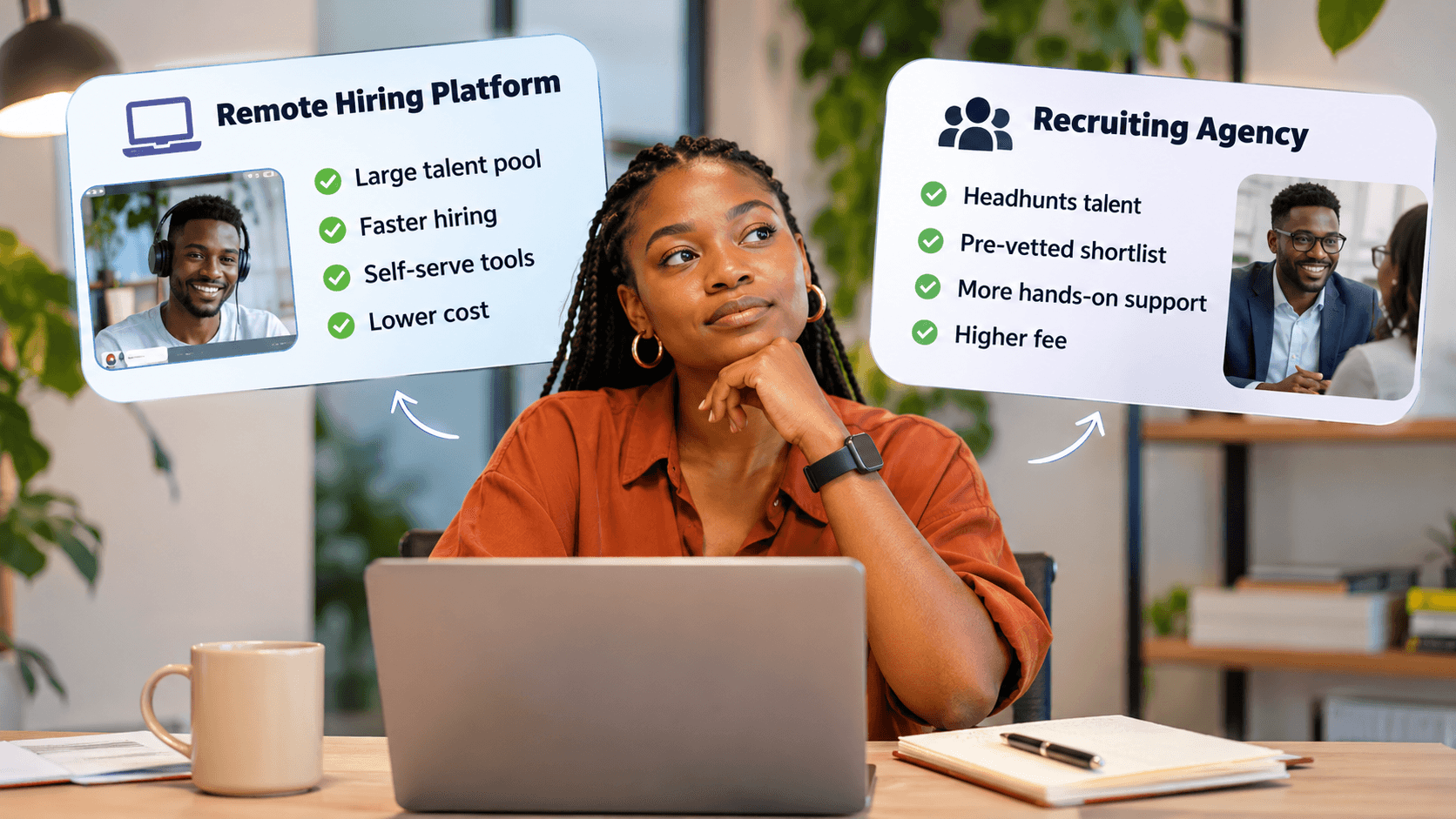
Pick a remote hiring platform if someone on your team already has the time to run it. Pick a recruiting agency if nobody does, or if the role is complex, regulated or cross-border. That is the short answer. For a deeper comparison, explore our guide on IMO Talent vs remote hiring platforms and recruitment agencies to understand which hiring solution best suits your business.
Both models exist to shorten the distance between an open requisition and a signed offer. They shorten it in very different ways, with very different cost structures, and with very different consequences when the relationship ends. A sound evaluation framework scores each model on capability, reputation, transparency, technical depth and fit with your hiring objectives. Separately. Never on one shared scorecard, because the questions you ask a software vendor are not the questions you ask a firm of recruiters.
How Do You Decide Between a Recruiting Agency and a Remote Hiring Platform?
Start with a diagnosis, not a shortlist. Most bad purchases I have seen began with someone comparing price pages before they knew what was actually broken.
Operational Bottleneck
Where does the work stall? If you have a recruiter or talent lead with spare hours, a platform gives them sourcing reach, screening workflows and payroll plumbing. If you have nobody, a platform simply hands a very nice tool to a very busy founder.
Practitioners on forums say this bluntly, and I agree: the real cost of software is the salary and attention of the person operating it. The licence fee is the cheap bit.
Strategic Complexity
Repeatable hires suit platforms. Think the fourth mid-level backend engineer in a stack you already understand. Searches that need market mapping, confidential outreach, or a candidate who is not looking suit agencies, since a good one sells the role to people who never applied.
Regulated sectors lean agency too. Background checks, licensing, right-to-work and sector-specific compliance reviews are easier to delegate than to learn mid-search.
Budget and Timeline
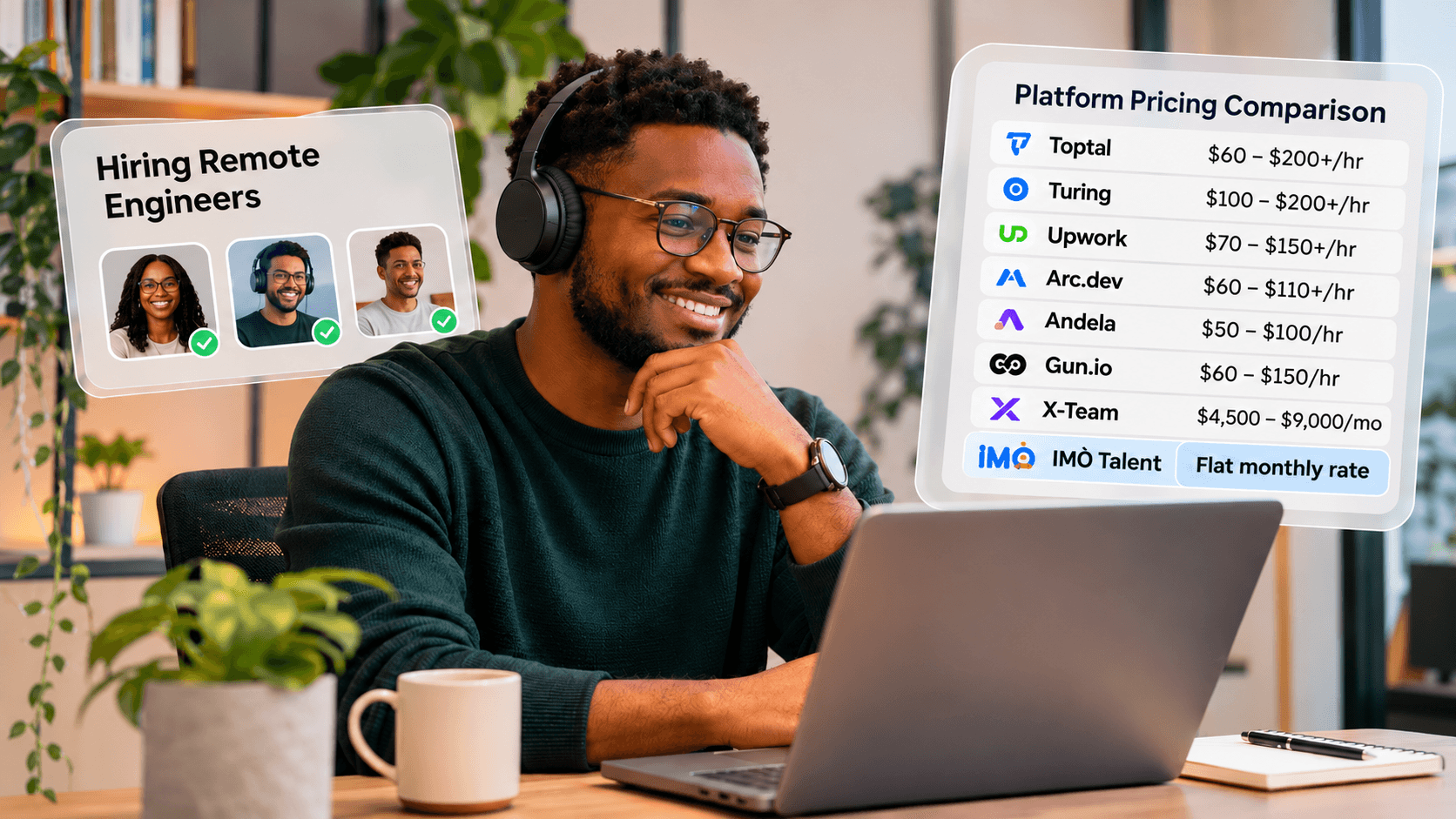
Agencies typically charge a contingency fee, often 15% to 30% of first-year salary, or a retainer that can run from roughly $4,000 (about £3,100) a month upward. Platforms usually bill subscriptions, per-hire fees or a monthly markup on the contractor rate. Cheaper on paper, slower if your team is stretched.
Three quick tests before you go further:
Do you have a named owner with at least a few hours a week for this?
Is the role repeatable, or does it need a bespoke search?
Can you tolerate a slower first hire in exchange for lower cost per hire later?
Three yeses point to a platform. Three noes point to an agency.
What Criteria Should You Use to Evaluate a Remote Hiring Platform?
Not every platform is built equally, and the generic ones are the trap. A large open database with self-reported profiles hands all the vetting to you. A purpose-built marketplace with a pre-vetted network does the filtering first. Our own evaluation checklist for remote hiring platforms goes deeper, but the three pillars below carry most of the weight.
Vetting and Talent Quality
Ask what happens between “applicant” and “visible to employers”. Skills assessments? Live technical interviews? Reference checks? Acceptance rates tell you plenty. If a platform cannot say how many applicants it rejects, it probably rejects very few.
The size of the pool matters less than you would think, though it is large: roughly 38% of skilled US knowledge workers freelance. Abundance is not quality. Abundance is noise.
Talent quality also depends on how effectively a hiring provider matches candidates to specific business requirements. Beyond technical skills, employers should consider relevant work experience, communication abilities, time-zone compatibility and readiness for remote collaboration.
For businesses exploring international recruitment, IMO Talent offers a more curated approach to finding skilled African professionals. Rather than relying entirely on broad candidate searches, IMO Talent focuses on talent matching and recruitment support, helping businesses identify professionals whose capabilities align with their hiring needs.
Fee Transparency
Find the full price on a single page. Then look for the extras: transaction fees, currency conversion margins, fees for converting a contractor to a permanent hire, and charges for extra seats. A platform that makes you book a call to learn its pricing is telling you something.
Compliance and Payroll Coverage
For cross-border hiring, ask who is the employer of record, who handles contractor classification risk, and which countries are genuinely covered rather than “supported via partners”. Check data permissions and governance too: where candidate records live, who can see them, and how deletion requests are handled.
What Criteria Should You Use to Evaluate a Recruiting Agency?
An agency is people, so you are judging judgement. Reputation counts for more here than any feature list. For how the two models source differently, see how platforms and agencies source and screen candidates.
Sector and Role Expertise
Does the firm place the kind of person you need, weekly, not occasionally? A generalist shop and a specialist boutique are different animals. Ask for recent placements in your function and seniority band, then speak to the hiring managers who received them. Client testimonials on a website are curated. A reference call is not.
On rigour, some figures are worth knowing: top-tier outsourcing agencies reportedly accept under 3% of applicants after four to six screening rounds. Treat that as a benchmark for what “vetted” should mean, then ask your shortlisted firm how theirs compares.
Pricing Model and Markups
Contingency, retained, or a hybrid? Contingency feels safe because you pay only on success, but it rewards speed over fit. Retained search aligns incentives for hard roles and costs more upfront. Whatever the model, ask for the markup on contractor or temp rates in writing.
Candidate Ownership and Guarantees
Who owns the candidate relationship? What is the replacement guarantee, how long does it last, and what voids it? A 90-day guarantee with six exclusions is not a 90-day guarantee. Also check the restrictions on rehiring that candidate later through another route.
Where Do Platforms and Agencies Differ on Cost, Control and Speed?
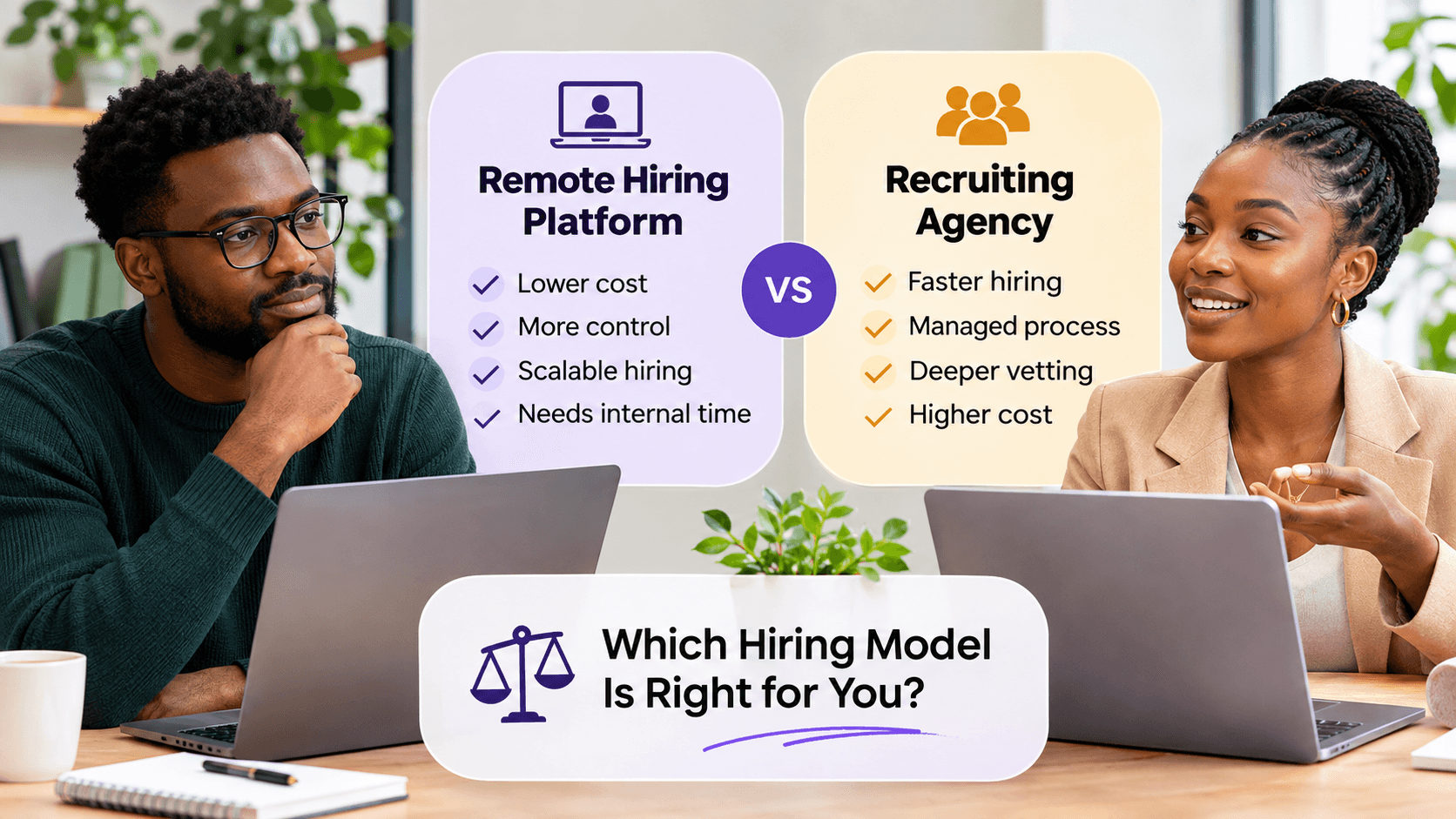
Platforms give you control and visibility into every step. Agencies give you speed and a managed layer that handles onboarding and quality control, at the price of opacity. There is evidence for the agency speed edge: one benchmark reports a 38% improvement in turnaround velocity for outsourced multi-disciplinary teams, though that figure comes from marketing services and I would apply it to recruiting cautiously.
Read the table as a decision guide: platforms win on cost, control, data ownership and repeatability; agencies win on speed, compliance handling and vetting depth. If two or more of your priorities fall in the agency column, start there and revisit platforms once hiring stabilizes. |
|---|
Our cost comparison of platforms and agencies puts real numbers on each line.
Calculate the Total Cost of Each Model
Sticker price lies. Always has.
Platform Fees Plus Internal Time
Take the subscription, add the loaded cost of the hours your team spends sourcing, interviewing and administering. Benefits alone run around 29.8% of total compensation in US private industry, which is a useful reminder that an internal hour is never free. A £60-a-month tool that eats ten hours of a manager’s week is not cheap.
Agency Retainers and Markups
Add the fee, the markup, any minimum commitment and the cost of a failed placement while the guarantee clock runs. Then divide by successful hires, not attempted ones.
Switching and Exit Costs
This is the line everybody forgets. Moving from a platform to an agency is easy; you simply hand over a brief. Moving from an agency to a platform is harder, because agencies often keep the vendor contacts, the candidate pipeline and the reporting history. Budget for rebuilding that memory.
Ask Providers These Questions Before Signing
Good providers welcome these. Evasive ones reveal themselves quickly.
What is your acceptance rate, and what does each screening stage actually test?
Show me the full fee schedule, including every exit and conversion charge.
Who owns candidate data and communication history if we leave?
What is your median time to shortlist for a role like mine, and can I speak to a client who waited longer?
What is excluded from your replacement guarantee?
Which compliance duties do you carry, and which stay with us?
Match Your Situation to a Decision Framework
Keep this simple, because complicated frameworks do not get used.
If you have a dedicated recruiter or talent manager, a recurring hiring need and a modest budget, start with a platform. If you have zero internal headcount for recruiting, an urgent or confidential search, or a regulated sector, hire an agency, but only after you have written down the outcomes you will hold it to. Time to hire, quality-of-hire at six months, retention. Without defined outcomes, an agency is a very expensive hope.
Between those poles sits the awkward middle: a lean team, a mix of routine and tricky roles. For that, read on. For a longer decision tree, our guide on when to choose platforms or agencies walks through more scenarios.
Run a Pilot to Prove Return on Investment
Never sign a twelve-month commitment on a demo. Run a pilot on two or three live roles, ideally one with each provider if you are undecided. Track cost per hire, time to shortlist, interview-to-offer ratio and new-hire retention at 90 days. Compare against your internal baseline, not against the vendor’s case studies.
Give the pilot a fixed end date and a pre-agreed pass mark. If a vendor resists measurable terms, that resistance is your answer.
Can You Combine a Platform With a Small Agency Retainer?
Yes, and mature teams increasingly do. Use the platform as your discovery engine and production capacity so data and candidate relationships stay in-house, then add a boutique recruiter or fractional talent strategist on a small advisory retainer for the senior, sensitive or stuck searches. You get the memory of a platform and the judgement of a human. What you avoid is renting an agency’s memory indefinitely.
What Happens to Your Data and Vendor Relationships When a Contract Ends?
With a platform, the records usually sit in your account, though check export rights before you need them. With an agency, assume nothing. Contracts should state that candidate lists, interview notes and reporting transfer to you on termination, in a usable format, within a defined number of days. Otherwise institutional knowledge walks out with the account manager.
FAQ
Is a recruiting agency always more expensive than a platform?
Per placement, usually yes. Overall, not always, because a platform’s internal time cost can exceed an agency fee when your team is thin.
Which is faster for a first hire?
A recruiting agency may be faster for an initial hire because it has dedicated recruiters and established talent networks. Traditional self-service platforms can become more efficient once hiring workflows are established. However, IMO Talent offers an alternative through curated talent matching and recruitment support, helping businesses connect with skilled African professionals without managing the entire candidate search independently. Actual hiring speed depends on the role, candidate availability and recruitment requirements.
Do platforms replace recruiters?
They replace administrative and sourcing work, not judgement. Someone still has to assess fit and close the candidate.
How many providers should I shortlist?
Three of each model at most. More than that and you are procrastinating.
Conclusion
Choosing between a recruiting agency and a remote hiring platform starts with understanding your hiring needs, internal resources and long-term recruitment goals.
Remote hiring platforms can offer greater flexibility and control for businesses managing recurring recruitment needs. Traditional recruiting agencies may be better suited to specialised searches requiring dedicated recruitment expertise. However, businesses do not always have to choose between entirely self-service hiring and traditional agency recruitment.
IMO Talent offers another approach, connecting international businesses with skilled African professionals through curated talent matching and recruitment support. For companies looking to expand their remote workforce, particularly across technology, product and business-support functions, it provides an option worth evaluating alongside conventional hiring models.
Ultimately, the best recruitment solution is the one that delivers qualified candidates, supports your hiring objectives and creates sustainable value for your business.
Explore IMO Talent to learn more about hiring skilled professionals for your team.