
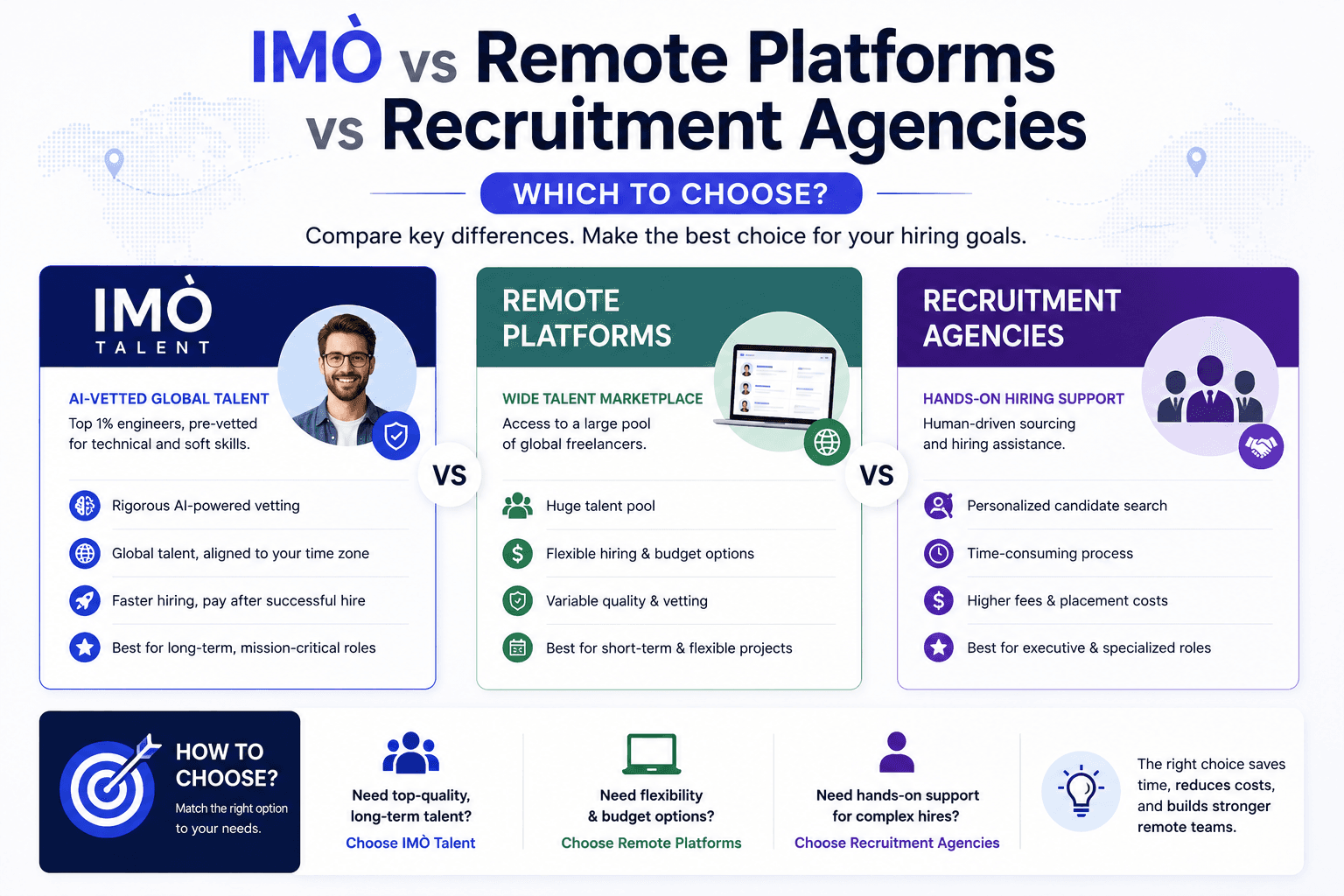
Right, so you’re staring at a spreadsheet of ten different remote hiring options, wondering which one won’t leave you either broke or stuck with a developer who ghosts you in week three. Fair enough. The honest answer is that there’s no single winner here. The right choice between IMÒ, a freelance marketplace, or a traditional recruitment agency depends entirely on three things: how fast you need someone in a seat, how much vetting you’re willing to pay for, and whether the role is a one-off gig or a two-year hire you’re building a team around.
I’ve watched founders burn six weeks and a few thousand pounds on a job portal only to end up with a shortlist that looked good on paper and fell apart in the interview. I’ve also seen people pay an agency’s recruiter fee expecting white-glove service and get a generic candidate list forwarded from a job board they could’ve searched themselves. Neither outcome is inevitable. It just comes down to matching the model to the job, not picking whatever’s trending on LinkedIn that week.
This isn’t a ranked list where number one beats number ten. Think of it more like a toolkit. A scalpel for surgery, a hammer for nails. Using the wrong one doesn’t just waste time, it actively costs you money through bad hires, blown deadlines, or a recruitment process that drags on so long the good candidates take other offers. Let’s go through the ten models actually competing for your hiring budget right now, and then get into the decision-making bit that matters more than any of the individual profiles.
1. IMÒ: Founder-Led Vetted Talent Platform
IMÒ sits in an odd, useful spot between the wild-west freelance platform and the slow-moving traditional agency. It’s built by founders who apparently got tired of both extremes, so what you get is a curated pool of remote professionals, mostly out of Africa and Latin America, who’ve already been through a rigorous vetting process before you ever see a resume. The pitch, and it’s a fair one, is that you skip the weeks of sourcing and land a matched hire within about 72 hours.
Cost-wise, this model runs 40 to 60 percent cheaper than a conventional agency, according to industry comparisons of bulk remote hiring frameworks, largely because you’re not paying for a recruiter’s overhead or a big-agency brand markup. The trade-off, if you want to call it that, is you’re leaning on IMÒ’s internal standards rather than running your own six-round interview gauntlet. For companies that want a genuine alternative to a marketplace when hiring specialised roles like SEO, or that need to understand how the platform positions itself for senior engineering hires, this tends to be the sweet spot between speed and quality.
2. Toptal: Elite Vetted Network for Critical Projects
Toptal built its reputation on the “top 3 percent” claim, and honestly, the screening process backs it up more than most marketing taglines do. If you’re launching something where a bad hire means real financial damage, a payment system that can’t afford bugs, a client-facing product that needs to work flawlessly, this is the network built for exactly that anxiety.
The catch, and it’s one people don’t mention enough, is that the famous 48-hour matching window tends to apply to bread-and-butter web stacks. Ask for a niche AI specialist or someone deep in blockchain infrastructure and you might be waiting considerably longer, premium pricing notwithstanding. Worth knowing before you set expectations with your own stakeholders.
3. Andela and Arc.dev: Emerging Market and Balanced Platforms
Andela made its name scaling engineering teams out of Africa and Latin America, and it’s genuinely strong here, though I’d argue it suits longer engagements more than quick contract gigs. There’s a real investment in talent development baked into their model, which pays off over a 12-month-plus relationship but feels like overkill if you just need someone for a three-week sprint.
Arc.dev, meanwhile, sits closer to the middle ground. Startups that want senior remote talent without Toptal’s premium price tag tend to land here, and the AI-assisted sourcing genuinely speeds things up compared to a traditional recruitment agency working through cold outreach and manual resumes review. If you’re weighing these two against the wider vetted-network field, this comparison of Imo Talent, Arc, and Toptal across vetting standards is a decent place to sanity-check your assumptions.
4. Revelo and BairesDev: Nearshore and Large-Scale Staffing
For US companies specifically wanting time zone alignment, Revelo has built a genuinely tight niche around LatAm tech talent, and it functions almost like a staffing agency in a box since it also handles payroll and compliance. That’s a meaningful difference from platforms that just do matching and leave you to sort the legal bits yourself.
BairesDev plays a slightly different game, it’s built for scaling whole teams rather than placing a single remote hire. Their automated vetting process moves fast, which matters when you need eight engineers by next quarter, not one contractor by next month. Founders debating Andela, Arc, and agency-style partners against a platform model usually find the deciding factor is less about talent quality and more about whether they’re hiring one person or building an entire remote team.
5. Upwork: Open Freelance Marketplace
Upwork is the everything-store of freelance platforms, and there’s no shame in that. Small projects, quick tasks, tight budgets, it does the job. What trips people up is treating the open marketplace the same way they’d treat a curated pool, then getting frustrated when the quality’s inconsistent.
The smarter move, and one a lot of experienced buyers already use, is the Business Plus tier, which filters toward pre-vetted freelancers and skips a good chunk of the chaos in the open job market. It’s not a perfect fix but it narrows the gap between Upwork and the more curated platforms considerably.
6. Deel and Remote: Employer of Record Platforms
Here’s where people get confused, and it’s worth clearing up properly. Deel and Remote aren’t sourcing platforms in the way IMÒ or Toptal are. They’re Employer of Record services, meaning their entire function is legal and payroll infrastructure for people you’ve already found. Remote, specifically, shines once you’ve identified your candidate and need someone to handle the tangle of international labour law and tax compliance.
Deel does the same job but has been building out its own talent marketplace alongside the EOR function, so you can theoretically find, hire, and pay someone without leaving the interface. Handy, though I’d still recommend treating the sourcing and compliance decisions as separate problems, because conflating them is how companies end up disappointed with both halves.
| Platform Type | Primary Strength | Typical Cost vs Agency | Time to Hire |
|---|---|---|---|
| IMÒ | Vetted talent, fast matching | 40-60% cheaper | ~72 hours |
| Toptal | Elite technical screening | Premium pricing | 48hrs (standard stacks) |
| Deel/Remote | Compliance & payroll (EOR) | Mid-range | Depends on sourcing |
| Robert Half | Executive search, local presence | 15-25% of salary | Weeks to months |
7. Robert Half: Traditional Recruitment Agency
Robert Half represents the old guard, and dismissing it entirely would be a mistake, even in 2026. Where it earns its keep is executive-level search and hybrid roles that genuinely need someone physically present or deeply embedded in a local market. The process is slower than any platform on this list, sometimes painfully so, but for a long-term personal search partner rather than a quick contractor, it still has a place.
The recruiter fee here typically runs 15 to 25 percent of a candidate’s first-year salary, which is a serious number once you’re hiring above a certain seniority. That’s the trade-off you’re accepting for a recruitment agency’s hands-on sourcing and local market knowledge, and for some roles it’s genuinely worth paying.
8. Boutique and Niche Recruitment Agencies
Smaller agencies occupy an underrated lane. They don’t have Robert Half’s brand recognition, but a good boutique recruitment agency specialising in, say, bilingual staffing or a specific regional job market, often outperforms the big names precisely because they’re not juggling hundreds of job orders at once.
The risk with small agencies is inconsistency. One might be brilliant, deeply networked, genuinely invested in your success. Another might just be re-posting your role across the same job listings you could’ve found yourself. Vet the agency almost as hard as you’d vet a candidate, check testimonials, ask for reference clients, don’t just take their word for their own recruitment automation software or process.
9. Hybrid Model: Platform Plus Agency Combination
Nobody talks enough about mixing models, but plenty of smart companies do exactly this. Use a platform like IMÒ or Arc for the bulk of your technical remote hiring, and reserve a traditional agency relationship for the rare executive or highly specialised search where local presence genuinely matters.
It’s not an either-or decision, despite how these comparisons usually get framed. Companies scaling teams often find that curated talent pools and open marketplaces carry very different cost, time, and quality implications depending on the role, which is exactly why a blended approach tends to outperform loyalty to a single method.
10. In-House Sourcing With Compliance Support
The final model is doing it yourself, essentially, using in-house recruiters plus a compliance layer like Remote or Deel to handle the legal end. This gives you maximum control over the hiring process and candidate experience, but it demands real internal bandwidth. You need someone who actually understands sourcing, not just someone assigned the task on top of their existing job.
This route suits larger companies with established recruitment consultants on staff already, or businesses hiring frequently enough that building internal capability pays for itself over time. For a five-person startup, it’s usually a poor use of founder hours.
How Do You Choose the Right Hiring Model for Your Business?
The honest framework is this: match urgency, budget, and role complexity against what each model actually delivers, rather than picking based on brand recognition. A startup needing a developer next week shouldn’t be filling out a Robert Half intake form. A company hiring a CFO shouldn’t be trusting an open freelance platform.
Company size matters more than people admit too. What works for a five-person startup looks nothing like what an enterprise needs, and platform selection genuinely shifts based on whether you’re a startup, SMB, or enterprise. Ignoring that distinction is probably the single most common mistake I see in this space.
What Vetting Standards Should You Demand Before You Hire?
Ask, specifically, what the vetting process actually involves before you commit. Some platforms lean on technical assessments and live coding rounds, others rely more on portfolio review and reference checks. Neither is wrong, but you should know which one you’re getting, because the vetting standards between platforms and agencies genuinely differ in ways that affect how much due diligence you still need to do yourself.
Don’t assume “vetted” means the same thing across every provider. It doesn’t. A platform’s internal bar might be rigorous technical screening; an agency’s might just be a phone screen and a resumes check.
How Does Time Zone Coverage Affect Your Hiring Decision?
Time zone alignment quietly determines whether a remote hire actually works day-to-day. A nearshore option like Revelo makes sense if your team needs real-time overlap for standups and pair programming. A platform sourcing from a wider global talent pool works fine for async roles, content, design reviews, backend work that doesn’t demand live collaboration.
Get this wrong and you’ll end up with a technically brilliant hire who’s asleep during your entire working day, which defeats half the point of hiring quickly in the first place.
What Red Flags Signal a Recruitment Agency to Avoid?
Watch for agencies that won’t disclose their fee structure upfront, that seem to be recycling the same job board listings rather than doing actual sourcing, or that can’t name a single reference client in your industry. A recruitment agency worth its fee should be transparent about process, timeline, and what happens if the placement doesn’t work out within the guarantee period.
Also worth noting: there’s a meaningful difference between a genuine recruitment partner and a glorified job board charging agency prices for job board effort. If they’re not adding value beyond what you’d get scrolling job portals yourself, question the fee.
Conclusion
There’s no universal winner across IMÒ, remote platforms, and recruitment agencies, only a better or worse fit for the specific hire in front of you. Speed and cost efficiency point toward platforms. Deep local market knowledge and executive search still lean agency. Compliance-heavy international hiring needs an EOR layer regardless of where you source the person.
Get comfortable running more than one model at once. The companies that hire well in 2026 aren’t loyal to a single method, they’re just honest about matching the right tool to the right job.
FAQ
Is IMÒ cheaper than a traditional recruitment agency? Generally, yes. Industry comparisons put platforms like IMÒ at 40 to 60 percent below what a conventional agency charges, since you’re not paying for the agency’s overhead or a first-year-salary recruiter fee.
Can I use a freelance platform and an agency at the same time? Absolutely, and plenty of companies do. A hybrid approach often works better than committing entirely to one model, especially when hiring volume includes both routine and highly specialised roles.
Do Deel and Remote find candidates for me? Not primarily. They’re built as Employer of Record services for compliance and payroll. Deel has added its own talent marketplace, but the core function on both remains legal and payment infrastructure, not sourcing.
What’s the biggest mistake companies make choosing between these models? Picking based on brand familiarity rather than matching urgency, budget, and role complexity to what the model actually delivers. A five-person startup rarely needs a Robert Half-style search, and an enterprise CFO search rarely belongs on an open marketplace.