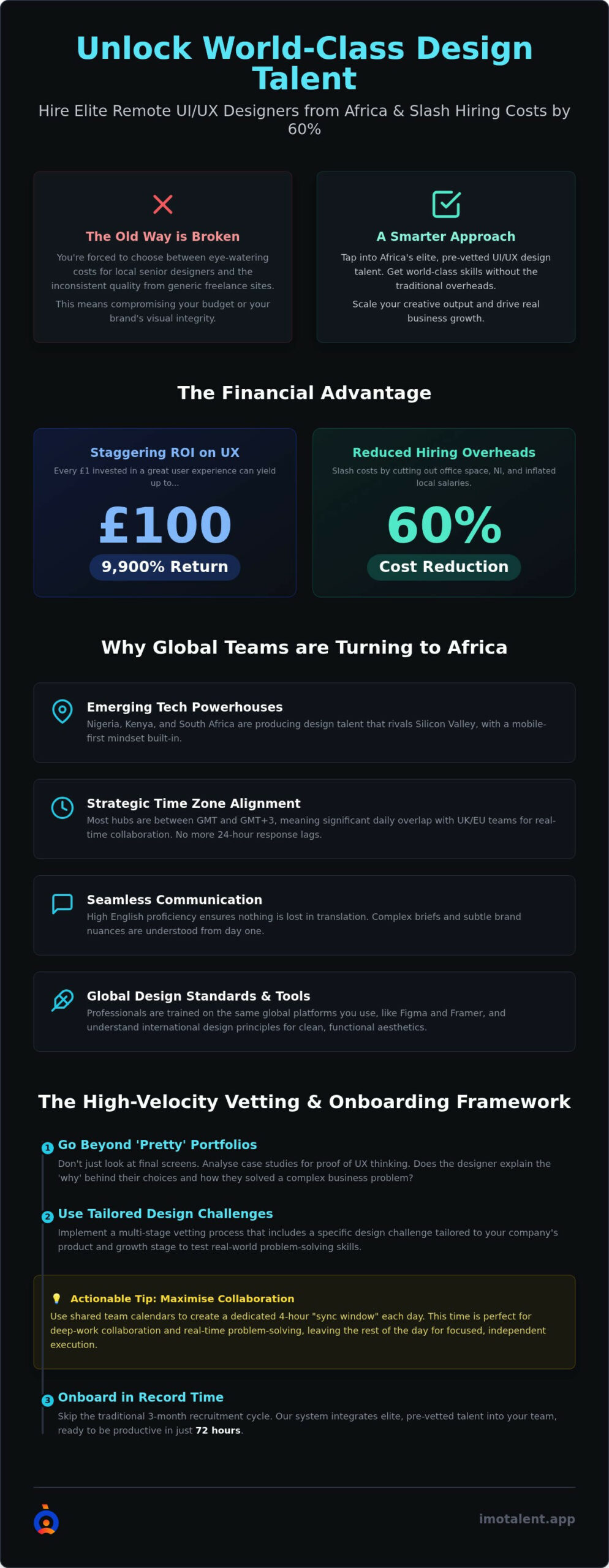
Did you know that every £1 invested in user experience can yield up to £100 in revenue? That is a staggering 9,900% ROI that many brands unfortunately miss because they are priced out of the senior talent market. You are likely exhausted by the eye-watering costs of local senior designers or the inconsistent quality found on generic freelance marketplaces. It often feels like you have to choose between your budget and your brand’s visual integrity.
We are here to tell you that you don’t have to compromise. This guide reveals how to source and integrate the most elite remote UI UX designers Africa provides, allowing you to scale your creative output while slashing hiring costs by 60%. We have perfected a system that moves at high velocity, matching you with top-tier professionals who understand global design standards and modern AI-native workflows.
You will learn our exact framework for vetting talent, managing seamless time zone overlaps, and getting your new hires productive within just 72 hours. It is time to stop settling for slow-moving traditional recruitment and start building a world-class design team that drives real growth.
Key Takeaways
- Discover why emerging tech hubs in Nigeria and Kenya are producing world-class remote UI UX designers Africa and how their English proficiency ensures smooth collaboration.
- Learn how to look past “pretty” screens by analysing case studies that prove a designer can solve complex business problems and improve user journeys.
- Realise a 60% reduction in hiring overheads by comparing global salary data and cutting out hidden costs like office space and National Insurance.
- Implement a multi-stage vetting process that includes portfolio deep-dives and specific design challenges tailored to your company’s growth stage.
- Skip the traditional three-month recruitment cycle and find out how to integrate elite, pre-vetted talent into your team within just 72 hours.
Why Global Teams are Turning to Africa for UI/UX Design
The traditional map of tech talent is being redrawn. While many companies spent the last decade looking East for support, the most forward-thinking brands are now looking South. Nigeria, Kenya, and South Africa have emerged as formidable design powerhouses, producing talent that rivals anything you’ll find in Shoreditch or Silicon Valley. This isn’t just about finding cheaper labour. It’s about tapping into a youthful, tech-savvy population that is mobile-first by default. In Sub-Saharan Africa, 48% of employers expect talent availability to improve significantly over the next few years, compared to just 29% globally. This demographic dividend is creating a surge of remote UI UX designers Africa can proudly export to the global market.
Communication is the bedrock of great design. You can’t build a world-class product if your designer doesn’t understand the nuances of your brief. High English proficiency across the continent’s major tech hubs ensures that nothing is lost in translation. Whether it’s a complex user journey or a subtle brand voice requirement, these designers can articulate their creative decisions clearly. This level of fluency allows for seamless integration into UK and US teams from the very first day.
The Strategic Advantage of Time Zone Alignment
One of the biggest headaches in remote work is the “ghost ship” effect. This happens when your team sleeps while your freelancers work. Africa eliminates this friction. Most major tech hubs sit between GMT and GMT+3. This means your team in London or Berlin can have a full working day of overlap with their colleagues in Lagos or Nairobi. You can jump on a quick video call, solve a design bottleneck in real-time, and see updates before you log off for the evening. Contrast this with the 12-hour lag common in South-East Asia, where a simple question can take 24 hours to answer. It’s a massive boost for your operational velocity.
Actionable Tip: Use shared team calendars to visualise a dedicated 4-hour “sync window” each day. Use this time for deep-work collaboration and leave the rest of the day for focused, independent design execution.
Cultural Neutrality and Global Design Standards
African designers aren’t working in a vacuum. They are trained on the same global platforms you use every day, such as Figma, Framer, and Adobe Creative Cloud. The “Silicon Savannah” in Kenya has fostered a culture of innovation that prioritises clean, functional, and globally accessible aesthetics. These professionals have a deep understanding of UI/UX design principles, ensuring their work meets international standards. Because they often design for diverse, multi-lingual markets locally, they are naturally adept at creating inclusive interfaces that work for everyone. When you hire remote UI UX designers Africa offers, you get a global aesthetic combined with an elite work ethic.
Evaluating the Skills of African Design Professionals
Elite talent isn’t found by accident. It is identified through a rigorous, methodical evaluation process. When you source remote UI UX designers Africa offers, you are looking for more than just aesthetic flair. You are looking for strategic partners who can translate business goals into functional user journeys. This region is a hotbed for innovation-led growth in Africa, and the design standards reflect that global ambition. You should expect mastery of tools like Figma, a cloud-based design platform, and a deep understanding of design systems, which are libraries of reusable components that keep your product consistent.
Beyond technical skills, soft skills are the true differentiator. You need designers who can articulate their creative decisions and handle feedback loops with professional maturity. They must be proactive problem-solvers who don’t just wait for instructions but suggest improvements to the user experience. If you want to dive deeper into the hiring landscape, check out our guide on how to Hire remote business and design talent Africa for a broader perspective.
What to Look for in a Portfolio
A portfolio should be a narrative, not just a gallery. Move beyond “pretty” screens and look for “UX thinking”. Did the designer explain the “why” behind their choices? They should clearly outline the problem they were trying to solve and the data or user feedback that led to the final result. Accessibility is another non-negotiable. Check if their designs hold up across different devices, from high-end iPhones to mid-range Androids. This ensures your product remains usable for everyone, regardless of their hardware.
Pro-tip: Request a “Figma walkthrough” during the interview. Watching a designer navigate their working files reveals their level of organisation. A messy file usually predicts a messy workflow, while a clean, structured file suggests a designer who values efficiency and collaboration.
The Importance of a Design Test
Whiteboard challenges are often a poor reflection of real-world talent. They create artificial pressure that doesn’t mimic a standard working day. Instead, use a small, paid task. This is a far more effective way to measure speed, attention to detail, and how well they align with your existing brand guidelines. It also shows that you respect their time, which sets a positive tone for the professional relationship. If you want to skip the guesswork, you can connect with pre-vetted designers through our curated network who have already passed these rigorous checks.
A paid test allows you to see how they handle prototyping, which is the process of creating a clickable model of your app to test how it feels. This stage is crucial for identifying potential friction points before a single line of code is written. By focusing on these practical assessments, you ensure that your remote UI UX designers Africa hires are ready to deliver world-class results from day one.
The Financial Logic: Comparing Costs and Value
Scaling a brand isn’t just about how much you spend. It’s about how far each pound goes. In high-cost hubs like London or New York, a senior designer can easily command a salary that swallows a startup’s entire seed round. By sourcing remote UI UX designers Africa offers, you can secure the same level of expertise while achieving a 60% reduction in talent costs. This isn’t about compromising on quality. It’s a strategic move that allows you to hire a senior professional for the price of a junior local hire. This shift extends your runway and gives your product the high-end finish it deserves without the financial strain.
The return on investment is clear. A senior designer from a tech hub like Lagos or Nairobi brings years of experience solving complex problems for global markets. They arrive ready to lead, requiring far less oversight than a junior hire in the UK. This speed to productivity is a massive advantage for fast-growing companies that need to ship features quickly to stay competitive. When you cut your hiring overheads, you’re not just saving money; you’re buying more time to find your product-market fit.
Salary Benchmarks for 2026
In 2026, the salary data presents a compelling case for global firms. In South Africa, a senior designer earns an average of £26,000 annually. In Kenya, senior roles average around £29,000. These rates are highly competitive within their local economies, ensuring you attract the top 1% of talent. For companies used to paying six-figure sums, this represents an incredible value proposition. If you want to see how these numbers compare across different technical roles, take a look at our Cost of hiring developers in US vs Africa guide.
Beyond the Salary: Total Cost of Ownership
The sticker price of a salary is only part of the story. Hiring locally in the UK comes with “hidden” costs that quickly add up. You’re looking at National Insurance contributions, pension schemes, and the ever-increasing cost of office space. Traditional recruitment agencies also take a significant cut, usually between 15% and 25% of the annual salary as a one-off fee.
Hiring remote UI UX designers Africa removes these burdens. You don’t need to provide physical desk space or navigate complex local tax systems. Plus, using a managed talent service provides a predictable monthly cost, making your long-term budgeting much simpler. You get elite, “ready-to-work” talent that integrates into your workflow without the need for expensive training or long-term administrative headaches.
Actionable Tip: Before you hire, calculate your “Total Cost of Ownership” for a local versus a remote hire. Include agency fees, taxes, and office overheads to see the true impact on your business’s financial health.
How to Vet and Onboard Remote Designers Effectively
Finding the right talent is only half the battle. To truly elevate your brand, you need a high-velocity integration process that turns new hires into productive team members within days. When you bring on remote UI UX designers Africa provides, you aren’t just filling a seat; you’re adding a strategic layer to your product team. Success depends on how well you bridge the gap between their expertise and your internal culture.
Your first step is defining your company’s design maturity. Startups usually need generalists who can handle everything from wireframes to high-fidelity prototypes. Scale-ups, however, often require specialists who can maintain complex design systems. Once you know what you need, use a multi-stage vetting process. This should move quickly from a portfolio review to a cultural interview and finally a practical challenge. If you want to refine your leadership approach, our playbook on Managing remote African developers offers excellent strategies for high-performance teams.
The Vetting Framework
Technical skill is a baseline, but cultural alignment is what ensures long-term success. You need to know if a candidate’s communication style matches your team’s rhythm. Are they proactive? Do they ask the right questions before starting a task? During the interview, focus on how they handle ambiguity and conflicting feedback. This is crucial for remote setups where you can’t always hop on a quick call to clarify every detail.
Actionable Tip: Use a weighted scorecard for every candidate. Rate them on technical skill, communication, and problem-solving. This keeps your evaluations objective and helps you compare different candidates without relying on “gut feeling”.
Setting Your New Hire Up for Success
The first week should be a structured “onboarding sprint”. Don’t just dump a list of tasks on their desk. Instead, focus on a “documentation first” culture. Ensure they have immediate access to your design systems, brand guidelines, and communication tools like Slack or Microsoft Teams. Handling hardware and software access early is vital; ensure their Figma permissions and project management logins are ready before their first day.
Introduce the concept of “Design Buddies”. Pair your new hire with an existing team member for the first 30 days. This person acts as a go-to for culture-related questions and helps the new designer navigate your internal workflows. Finally, establish clear KPIs and communication rituals from the start. Daily syncs and weekly retrospectives, which are short meetings to review progress and blockers, keep everyone aligned. This ensures your remote UI UX designers Africa hires feel like a core part of the team. Ready to build your elite design squad? You can start your talent search today and see vetted candidates in record time.
Hire Your Next Designer in 72 Hours with IMO Talent
Traditional hiring is a slog. Most companies waste three months sifting through mediocre portfolios and conducting endless rounds of interviews. We have changed the game. By tapping into our curated network of remote UI UX designers Africa has to offer, you bypass the noise. We operate at high velocity because your product roadmap doesn’t have time for delays. You need elite talent that can ship features now, not next quarter.
Our “Secret Sauce” is a pre-vetted database of elite professionals who have already cleared our rigorous technical and cultural hurdles. We don’t just find people; we match them to your specific design maturity. Whether you’re a startup needing a design generalist or a scale-up building a complex system, we have the right fit ready to go. Our four-step process takes you from your initial request to a successful hire in just three days. It is efficient, assertive, and designed for results.
The 72-Hour Matching Guarantee
Speed is our standard. Once you share your requirements, we identify the top three candidates for your specific needs within just 72 hours. This isn’t a random selection. Our vetting is far more rigorous than a standard recruitment agency. We look at file organisation in Figma, problem-solving logic, and communication clarity. This ensures your product team stays on schedule and avoids the financial drain of a bad hire. You get to skip the “ghosting” and low-quality applications common on freelance marketplaces.
Actionable Tip: To make the most of our 72-hour window, have your brand guidelines and a clear project brief ready before you book your call. This allows candidates to show you exactly how they would tackle your specific challenges during the interview.
Managed Talent for Long-Term Growth
We don’t just disappear once the contract is signed. We take over the heavy lifting of administrative management, payroll, and compliance. This is why companies see significantly higher retention rates with our professionals. We act as an ongoing partner in your success, ensuring the integration remains seamless as your brand scales. You focus on the product; we focus on the people.
It is about more than just a placement. It is about efficient remote talent placement that grows with you. Stop settling for slow-moving traditional processes or the uncertainty of unvetted freelancers. The right remote UI UX designers Africa provides are ready to elevate your brand. The future of your user experience is just 72 hours away.
Build Your Elite Design Team Today
The design landscape has changed, and the strategic advantage now lies in global collaboration. You have seen how emerging tech hubs are producing world-class talent and how the favourable time zone overlap eliminates the friction of remote work. By choosing to hire remote UI UX designers Africa offers, you aren’t just saving money. You are investing in high-end innovation that drives real ROI.
It’s time to move past the slow, traditional recruitment cycles that hold your brand back. You can access the top 1% of African design talent and reduce your hiring overheads by up to 60% while maintaining the highest standards. We handle the vetting, the payroll, and the management so you can focus on building a product that users love. Your brand deserves a team that works at your velocity.
Don’t let your competition outpace you with faster shipping cycles. You can Scale your design team with vetted African talent today and see your first candidates in just 72 hours. Your next great user experience is ready to be built, and the right talent is waiting to get started.
Frequently Asked Questions
Is there a significant time difference when working with designers in Africa?
No, the time difference is actually one of the biggest advantages of the region. Major tech hubs like Lagos and Nairobi operate within GMT to GMT+3, meaning they have a 0 to 3 hour difference from the UK. You get a full working day of overlap for real-time collaboration, sync meetings, and instant feedback. It is a much smoother experience than the 12-hour lag often found when outsourcing to other continents.
How do African UI/UX designers compare to those in the UK or US in terms of quality?
The quality is world-class, as these designers are trained on the same global standards and platforms used in London or New York. Many are “mobile-first” experts who have built innovative products for some of the world’s fastest-growing markets. They bring a fresh, inclusive perspective to remote UI UX designers Africa roles, ensuring your product is both visually stunning and highly functional for a global audience.
What design tools are most commonly used by remote African designers?
Figma is the primary tool of choice, reflecting the global shift towards collaborative, cloud-based design. You can also expect mastery in Adobe Creative Cloud, Framer, and Sketch. These professionals are well-versed in building and maintaining complex design systems. This ensure your product remains consistent and scalable as you add new features, without the need for constant, manual oversight of every single screen.
How does IMO Talent vet the designers in its network?
We use a rigorous, multi-stage vetting process that filters for the top 1% of talent. This includes deep-dives into their portfolios, live design challenges to test their logic, and cultural fit interviews. We don’t just look for “pretty” designs; we ensure every professional can articulate their creative choices and solve complex business problems. Our goal is to match you with a designer who hits the ground running.
Can I hire a designer for a short-term project or only for full-time roles?
We specialise in long-term placements because we believe design consistency is the key to a successful brand. While we focus on building stable, high-performance teams, our flexible model allows you to scale your design capacity as your roadmap evolves. Hiring remote UI UX designers Africa through our network ensures you have dedicated talent that grows with your company, rather than a revolving door of gig-based freelancers.
What happens if the designer I hire is not a good fit for my team?
We provide ongoing talent management support to ensure your integration is successful. If a hire isn’t the right fit, we act quickly to resolve the issue or provide a replacement from our pre-vetted pool. Our 72-hour candidate presentation guarantee means we can pivot and find a new match without stalling your product development. We are committed to your long-term success and team harmony.
How do I handle payments and payroll for a remote designer in Africa?
We handle the entire administrative process, including payroll, statutory contributions, and local compliance. You simply pay a single monthly invoice to us, and we take care of the rest. This removes the legal and logistical headaches of international hiring. It is a streamlined, efficient system that lets you focus on your core business while we manage the complexities of cross-border employment and talent retention.
What are the average salary expectations for a senior UI/UX designer in Nigeria or Kenya?
Senior designers in these regions typically earn between £26,000 and £30,000 annually, depending on their specific hub and experience. In Kenya, a senior designer averages around £29,000, which offers a 60% cost reduction compared to hiring a professional with the same expertise in the UK. These competitive rates allow you to secure elite talent while significantly extending your company’s financial runway.