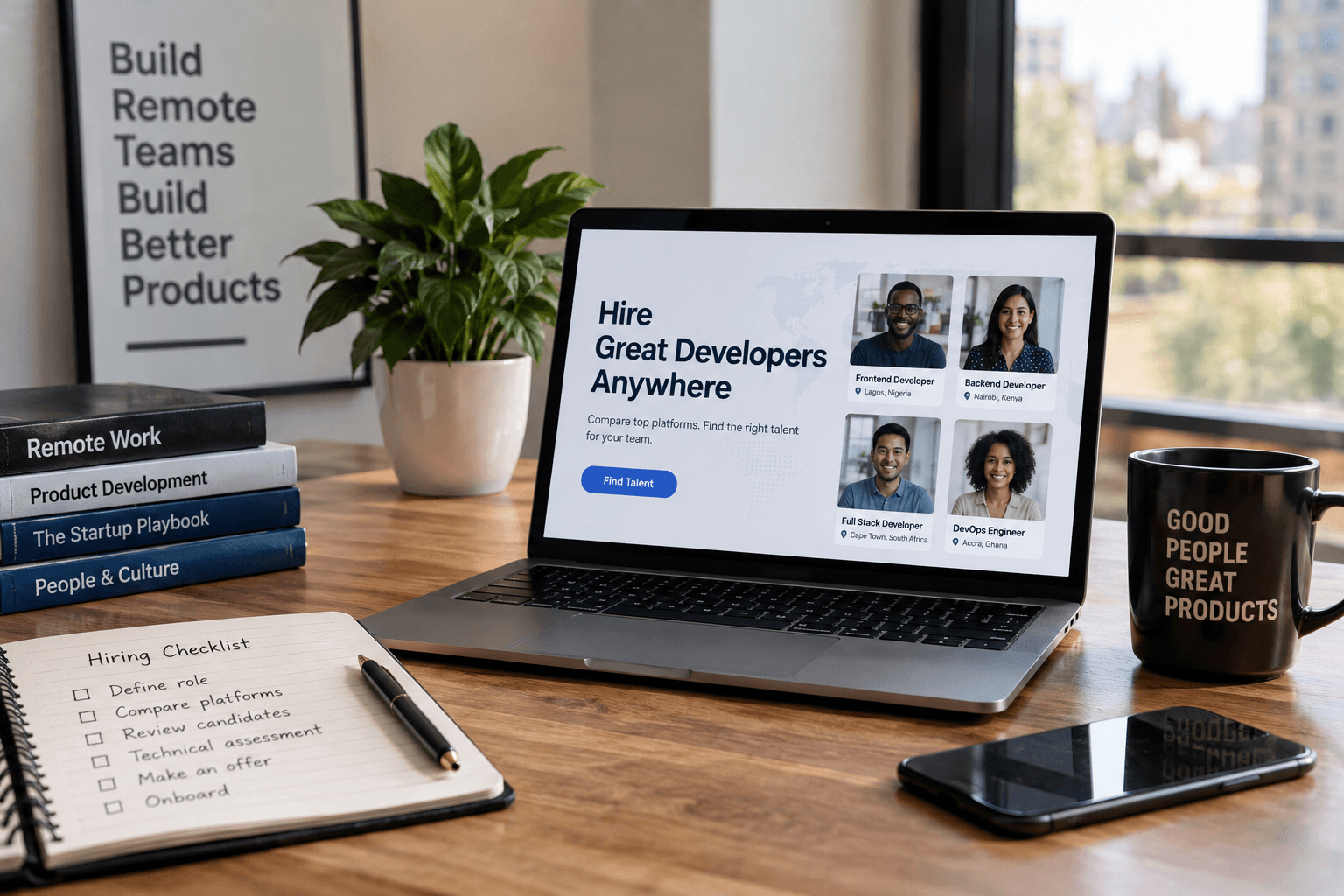

Why settle for a 40-day hiring cycle when your competitors are scaling in less than three? Most leaders agree that the traditional recruitment model is fundamentally broken, often leading them to seek a more efficient remote talent placement service. Between high local fees and the administrative headache of international payroll, finding the right person often feels like an exhausting, uphill battle. You need high-quality experts who can hit the ground running, but generic job boards usually deliver mediocre results that don’t justify the investment.
We’re going to show you how to slash your hiring costs by 60% and secure elite, pre-vetted professionals in under 72 hours. This guide explores the mechanics of rapid placement and how to access a global talent pool that aligns perfectly with your business goals. You’ll learn how to bypass the usual bottlenecks and implement a strategic scaling plan that prioritises efficiency and excellence, ensuring your organisation stays agile in a fast-moving market.
Key Takeaways
- Learn how to reduce your recruitment expenses by 60% while filling critical roles in less than 72 hours.
- Understand the 4-step vetting process that ensures your remote talent placement service delivers candidates with both technical mastery and excellent communication skills.
- Discover why managed placement is superior to freelance platforms for building long-term team stability and achieving higher retention rates.
- Identify the essential criteria for choosing a provider, focusing on transparency and market specialisation in high-growth regions like Africa.
- Optimise your workflow by leveraging time zone alignment and high English proficiency for seamless team integration.
What is a Remote Talent Placement Service and Why Does Your Team Need One?
Traditional hiring is dying. If you are still relying on “post and pray” job boards to find your next lead developer or designer, you are already behind. A remote talent placement service is a managed solution that acts as an elite gatekeeper for your business. It doesn’t just list jobs; it vets, matches, and provides ongoing support for high-performing professionals across the globe. This represents a massive shift from self-service job boards to expert-curated growth.
In 2026, the speed of business demands a faster approach. Waiting for the right candidate to find your listing is a luxury you don’t have. Understanding what remote work is in a modern context means looking beyond your local city. By using a managed service, you can access global talent pools that offer a 60% reduction in hiring costs and a 72-hour turnaround. It’s about moving from a slow, local search to a high-velocity, global strategy that prioritises quality and speed.
The Problem with Traditional Recruitment Agencies
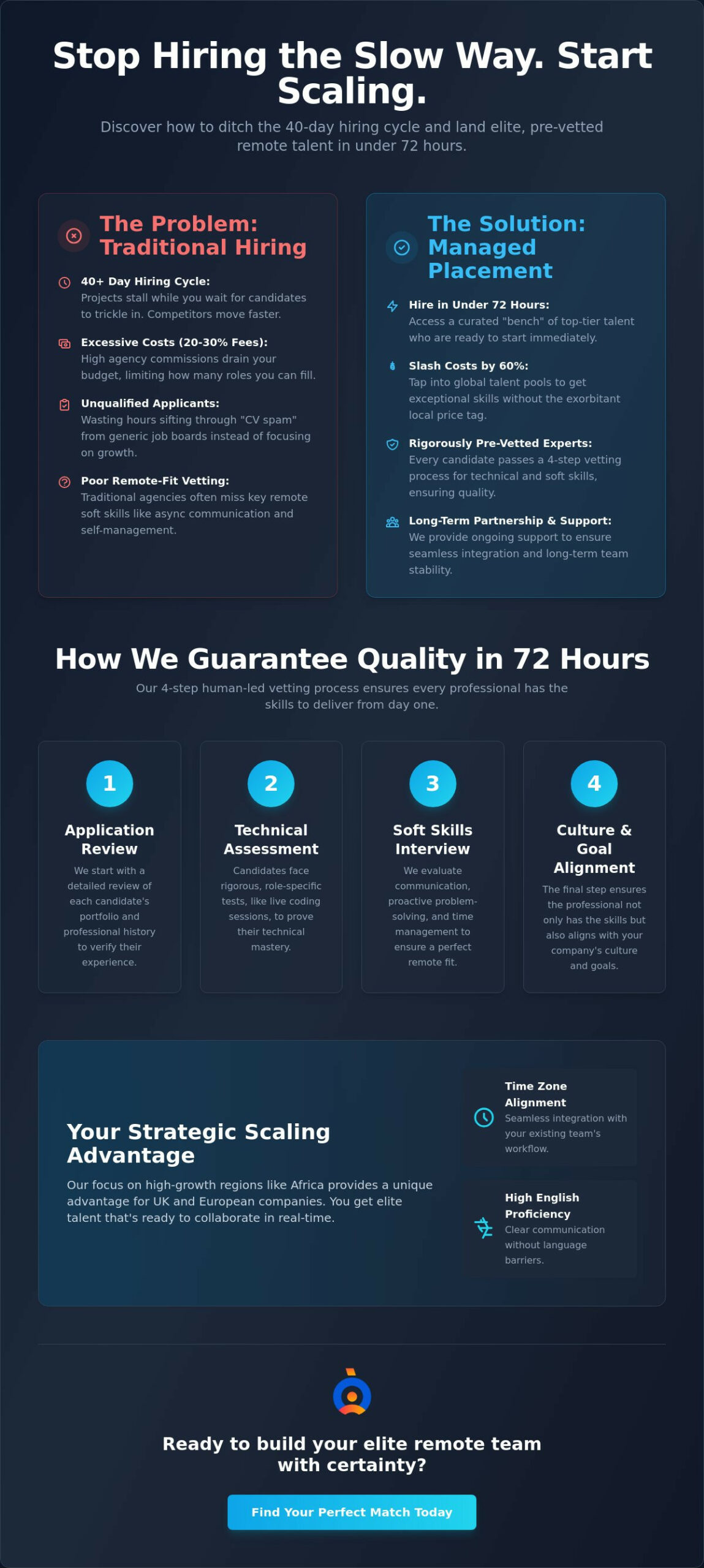
Most traditional agencies are built for a world that no longer exists. They often charge high commission fees, sometimes reaching 20% to 30% of a candidate’s annual salary. This is a significant drain on resources for any scaling business. These agencies also tend to lack the specific expertise needed to vet remote-specific soft skills, such as asynchronous communication and self-management. Their processes are often sluggish, failing to keep up with the rapid pace of tech and design industries. You end up paying more for a slower, less reliable result.
The Managed Placement Advantage
Managed placement is different because it offers continuous support. It isn’t just a one-off transaction; it’s a partnership that ensures your new hire integrates seamlessly into your team. You gain access to pools of talent that are ready to start immediately, rather than waiting for a recruiter to source them from scratch. A pre-vetted remote professionals service provides a curated pool of experts who have already cleared rigorous technical and soft-skill assessments. This foundation allows you to scale with certainty, knowing that every candidate has the “African Advantage” of high English proficiency and time zone alignment with the UK and Europe. You get the elite skills you need without the administrative nightmare of traditional hiring.
The Mechanics of a 72-Hour Placement: How Vetting Works
Speed is often the enemy of quality in recruitment. However, a professional remote talent placement service flips this script by using pre-existing, curated talent pipelines. You don’t have to wait weeks for a recruiter to start searching because the best professionals are already identified and ready to move. This isn’t just about filling a seat; it’s about finding the perfect fit at a high velocity.
According to official U.S. remote work data, the demand for flexible work remains high, but the challenge for leaders is identifying who actually thrives in a remote environment. Technical skill is only 50% of the equation. A developer might be a wizard with Python, but if they can’t communicate asynchronously or manage their time without oversight, the placement will fail. This is why a human-led approach beats AI-only matching every time.
Deep-Diving into the Vetting Process
The vetting process consists of four distinct stages. It begins with a detailed application review, followed by a technical assessment tailored to the specific role. This could involve live coding sessions or comprehensive portfolio reviews. We then move to a soft skills interview to evaluate proactive problem-solving and communication clarity. Finally, we perform a matching analysis to ensure the candidate aligns with your company culture. You can learn more about the remote talent vetting process to see how these safeguards protect your investment.
The Speed Factor: How to Hire in Days, Not Months
Traditional hiring often results in “CV spam,” where you are forced to sift through hundreds of unqualified applicants. We eliminate this by maintaining a “bench” of top-tier talent. These individuals are pre-vetted and waiting for the right opportunity, allowing for a match in under 72 hours. To make this work even faster, a great practical tip is to have your internal onboarding documents and software access ready before the match happens. This ensures your new hire can start delivering value from day one.
The relationship doesn’t end once the contract is signed. Ongoing talent management is vital for long-term retention. We provide continuous support to both the employer and the professional, bridging any gaps that might arise during the first few months. If you are ready to stop wasting time on mediocre job boards, you can start building your elite team today. By focusing on both immediate speed and long-term stability, we help you scale with complete confidence.
Managed Placement vs. Freelance Platforms: Choosing the Right Strategy
Stop treating your core team like a side project. Freelance platforms like Upwork or Fiverr serve a purpose; they are great for quick, isolated tasks like a logo design or a one-off spreadsheet fix. But if you’re trying to scale a tech, design, or business department, a transactional approach won’t work. A remote talent placement service focuses on long-term integration rather than one-off deliveries. It’s the difference between hiring a plumber and building a dedicated maintenance department.
The “Retention Gap” is a silent killer for many scale-ups. Freelancers are often juggling multiple clients at once. Their loyalty is usually tied to the next contract, not your company mission. Placed professionals, however, are matched based on long-term compatibility and career growth. This creates a stable workforce that understands your culture and grows with you. Many leaders now seek more sophisticated remote workforce recruitment strategies to avoid the revolving door of gig workers.
Accountability is another major differentiator. When a freelancer goes dark on a gig site, your only recourse is a platform dispute that takes weeks to resolve. With a managed placement service, you have a partner to call. We act as the bridge, ensuring performance stays high and communication remains clear. It’s about having a safety net that protects your time and your budget.
The Hidden Risks of the Gig Economy
Hiring from unvetted pools creates massive security and IP protection risks. You also face a heavy administrative burden. Managing payroll, compliance, and performance for a dozen individual contractors across different platforms is a full-time job. The high churn rates in freelance models mean you are constantly restarting the hiring process, which is a significant drain on your resources. You might save on the initial hourly rate, but you lose thousands in turnover costs and lost momentum.
Building a Long-Term Remote Workforce
Building a team is about more than just skills; it’s about culture. Placed professionals are integrated into your company from day one. This is where the “African Advantage” becomes a strategic weapon. Talent from hubs in Africa offers perfect time zone alignment (GMT/WAT) with the UK and Europe. Their high English proficiency ensures that communication is seamless. To maximise this, look for a service that offers ongoing talent management subscriptions. This ensures your remote team members continue to upskill alongside your business, keeping your operations elite and ready for any challenge. Focus on value over the cheapest price tag, and you’ll build a team that actually stays.
How to Evaluate a Remote Talent Placement Provider in 2026
Choosing a partner is the difference between scaling your organisation and stalling your growth. You don’t want a middleman; you want an elite gatekeeper. A high-performing remote talent placement service operates with total transparency. They should be willing to share their pass rates and specific vetting filters. If a provider is vague about how they test for technical mastery or soft skills, they aren’t a partner you can trust. Trust is a metric, not a feeling.
Market specialisation is your biggest asset. In 2026, the African tech hub is the primary destination for companies seeking high-velocity growth. Your provider must understand this region deeply. They should know which cities are producing the best UI/UX designers and which hubs are centres for backend excellence. They must also handle the legal heavy lifting. International contracts and compliance are complex. A true partner manages these risks so you don’t have to worry about the administrative fallout of global hiring. Using a dedicated remote African talent platform gives you the regional expertise and compliance infrastructure needed to hire with confidence in 2026.
The Checklist for Hiring Managers
Before you sign a contract, run through this essential checklist to ensure the provider can meet your speed and quality requirements:
- 72-Hour Shortlist: Can they actually deliver pre-vetted candidates in three days? If they need weeks to “source”, they don’t have a curated bench.
- Proven Track Record: Verify their experience in streamlining the hiring process for remote developers and other specialised roles.
- Retention and Support: Ask about their 12-month retention rates. A hire is only successful if they stay and contribute to your culture.
Understanding the Cost Structure
Price is what you pay; value is what you get. You must understand the difference between a one-off placement fee and an ongoing management fee. A managed model often provides better ROI because it includes continuous support and performance tracking. When you switch to an African talent model, calculate your savings not just in salary, but in reduced turnover and faster time-to-hire. Avoid providers who hide “success fees” or “administrative charges” in the fine print. Transparency in pricing is just as important as transparency in vetting. If you want to see how we maintain these standards, you can view our placement framework today to get started.
Scaling with Certainty: The IMO Talent Difference
Scaling a business isn’t just about adding more hands; it’s about adding the right ones at the right time. IMO Talent isn’t a traditional recruitment agency. We operate as an elite remote talent placement service designed for high-velocity growth. While many providers limit themselves strictly to software engineers, we recognise that a truly balanced team needs more. That is why we provide immediate access to vetted Product Managers, UI/UX Designers, and Business Analysts who are ready to integrate into your workflow without the usual friction. For instance, a company in the beauty sector using SalonIQ might hire a remote Business Analyst to optimize their management and marketing systems.
The “African Advantage” is our secret weapon for your success. We focus on talent hubs in Nigeria, Kenya, and Ghana, where the tech ecosystems are booming. These regions produce professionals who aren’t just technically gifted but are also culturally aligned with UK and European business practices. Hiring remote developers from Africa gives you a massive competitive edge in 2026 because you gain elite skills without the time zone headaches found in other outsourcing regions. With GMT and WAT alignment, your remote team works exactly when you do, eliminating the communication lag that often kills project momentum.
Why Africa is the New Frontier for Remote Talent
The professionals we place offer a level of English proficiency and cultural alignment that is hard to match elsewhere. This means less time spent explaining requirements and more time spent shipping features. Global teams using our model are already reducing their hiring costs by 60% without losing an ounce of quality. They aren’t just saving money; they are building more agile, diverse, and capable organisations. It’s a strategic shift that moves you away from the limitations of your local talent pool and into a world of untapped excellence.
Getting Started with IMO Talent
Our process is designed for speed and precision. It follows four clear steps: Application, Vetting, Matching, and Onboarding. We handle the heavy lifting of international compliance and rigorous testing so you don’t have to. Our 72-hour guarantee ensures you aren’t left waiting while your competitors move ahead. If you’re new to this model, here is an actionable tip: start with a single role. Whether you need a Business Analyst or a Designer, testing the quality and speed of our remote talent placement service with one placement will prove the ROI before you scale an entire department.
Ready to scale with complete certainty? Book a consultation with IMO Talent today and discover how we can transform your team’s capabilities in days, not months. Stop settling for slow processes and start building your elite global workforce now.
Take Control of Your Scaling Strategy
The era of waiting months for the right hire is over. By moving away from generic job boards and embracing a managed remote talent placement service, you’ve seen how to secure elite professionals while reducing your recruitment overheads by 60%. You now have the framework to evaluate providers based on transparency, regional expertise, and a rigorous 4-step vetting process. Technical skill is only half the battle; culture and communication are what truly drive long-term retention.
Your next step is simple. Start by identifying one critical role that’s currently holding your team back. Whether it’s a developer, designer, or product manager, applying a 72-hour placement model will transform your operational velocity. You don’t have to navigate international compliance or vetting hurdles alone when you have a partner dedicated to your success. It’s time to build a team that works as hard as you do.
Ready to get started? Scale your team with vetted African talent in 72 hours. The global market is waiting, and your growth shouldn’t have to wait with it.
Frequently Asked Questions
What is the difference between a recruitment agency and a remote talent placement service?
A placement service acts as a managed partner rather than a simple middleman. While traditional agencies often source candidates from scratch after you pay a fee, a remote talent placement service provides access to a pre-vetted, curated pool of professionals who are ready to start immediately. We don’t just find a name; we manage the integration and ongoing success of the hire.
How much can I actually save by using a remote talent placement service in Africa?
UK and US businesses typically reduce their hiring costs by 60% when switching to an African talent model. These savings come from lower salary benchmarks in high-growth hubs like Nigeria and Kenya, combined with the elimination of high local recruitment commissions. You get elite skills without the premium price tag associated with local Western markets.
Is it difficult to manage remote workers in different time zones?
Not when you hire from Africa. Hubs in Nigeria, Ghana, and Kenya operate on GMT and WAT, which means they align perfectly with UK and European working hours. You won’t have to deal with the communication delays or “night shift” issues common with outsourcing to Asia or Eastern Europe. Your team works when you work.
How does IMO Talent ensure the quality of their vetted professionals?
We use a rigorous 4-step vetting process that filters out everyone but the top performers. This includes deep technical assessments, soft skills interviews, and cultural matching. We ensure every candidate can handle the specific demands of remote work, such as asynchronous communication and self-management, before they ever reach your shortlist.
Can I hire for non-technical roles like Marketing or Design through your service?
Yes, we place a wide range of business and creative professionals. While many providers focus only on developers, we provide vetted UI/UX Designers, Product Managers, and Business Analysts. This allows you to scale your entire operations department with the same level of certainty and speed you expect for your tech team.
What happens if a placed professional is not a good fit for my team?
We provide ongoing talent management to ensure every placement is a long-term success. If a professional doesn’t meet your expectations or align with your culture during the initial period, we act quickly to resolve the issue or provide a replacement. Our model is built on stability and retention, not just filling seats.
How do you handle international payroll and legal compliance for remote hires?
We take care of the administrative heavy lifting so you don’t have to. Our remote talent placement service manages international contracts and ensures compliance with local labour laws in the candidate’s home country. This removes the legal complexity and payroll headaches that usually stop companies from hiring globally.
How fast can I realistically expect to have a new hire starting?
You can expect to see a shortlist of elite, pre-vetted candidates in under 72 hours. Because our talent “bench” is already screened and ready for placement, the entire process is significantly faster than traditional recruitment. Most of our clients have their new team members onboarded and delivering value within a week.