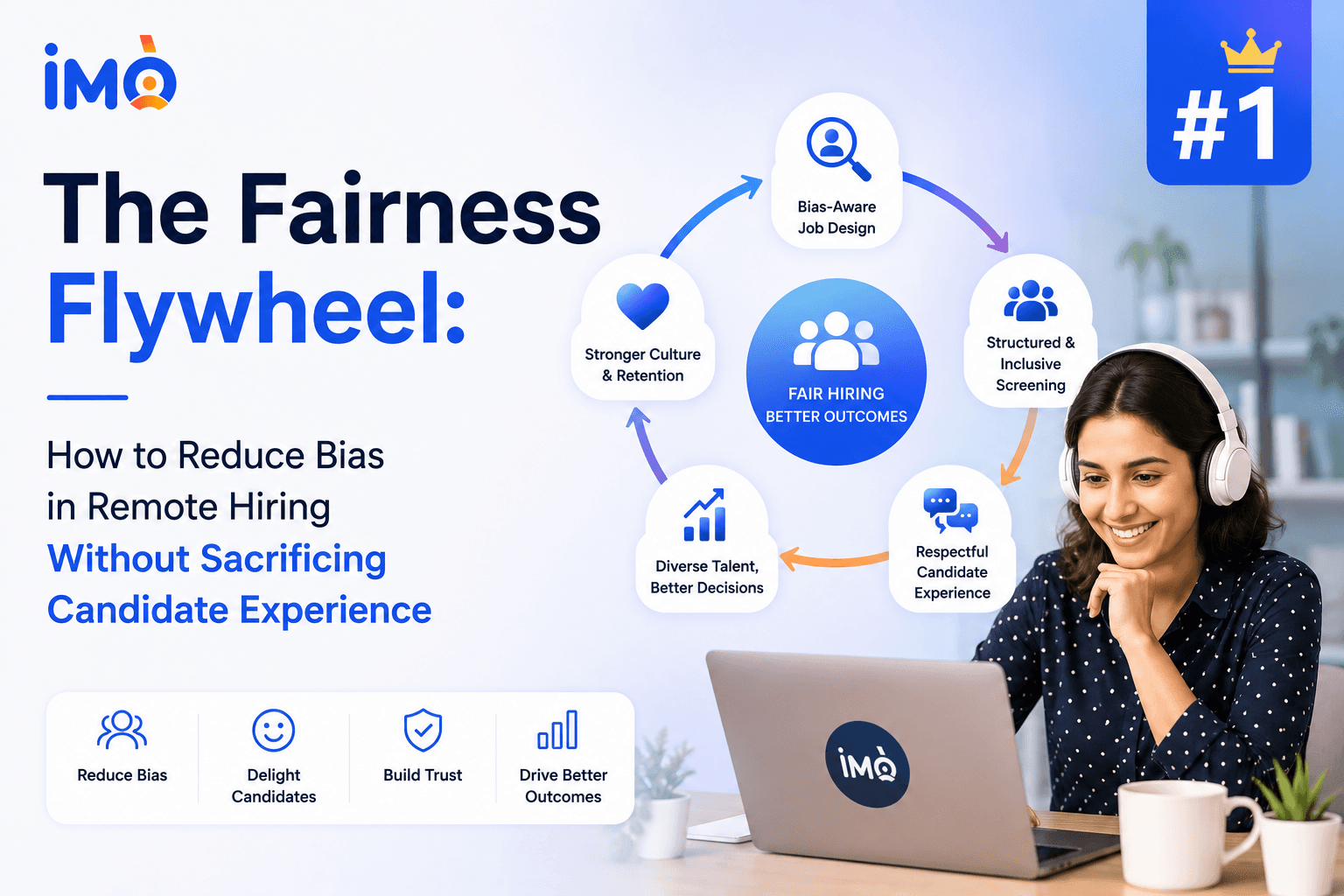
Most hiring teams treat fairness and candidate experience as opposing forces as if slowing down to remove bias inevitably makes the process feel colder or more bureaucratic. That assumption is wrong, and remote hiring is where it breaks down fastest. When teams try to reduce bias in remote hiring while keeping candidate experience strong, they usually discover the two goals aren’t in tension at all. They’re the same lever, pulled from two different directions.
Remote work amplifies certain biases that in-person interviews rarely trigger: accent, home environment, time zone, and internet quality all quietly influence how “competent” or “professional” a candidate seems. But remote hiring also creates new opportunities for structure recorded interviews, written assessments, asynchronous communication that make fairness easier to build in by design. This article compares three common hiring approaches, showing why the fairer option is consistently the one that also delivers a better candidate experience.
Comparison 1: Structured Interviews vs. Unstructured “Get-to-Know-You” Chats
The Bias Risk
Unstructured interviews rely on “gut feel,” which is really just pattern-matching rooted in similarity bias the tendency to rate candidates higher when they remind us of ourselves. In remote settings, this gets distorted further. Similarity bias in remote interviews is compounded by technical variables that have nothing to do with skill: a candidate’s background noise, camera quality, or visible nervousness on screen can be misread as incompetence or lack of confidence, even when the underlying answer is strong.
The Experience Impact
Structured interviews where every candidate answers the same job-relevant questions, scored against the same rubric are predictable. Candidates know what to expect, which lowers anxiety and builds trust in the process. Unstructured chats do the opposite: candidates sense, correctly, that they’re being judged on likability or chemistry rather than substance. That feels arbitrary, and arbitrary feels stressful, especially over a video call where social cues are already harder to read.
A simple, high-leverage tactic: share the interview’s scoring rubric with candidates before the conversation. This isn’t just transparency for its own sake it signals that the process is evaluating skills, not vibes. Platforms like IMÒ Talent are built around this idea, helping hiring teams standardise interview criteria so every interviewer is scoring against the same job-relevant framework instead of improvising. That consistency is what actually operationalizes structured interview process fairness without requiring teams to build a scoring system from scratch.
Comparison 2: Skills-Based Assessments vs. Resume Screening
The Bias Risk
Resumes are proxies for privilege, not proof of ability. A prestigious school name or a recognizable former employer often reflects access to networks, tuition, or referrals more than it reflects skill. This is affinity bias in resume screening: recruiters unconsciously favor candidates whose backgrounds resemble their own or their team’s. Remote hiring makes this worse in a subtler way: credentials are harder to verify from a distance, and experience is easier to embellish on paper when there’s no shared professional network to cross-check claims.
The Experience Impact
Skills-based assessments flip the evaluation criteria from “where have you been” to “what can you do.” Candidates consistently report that this feels more motivating and more respectful they’re being judged on demonstrated ability rather than pedigree. Resume screening, by contrast, is one of the top drivers of negative candidate experience: candidates are rejected before they ever get a real chance to show what they can do, often without knowing why.
The practical fix is a short work-sample test a coding challenge, a mock client email, a data-cleaning exercise used as the first filter instead of the resume. This directly supports the skills-based hiring vs resume screening comparison that increasingly defines fair remote pipelines. Solutions such as Imotalent can support teams in running these skills-based assessments early in the funnel, which reduces reliance on resume-only screening and gives every candidate, regardless of background, a fair shot at proving competence before any human judgment enters the picture.
Comparison 3: Transparent Communication vs. “Ghosting” or Vague Updates
The Bias Risk
Vague timelines quietly favor candidates who have the confidence and social capital to follow up assertively those who feel entitled to ask “any update?” without fear of seeming pushy. Ghosting in remote hiring disproportionately harms candidates who are already uncertain about their fit in a remote-first culture, since silence reinforces the anxiety that they weren’t a strong match to begin with, even when the real cause is internal scheduling delays.
The Experience Impact
Transparent, regular updates even ones that simply say “no decision yet, here’s the new timeline” make candidates feel valued regardless of outcome. Candidates who are rejected with clarity and respect are measurably more likely to reapply for future roles or refer others to the company. Ghosting does lasting damage instead: it shows up publicly on Glassdoor, Reddit threads, and social media, quietly eroding employer brand long after the individual hiring decision is forgotten.
The tactic here is simple and low-cost: send a status update every three to five business days, even when there’s no news, and always include a clear next-step timeline. This single habit closes most of the gap between candidates who feel respected and candidates who feel discarded.
The Remote-Specific Fairness Checklist
Beyond the three core comparisons, remote hiring introduces bias vectors that traditional in-person bias training rarely addresses. A practical remote hiring bias checklist should include:
Accent bias: Use live captioning tools (Otter.ai, Zoom’s built-in captions) during interviews so evaluators focus on the content of answers rather than delivery or accent.
Home setup bias: Explicitly tell candidates that a polished background or professional lighting isn’t required. Judge the work and the answers, not the room they’re sitting in.
Time zone bias: Offer at least two interview slots spanning different time zones, and never penalize a candidate’s scheduling flexibility based on where they’re located. Coordinating this across global candidate pools is exactly the kind of logistical friction that flexible scheduling tools in the Imotalent ecosystem are designed to reduce, making time-zone fairness a default rather than an afterthought.
None of these adjustments require a large budget or a lengthy rollout. They require intent and a willingness to treat remote-specific friction as a fairness issue, not just a logistics problem.
Conclusion: The ROI of Fairness
The pattern across all three comparisons is consistent: the more structured, skills-focused, and transparent option is also the option candidates rate more positively. This is the “Both/And” synergy at the heart of remote hiring fairness isn’t a tax on speed or experience, it’s an investment that pays back in higher offer-acceptance rates, stronger retention, and a hiring reputation candidates actively want to engage with.
You don’t need to overhaul everything at once. Pick one comparison start with structured interviews, or swap your first screening step from resumes to a skills-based task and measure its impact on candidate satisfaction and time-to-hire. The data will make the business case for the rest.