Every hiring manager I’ve spoken to lately has the same complaint. CVs look flawless now, portfolios shine, cover letters read like they were written by a Rhodes Scholar. And yet half the candidates can’t debug a null pointer exception without googling the exact error message. That gap between paper and practice is why remote technical assessment design has become the single most contested part of tech recruitment this year, and honestly, it deserves the attention.
The straight answer to “how do you design a good remote technical assessment” is this: build a test that mirrors the actual job, run it in conditions that don’t penalise a candidate’s broadband speed, and score it with a rubric that two different reviewers would grade the same way. Everything else, the platforms, the proctoring, the live coding rounds, exists to serve that one goal. Miss it and you’re just running an expensive filter that removes good engineers for the wrong reasons.
Why Remote Technical Assessments Matter
AI-Generated CVs Demand Objective Verification
Nobody wants to say it out loud, but recruiters know it. Large language models have made it trivial to polish a CV, write a plausible cover letter, and even fake a GitHub commit history with a bit of effort. Industry observers have flagged this shift, noting that structured digital testing now serves as one of the only reliable sources of truth for verifying actual engineering capability, rather than a candidate’s ability to describe it convincingly. A technical assessment strips away the narrative and asks a blunt question: can you actually build the thing?
Construct Validity Depends On Realistic Conditions
Here’s something a lot of hiring teams overlook. If your assessment measures the wrong variable, it doesn’t matter how rigorous it looks on paper. Ahmed and Sidiq’s 2023 review of online testing environments makes a point that stuck with me: assessments frequently fail not because candidates lack skill, but because uneven internet speeds or device constraints quietly turn a skills test into a bandwidth test. That’s a construct validity problem, and it’s more common than most hiring managers admit.
Poor Design Filters Out Strong Candidates
I’ve seen it happen. A brilliant backend engineer in Lagos gets bounced from a process because the assessment platform required a webcam feed her laptop couldn’t handle reliably. Poor test design doesn’t just waste time, it actively removes qualified candidates before a human even looks at their work. If you’re serious about widening your talent pool, as covered in ensuring quality when hiring remote talent in Africa, the assessment itself has to be built for the realities of distributed connectivity, not against them.
What Are The Core Remote Assessment Methods?
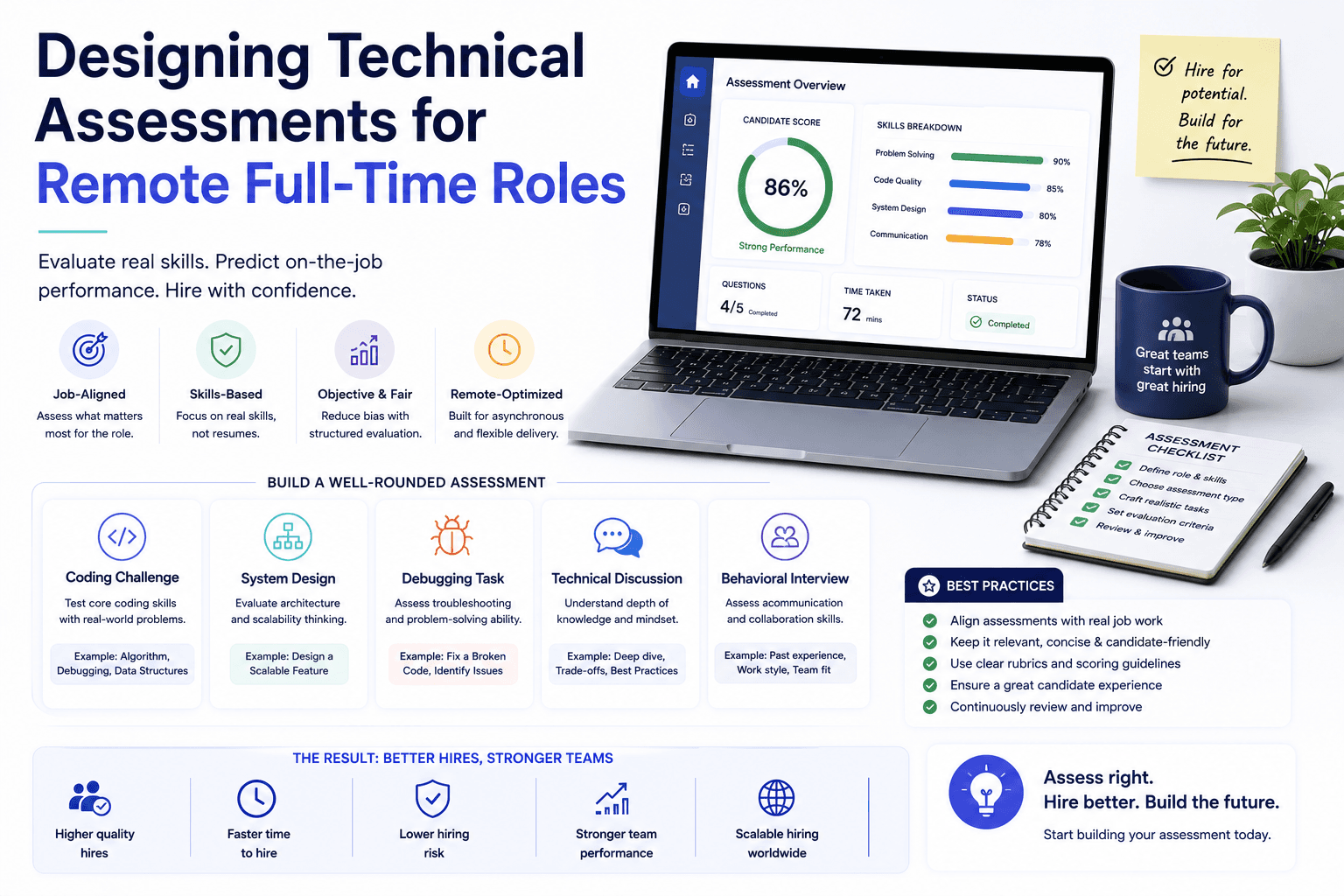
Most tech assessment platforms lean on a handful of formats, and each one tests something slightly different. Knowing which lever to pull matters more than people think.
- Take-home coding assignments, usually a two to three hour project with documentation expectations, work well for evaluating depth and code quality without the pressure of someone watching.
- Live coding sessions, run through tools like CoderPad or shared VS Code instances, reveal how a candidate thinks under mild pressure and how they communicate while stuck.
- Asynchronous work simulations, where candidates respond to tickets, PRs, or mock incidents on their own schedule, replicate actual day-to-day software development far better than abstract puzzles ever could.
- Automated skill screening tests, often multiple-choice or short-answer batteries, filter volume efficiently but should never be the sole basis for hiring decisions.
How Do You Design A Realistic Assessment Scenario?
Mirror Actual Job Tasks
The old whiteboard algorithm question is dying, and frankly it should. Forward-thinking teams have started replacing abstract puzzles with actual work-sample tasks like debugging a failing test suite or extending a half-built feature. If the role involves reviewing pull requests and untangling legacy code, test exactly that. Anything else measures trivia, not competence.
Use Device-Agnostic Test Environments
A good technical assessment platform runs in a browser, doesn’t demand a specific OS, and degrades gracefully on a patchy connection. This sounds obvious until you’ve watched a candidate lose forty minutes because a proprietary IDE plugin wouldn’t install on their machine.
Avoid Testing Infrastructure Instead Of Skill
Timed tests with aggressive countdown clocks punish slow typers and shaky Wi-Fi just as much as they punish weak coding. If the goal is measuring problem-solving skills, build in buffer time and let candidates work in an environment they already know, rather than forcing an unfamiliar tool onto the clock.
How Do You Balance Breadth And Depth?
Screen Broad Skills Early
Early-stage assessments should cast a wide net. Short automated tests covering basic coding fluency, language syntax, and simple logic weed out the clearly unqualified without burning senior engineering time. This is the same principle behind rigorous technical screening used by teams sourcing talent from competitive hiring markets.
Go Deep In Later Rounds
Once a candidate clears the initial filter, depth matters more than breadth. This is where take-home projects, system design discussions, and pair programming sessions earn their keep, because they expose reasoning quality rather than just correct answers.
Match Test Length To Role Seniority
A junior developer test shouldn’t take three hours. A staff engineer candidate probably needs more than a forty-five minute multiple choice quiz to prove anything meaningful. Matching assessment length and complexity to seniority avoids both insulting senior engineers and overwhelming junior ones.
| Seniority Level | Typical Assessment Format | Approx. Time Commitment |
|---|---|---|
| Junior / Graduate | Automated screening + short coding exercise | 45–60 minutes |
| Mid-level | Take-home assignment + live code review | 2–3 hours + 45 min call |
| Senior / Staff | System design + pair programming + async task | 3–4 hours across stages |
How Should You Structure The Interview Process?
Sequence Assessments Across Stages
Spreading assessment across multiple touchpoints, rather than cramming everything into one gruelling test, respects candidate time and gives hiring teams cleaner signal at each stage. This staged approach is something we’ve detailed in async assessments and interviews as a way to improve overall remote-hiring metrics without dragging out the timeline.
Combine Automated Tools With Human Review
Talent analytics expert Lee Cullumbine has argued that the strongest frameworks lean into asynchronous, task-based work simulations paired with structured human touchpoints, rather than relying purely on automated scoring. That combination, machine efficiency plus human judgement, tends to catch things pure automation misses, like a candidate’s ability to justify a tricky architectural tradeoff.
Schedule Code Review Conversations
A short conversation walking through a candidate’s own take-home submission tells you more in fifteen minutes than another automated test ever could. It’s also where cheating, if it happened, tends to surface fast, because a candidate can’t fake understanding of code they didn’t actually write.
How Do You Score Assessments Fairly And Consistently?
Build Structured Rubrics Before Testing
Scoring after the fact, based on gut feeling, is how bias creeps into hiring decisions. A rubric built before candidates even start, covering correctness, code readability, edge case handling, and communication, keeps evaluations grounded in the same criteria every time.
Use Multiple Reviewers For Key Decisions
For senior or high-stakes hires, a single reviewer’s opinion isn’t enough. Two independent scorers working from the same rubric, then reconciling differences, produces far more defensible hiring decisions and reduces the risk of one person’s off day derailing a strong candidate.
Standardise Scoring Across Candidates
If candidate A gets graded by a strict senior engineer and candidate B gets graded by a lenient one, your process has a fairness problem baked in. Standardising rubrics and calibrating reviewers periodically, something outlined in the expert-led technical assessment and cultural fit stage of a proper vetting pipeline, keeps the process defensible.
How Can You Reduce Candidate Stress During Testing?
Limit Intrusive Proctoring
Webcam monitoring, keystroke analysis, and lockdown browsers all sound reassuring on a sales page, but research on remote testing environments consistently notes that heavy-handed proctoring triggers test anxiety and lowers performance, which defeats the entire point of measuring true ability. Use the lightest touch that still protects integrity.
Communicate Expectations Clearly
Tell candidates exactly what tools they can use, how long they have, and what “done” looks like. Ambiguity doesn’t test problem-solving, it just tests anxiety tolerance, and that’s not a skill you’re hiring for.
Give Candidates Reasonable Time Windows
A 48 to 72 hour window to complete a take-home assignment respects the fact that most strong candidates already have full-time jobs. Cramming a test into a same-day deadline filters for availability, not talent.
How Do You Evaluate Communication And Problem-Solving?
Ask Candidates To Explain Their Reasoning
Asking a candidate to narrate their thought process, rather than just submit a final answer, reveals far more. A useful reframe borrowed from qualitative research design is asking candidates to show rather than tell when walking through their solution, since demonstrated reasoning is much harder to fake than a rehearsed explanation.
Observe Behaviour Under Ambiguity
Deliberately vague requirements, the kind real product tickets often have, reveal whether a candidate asks clarifying questions or just guesses and hopes. This single moment tells you more about how someone will operate on a real team than most interview questions ever could.
Review Collaboration During Pair Programming
A 60 to 90 minute pair programming session, run live over shared screen, surfaces teamwork instincts that a solo take-home never will. Watching how someone responds to a suggestion, or admits they’re stuck, says a lot about how they’ll behave three months into the job.
Which Tools And Platforms Suit Your Assessment Needs?
There isn’t one universal answer here, and any platform claiming otherwise is oversimplifying. Choosing between technical assessment platforms comes down to matching the tool to your specific hiring needs, not just picking the one with the flashiest dashboard.
For high-volume early screening, automated skill assessment tests with large item banks reduce recruiter workload significantly. For mid-to-senior roles, platforms supporting live pair programming, shared repositories, and asynchronous project submission tend to produce better signal. Teams that have documented their own evaluation checklists, like the one described in how to vet for value when hiring remote engineers, often blend two or three tools rather than relying on a single all-in-one suite. That blended approach, frankly, tends to age better as your hiring needs shift.
What Questions Do Hiring Teams Still Ask?
Most confusion I encounter boils down to the same handful of worries. Will a take-home assignment scare off senior engineers who already have jobs? Sometimes, yes, if it’s poorly scoped or unpaid. Should you pay candidates for lengthy assessments? If the task exceeds two hours and produces real work product, many teams now offer a stipend, and it’s becoming close to standard practice for senior roles. Is AI-assisted coding during a test cheating? That’s murkier than it used to be, and most teams are landing on the position that using Copilot-style tools is fine as long as the candidate can explain and defend every line, since GitHub’s own research found developers felt more confident in code quality with AI assistance rather than less.
Conclusion
None of this works as a checklist you tick once and forget. Remote technical assessment design is closer to a living process, something you recalibrate every hiring cycle as tools change, candidate expectations shift, and your own team learns what actually predicted success six months later. Get the fundamentals right, realistic tasks, fair scoring, minimal friction, and the rest tends to sort itself out.