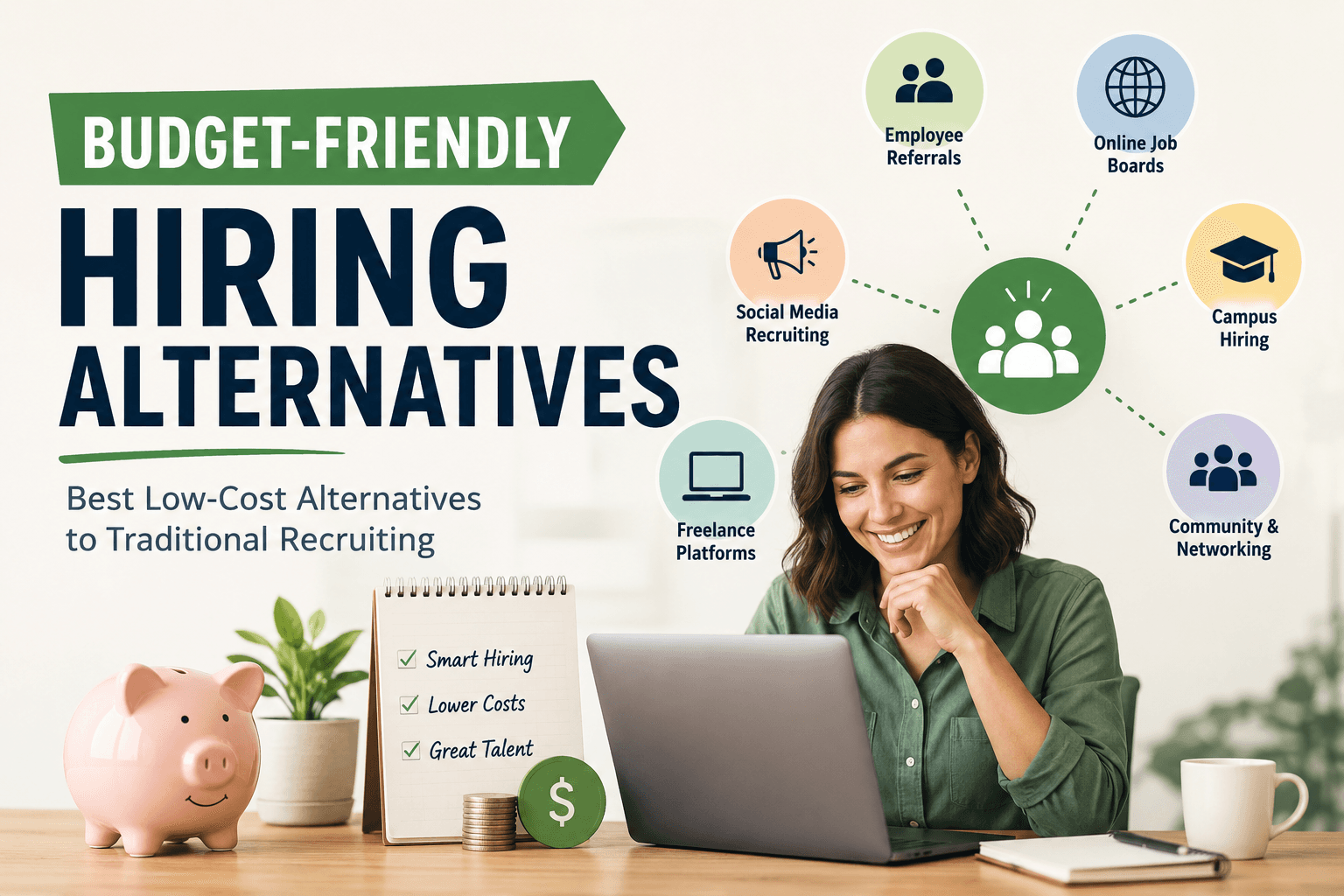
Traditional recruiting agencies charge 20–30% of a new hire’s first-year salary. For an $80,000 role, that’s $16,000–$24,000 often more than a seed-stage startup’s entire quarterly hiring budget. Yet many founders believe they have no choice: either pay the premium or struggle to find talent.
This guide dismantles that false choice. Over the past five years, a new ecosystem of budget-friendly hiring channels has emerged, enabling startups and SMBs to consistently achieve cost-per-hire under $5,000 while maintaining quality and speed. These aren’t corner-cutting hacks they’re systematic alternatives backed by transparent economics and proven sprint plans.
Whether you’re a solo recruiter at a Series A company, a hiring manager wearing multiple hats, or a founder making your first technical hire, this playbook delivers decision frameworks and actionable templates you can implement immediately.
What You’ll Get (and Who This Is For)
This guide is built for seed-to-Series B startup leaders, hiring managers, and solo recruiters who need to hire engineers, GTM roles, designers, and operations talent without burning through runway on agency fees.
Inside, you’ll find:
- Decision frameworks to select the right channel in under 5 minutes
- Transparent cost calculators with real CPH comparisons
- Role-stage recommendations for your first engineer, SDR, or designer
- Sprint plans and templates to launch your hiring process in 2 weeks
The promise is simple: 50–70% cost savings versus traditional agencies, faster time-to-hire, and complete transparency on what you’re actually paying for. No fluff, no vendor pitches just actionable intelligence from day one.
TL;DR — Cheapest Effective Channels by Budget
Not every hiring challenge requires the same solution. Here’s a snapshot of the most cost-effective channels organized by budget tier and urgency level.
Under $1,000 (Fast)
When speed and minimal budget are your constraints, tap into networks you already have access to:
- Employee referrals with structured programs: $500–$1,000 bonus per hire, 3–5x higher retention
- Silver medalists and past candidates: Re-engage candidates from previous searches (zero cost)
- Alumni networks and university portals: Free or low-cost job postings, strong for early-career roles
- Niche Discord/Slack communities: Direct access to specialized talent pools ($0–$200/year)
- Pay-per-applicant job boards: $3–$10 per qualified applicant, no upfront commitment
- Virtual meetups and webinars: Host or sponsor events to attract passive candidates ($200–$800)
$1,000–$5,000 (Balanced)
This sweet spot balances reach, quality, and cost for most startup hiring needs:
- Curated talent networks for trial-to-hire: Pre-vetted candidates with 1–2 week paid trials ($1,500–$4,000 per hire)
- Multi-posting tools and programmatic distribution: Reach 50+ job boards from one interface ($300–$800/month)
- Lightweight ATS: Organize candidates and automate workflows ($100–$300/month, amortize across multiple hires)
- Freelance marketplaces for project-based roles: Convert contractors to full-time after validation ($2,000–$5,000 total)
- LinkedIn Recruiter Lite for direct sourcing: $170/month for 30 In Mails, ideal for 1–2 specialized roles
$5,000–$15,000 (Speed/Quality)
For senior, rare, or compliance-heavy roles where quality and speed justify higher investment:
- Curated remote talent platforms for senior/rare roles: Specialized vetting for niche skills ($5,000–$10,000 per hire)
- Fractional RPO-lite services: Part-time recruiting support without full agency fees ($3,000–$8,000/month, multiple hires)
- Employer of Record (EOR) for cross-border compliance: $400–$600/month per employee plus setup ($1,000–$2,000)
- Specialized tech recruiting platforms: GitHub-sourced engineers, AI/ML talent pools ($6,000–$12,000 per hire)
- Executive search alternatives (flat-fee models): Fixed pricing for leadership roles ($10,000–$15,000 vs. $30,000+ traditional)
Decision Framework: Choose Your Channel in 5 Minutes
Selecting the right hiring channel shouldn’t require a consulting engagement. Use this scorecard to match your situation to the optimal approach in minutes.
Scorecard Factors (Rate 1–5)
Evaluate your current hiring need across these seven dimensions:
- Factor 1 (Low) 5 (High)
- Role scarcity Common skills (customer support, junior sales) Unicorn skills (AI research, blockchain architect)
- Urgency Flexible timeline (2–3 months)Critical need (must fill in 2–4 weeks)
- Interview capacity 2–3 hours/week available20+ hours/week dedicated to hiring
- Budget Under $1,000 total $15,000+ available
- Geo/compliance risk Local only, no cross-border Global hiring, complex compliance
- Manager time Hiring manager has minimal availability Hands-on manager ready to engage
- Brand pull Unknown startup, no inbound interest Recognized brand with organic applicants
Scoring guide: Add up your ratings. A total score of 7–14 suggests internal/low-cost channels; 15–25 points to balanced marketplace approaches; 26–35 indicates you need curated networks or fractional RPO support.
Quick Flow
Use these decision paths to narrow your options instantly:
- Low scarcity + low budget → Start with employee referral programs and free job boards. Leverage your team’s networks before spending.
- High scarcity + high urgency → Invest in curated talent networks or fractional RPO. Speed and quality justify the $5,000–$10,000 range.
- Cross-border + low risk tolerance → Use EOR platforms to handle compliance, payroll, and benefits. Worth the $400–$600/month to avoid misclassification penalties.
- Early-talent focus → Partner with coding bootcamps, university career centers, and internship programs. Lower cost, higher training investment.
- Project/contract work → Start on freelance marketplaces with explicit trial-to-hire agreements. Validate fit before committing to full-time.
Role-Stage Quick Picks
Specific recommendations for common early-stage hiring scenarios:
- First engineer: Curated networks (Imotalent, Hired) + founder’s personal network + bootcamp partnerships. Budget: $3,000–$5,000.
- First SDR: Sales bootcamps (Aspireship, SV Academy) + LinkedIn direct outreach + employee referrals. Budget: $500–$2,000.
- Part-time designer: Freelance marketplaces (Dribbble, Behance, Upwork) with trial projects. Budget: $1,500–$3,000 to convert.
- AI/ML contractor: Specialized platforms (Toptal, Turing) + GitHub sourcing + academic networks. Budget: $5,000–$8,000.
- Support team scale-up: Multi-post to job boards + structured referral bonuses + virtual career fairs. Budget: $500–$1,500 per hire.
True Cost Comparison — Alternatives vs Agencies
Understanding real cost-per-hire requires looking beyond sticker prices. Here’s how to calculate the true economics of each channel.
Simple Formulas
Base CPH formula:
(Job ads + tools + vendor fees + internal hours × loaded rate + incentives) ÷ number of hires
Channel-specific calculations:
- Pay-per-applicant (PPA) job boards: Total applicants × $/applicant ÷ hire rate. Example: 100 applicants × $5 each = $500 ÷ 0.02 hire rate = $25,000 CPH (poor targeting). With better screening: 30 applicants × $8 = $240 ÷ 0.10 hire rate = $2,400 CPH.
- Freelance marketplace: (Hourly rate × trial hours) + platform fee (10–20%). Example: $75/hr × 80 hours = $6,000 + 15% fee = $6,900 total.
- Curated network: Hourly contractor rate × estimated hours + markup (20–40%). Example: $60/hr × 60 hours × 1.30 markup = $4,680.
- Traditional agency: First-year salary × 20–30%. For $80K role: $16,000–$24,000.
- EOR platform: Setup ($1,000–$2,000) + monthly fee ($400–$600) × 12 months = $5,800–$9,200 first year.
Comparison table for $80,000 role:
Channel Cost Per Hire Time to Hire Traditional Agency $16,000–$24,0004–8 weeks Curated Network$3,000–$6,0002–4 weeks Freelance Marketplace (trial-to-hire)$2,500–$5,0003–6 weeks Job Boards + ATS$800–$2,0006–10 weeks Employee Referrals$500–$1,5002–6 weeks
Hidden Costs to Include
Don’t let these easily overlooked expenses derail your budget:
- Candidate churn: If 20–30% of early-stage hires leave within 90 days, factor in re-hiring costs. Budget 1.25x your CPH to account for one failed hire per four successful ones.
- Manager time: Calculate loaded hourly rate (salary + benefits + overhead ÷ 2,080 hours). A $120K manager costs ~$75/hour loaded. Ten hours of interviews = $750 hidden cost per hire.
- Misclassification risk: Treating employees as contractors can trigger $5,000–$50,000+ in penalties, back taxes, and legal fees. EOR platforms eliminate this risk.
- Failed trials: Paid trial periods that don’t convert are sunk costs. Budget for 1–2 failed trials per successful hire when using trial-to-hire models.
- Tool overlap: Audit your stack quarterly. Paying for an ATS, three job boards, a sourcing tool, and a scheduling platform can add $500–$1,000/month in redundant subscriptions.
Conclusion: Your Next Steps
Budget-friendly hiring isn’t about sacrificing quality it’s about deploying capital strategically. By understanding the true economics of each channel and matching your approach to your specific role, timeline, and constraints, you can consistently achieve sub-$5,000 cost-per-hire while building a strong team.
Start here:
- Score your current role using the decision framework above
- Select 2–3 channels that match your score and budget tier
- Calculate your true CPH target including hidden costs
- Launch a 2-week sprint testing your chosen channels with clear success metrics
- Iterate based on data: track applicant quality, interview-to-offer ratio, and time-to-hire
The traditional recruiting agency model isn’t going away, but it’s no longer your only option—or even your best one. With the right framework and a willingness to invest time upfront in building systematic processes, startups and SMBs can compete for top talent without burning through runway on agency fees.
Remember: every $15,000 you save on recruiting is another month of runway, another marketing experiment, or another critical hire. Choose your channels wisely, measure relentlessly, and build hiring systems that scale with your company.