
Introduction
Remote collaboration and self-management show up in interviews as evidence, not promises: the candidate can explain how they communicate without drama, ship outcomes without being watched, and keep themselves steady when the work environment is quiet, ambiguous, and scattered across time zones. If you cannot prove those capabilities with specific stories, you are basically asking the interviewer to “trust your vibes”. They won’t.
Remote work has matured past the novelty stage. Nearly everyone has used Zoom and Slack; fewer people can operate inside a remote work environment where expectations are written down, priorities move weekly, and nobody’s there to “just check in” by hovering near your desk. That gap is why hiring teams keep coming back to the same question: can this person collaborate at distance and manage themselves when the office disappears?
What counts as remote work today?

Fully remote vs hybrid
Fully remote is when the work model assumes you are not coming into an office, full stop, and the remote workforce runs on documentation, asynchronous work, and explicit ownership. Hybrid is a flexible work setting with some office hours, some home days, and the awkward truth that the people who “happen to be in the room” tend to get more context.
A quick reality check:
Work model | What it rewards | What it punishes |
|---|---|---|
Fully remote | written clarity, autonomy, predictable handoffs | vague updates, “I’ll explain on the call” habits |
Hybrid | fast decisions for co-located groups, ad hoc mentorship | information asymmetry, silent politics |
Async-first team habits
Async-first does not mean “no meetings”. It means decisions, priorities, and task management live somewhere durable, so a remote worker in Nairobi or São Paulo is not blocked by a Los Angeles morning. GitLab’s take on asynchronous communication is blunt in the best way: write it down, assume people will read it later, and design workflows for that reality.
If a candidate says they “communicate well” but cannot describe their communication habits in writing, they are guessing.
Common failure modes
Most remote teams don’t fail because people are lazy. They fail because the system is mushy.
Activity masquerades as productivity: lots of chat, little progress.
A communication gap turns small confusion into rework.
Collaboration becomes meeting-heavy because nobody trusts documentation.
If you’ve ever seen a virtual team drown in status meetings, you already know.
Why these skills decide remote performance
Outcomes over activity
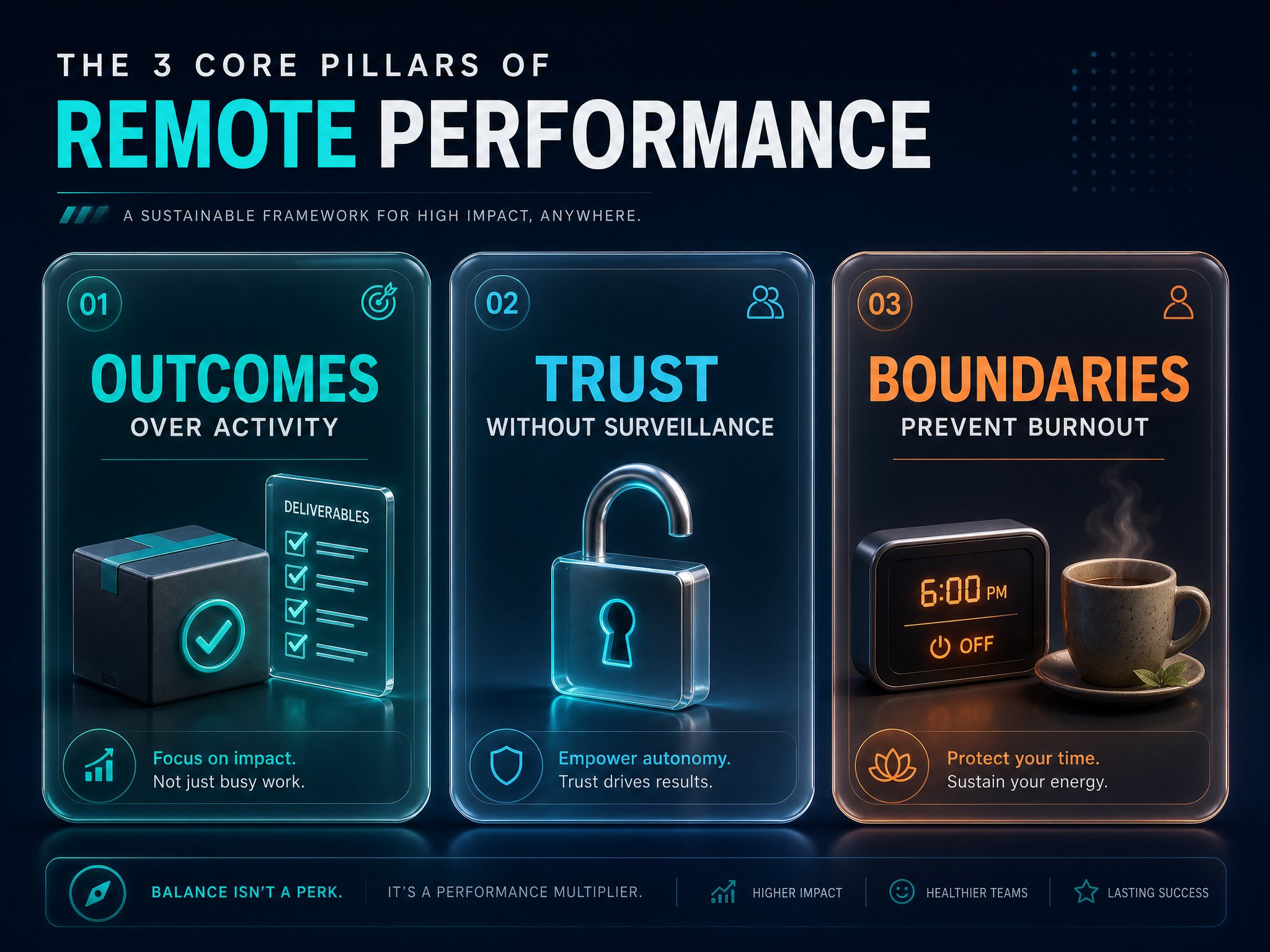
The traditional work environment rewarded presence. A distributed workplace rewards delivery. That is why outcome-based management keeps coming up in research and practice, including Stanford’s work on hybrid productivity that keeps pointing to “it’s not automatically worse”, as long as the management and the employee both adapt.
Trust without surveillance
Leaders keep saying they want trust, then they install tracking software. The numbers betray the anxiety: one round-up of remote productivity statistics cites a big chunk of leaders struggling with trust. You do not interview your way out of trust issues with a single “are you self-motivated?” question. You probe for repeatable behaviour.
If you want a strong remote workforce, you hire for judgement and transparency, not for someone who tolerates being monitored.
Boundaries prevent burnout
Self-management includes stopping. Not just working. Gallup’s State of the Global Workplace keeps surfacing the wellbeing side of performance, and boundary management is a quiet predictor of whether someone will still be effective in six months.
People who cannot detach tend to become brittle, then resentful, then “mysteriously” less productive.
What signals strong collaboration at distance?

Written clarity
Strong collaborators can write an update that makes sense to someone half asleep in another time zone. They use context, decisions, and next actions. They do not hide behind extraversion.
If you’re building a more deliberate remote setting, I’d borrow a few ideas from standardising remote work practices because consistency is what turns “good intentions” into team cohesion.
Feedback and conflict
Remote conflict is sneaky. It looks polite. Then the delivery slips.
Good collaboration skills show up when a team member can describe a disagreement, how they raised it, and what changed. If their story ends with “and then we agreed to disagree”, I get suspicious. Impact matters.
Tool and ritual fit
Tools are not the point, yet they reveal maturity. A candidate who can explain how they used Notion, Jira, Asana, Trello, or a simple shared doc to keep work visible is signalling practical remote work capabilities, not theory. If you want a deeper tour of the landscape, remote collaboration tools is a decent map.
What signals strong self-management?

Time and priority control
Self-management is not “I’m great at time management skills”. It’s: what did you do when three tasks collided, a stakeholder panicked, and you had no manager online?
I like answers that mention personal triage rules, explicit response-time expectations, and some version of a weekly priorities document. You can call it boring. Boring is scalable.
Autonomy and judgement
In smaller teams, this is the whole game. Scrappy companies do not want polished speeches. They want someone who can act with partial information, document the decision, and move. If you’re hiring in that mode, the section on vetting for remote-first soft skills nails the spirit: look for initiative that doesn’t turn into chaos.
Emotional self-regulation
Remote work environments amplify mood. No corridor chat, fewer social cues, more misreads. A strong remote employee can name their own stress signals, how they reset, and how they avoid dumping anxiety into team channels.
That’s emotional intelligence with operational consequences.
Use a six-part interview framework

Role context and constraints
Before you even get to interview questions, define the constraints you’re actually hiring into: time zones, overlap hours, on-call expectations, documentation norms, and which tools are fixed vs flexible. Candidates cannot demonstrate fit if you keep the work environment vague.
Behaviour questions by competency
I’m not a fan of “tell me your strengths”. I want lived-in observations. Metaview’s guide to remote work interview questions leans the same way: behaviour beats aspiration.
Use questions like these, then stay quiet long enough to get detail:
“Talk me through a week where async collaboration broke down. What did you change?”
“How do you decide what gets documented versus what gets handled in a meeting?”
“Tell me about a time you shipped without full clarity. What risks did you log?”
“What boundaries do you set so you do not end up always-on?”
“When you disagree with a colleague in writing, what’s your method for keeping it constructive?”
“What does ‘a good day’ look like for you in a remote role, in measurable outcomes?”
Scorecards, rubrics, notes
Do not freestyle. You will fall in love with charisma.
A lightweight rubric is enough:
Competency | 1 (weak evidence) | 3 (solid) | 5 (strong) |
|---|---|---|---|
Written communication | vague, no artefacts | clear examples | shows docs, decision logs, crisp updates |
Self-management | generic claims | prioritisation method | guardrails, SLAs, proactive risk handling |
Collaboration | “team player” talk | conflict example | feedback loops, repairs, improved workflow |
If you want a stricter hiring flow, the idea of a structured remote screening process is less glamorous than “gut feel”, and that’s why it works.
Ask better questions, spot stronger evidence
When someone is genuinely good at this, they do not just say they’re organised. They describe systems: overlap windows, response-time SLAs, decision logs, and the sort of “one-pager playbook” you can hand to a new remote workforce manager without embarrassment. Oddly enough, that’s also how you spot people who won’t need hand-holding during onboarding, which is why I keep pointing teams to high-impact remote onboarding even outside engineering.
Watch for texture. Dates. Trade-offs. Who they informed. What they wrote down. What changed afterwards.
FAQ
What’s the fastest way to detect weak remote collaboration?
They cannot explain how they work asynchronously, and their examples rely on meetings to create clarity.
Are tools like Asana or Notion required?
No. Tool obsession is theatre. You’re hiring judgement, communication, and task management discipline. Tools just make that visible.
Should you prefer extroverts for remote teams?
No. Extraversion can help in meetings, but strong remote collaboration is usually built on written clarity, predictable workflows, and calm follow-through.
Conclusion
If you want to hire people who thrive outside the office, stop asking for confidence and start asking for proof. Remote collaboration and self-management are not personality traits. They’re repeatable practices, and in a remote work environment, practices are what keep teams shipping when nobody’s watching.