

Most hiring managers assume the remote screening process is just the office one with a webcam bolted on. Swap the conference room for Zoom, and you’re sorted.
You’re not.
Here’s the awkward truth. Remote full-time hires fail for reasons that have almost nothing to do with technical skill and almost everything to do with how they behave when nobody’s watching. A candidate can dazzle you across a forty-minute call and still turn into a black hole three weeks in, when the messages go unanswered and the case log gets updated whenever they feel like it.
So the primary answer to “what should a screening checklist for remote full-time hires include” is this: define the role with painful specificity, then test for self-management, written communication, tool fluency, time-zone overlap, and verified references, using work samples rather than talk-only interviews, and document every decision along the way. That’s the whole game in one sentence. The rest of this piece is the how.
And with 52% of the global workforce now working remotely in some capacity, the odds are high you’re doing this anyway. Might as well do it properly.
What Belongs on a Screening Checklist for Remote Roles?
A remote hiring checklist isn’t a longer version of your in-person one. It’s a different beast because the failure modes are different. In an office, a struggling employee is visible. Someone notices. Remote work strips that safety net away, which is exactly why you screen for the traits that hold up under supervision-light conditions.
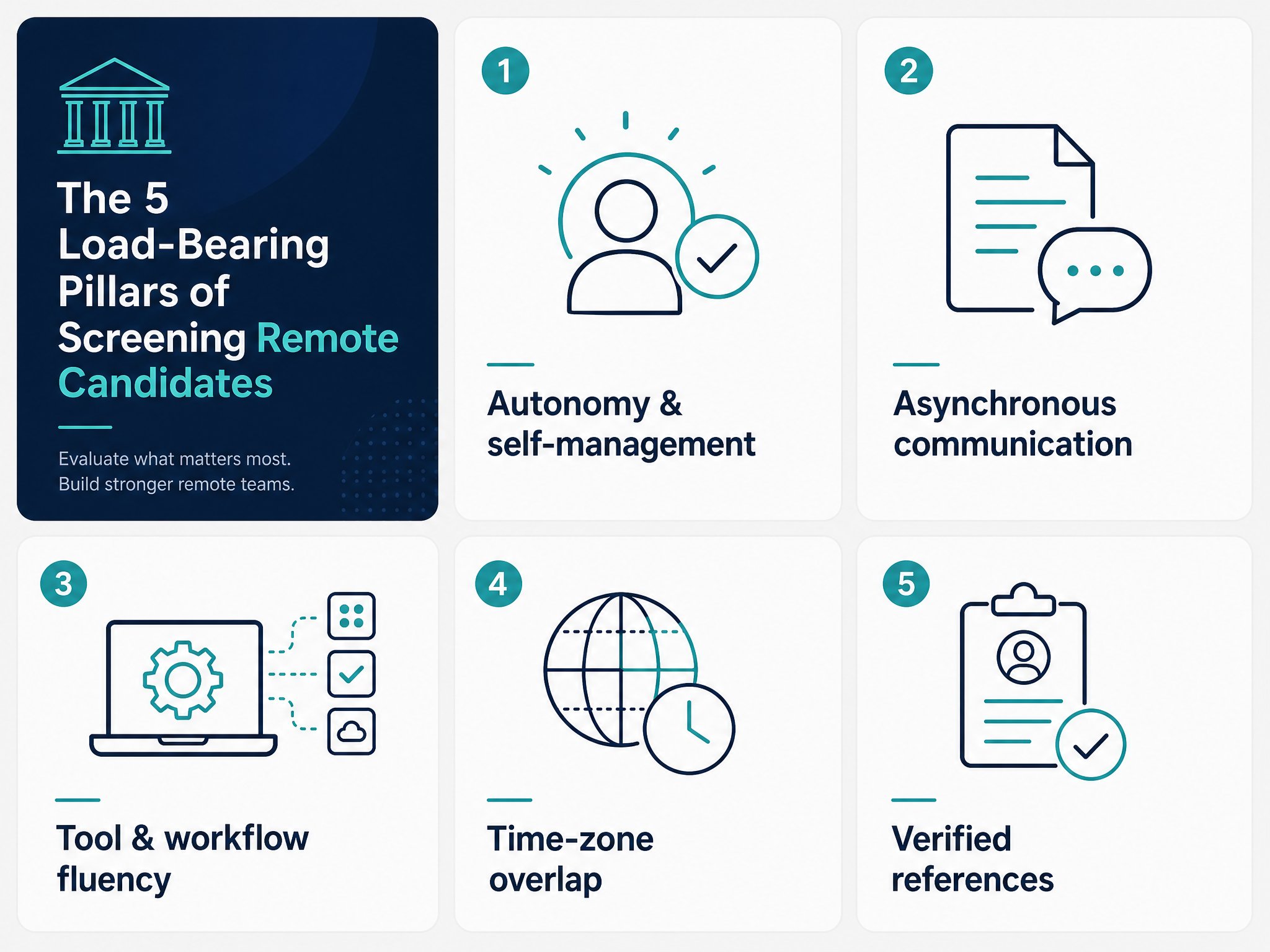
The load-bearing pillars, before we go step by step:
Autonomy and self-management — will they move work forward without being poked?
Asynchronous communication — can they write clearly and respond on a sane cadence across time zones?
Tool and workflow fluency — do they navigate the stack without hand-holding?
Time-zone overlap — enough shared hours for real collaboration, not just handoffs.
Verified references and background checks — because self-provided references carry obvious selection bias.
That’s the skeleton. Now the muscle.
Step 1: Define the Remote Role With Boring Specificity

I mean it. Boring. The vaguer your job description, the more mismatched applicants you attract and the harder every downstream stage becomes. A remote job post that says “self-starter wanted for exciting fast-paced team” tells the candidate nothing and filters no one out.
Core deliverables
Write down what this person actually produces. Not responsibilities, deliverables. “Updates the case log within two hours of every client call” beats “strong attention to detail.” When you get this granular, your screening questions write themselves and your remote scope stops being a mystery to everyone involved.
Supervision-light expectations
Say the quiet part out loud in the remote job title and the posting itself. How often will they check in? Who reviews their output? What decisions can they make alone? A good structured remote screening process starts here, because you can’t assess autonomy against a standard you never set.
Documentation standards
This is the one people skip and regret. Naming conventions, version control, where files live. In documentation-heavy roles, small inconsistencies in how someone labels files or summarises calls snowball into “where on earth is the right document” chaos. Set the standard before you screen for it.
Step 2: Prioritise Self-Management and Autonomy

Physical presence metrics mean nothing now. What matters is whether a candidate self-motivates, and you’d be surprised how early that shows.
Self-motivation signals
Ask about a project they drove with no oversight. Listen for whether they invented the structure or waited for it. The strong candidates describe systems they built for themselves. The rest describe being managed.
Independent problem-solving
Throw a mild ambiguity at them mid-interview and watch. Do they ask three clarifying questions and then act, or do they stall waiting for permission? Remote work rewards the former ruthlessly. The productivity data on remote environments consistently ties output gains to people who manage themselves rather than wait to be organised.
Process discipline
I’ll say it plainly: I’d rather hire someone who nails checklists and consistency than someone who sparkles for thirty minutes. Process discipline is the trait that separates a smart remote coordinator from a reliable one, and it’s the thing an interview alone will lie to you about.
Step 3: Assess Written and Asynchronous Communication

For remote teams, writing is the workplace. If a candidate can’t write clearly, no amount of charm rescues them.
Written clarity
Read their application like it’s a work sample, because it is. Rambling emails predict rambling everything. Look at how iMocha frames remote interviews around testing communication and adaptability directly rather than assuming them.
Async response habits
Send a written prompt and note how they reply. Timely? Structured? Or a wall of text at 11pm with no clear ask? Async response habits are a genuine remote work skill, and you can measure them before you ever hire.
Summary and labelling accuracy
Give them a messy call transcript and ask for a two-line summary plus a file name. This tiny test surfaces the exact failure that wrecks remote workflows. Consistency in how someone summarises and labels is worth more than a polished CV.
Step 4: Test Tech and Collaboration Tool Proficiency
Core stack fluency
Name your actual tools and ask them to walk you through one. Fluency isn’t “I’ve used Slack.” It’s knowing when to thread, when to move to async docs, when to just call.
Virtual workflow handling
Fronted’s take on remote hiring leans hard on simulations over standard interviews, and they’re right. Give the candidate a slice of your real workflow and watch how they route it.
Troubleshooting under ambiguity
When the tool breaks or the record’s missing, what do they do? Freeze, or find a workaround? Ambiguity is the natural habitat of remote work, and troubleshooting under it is a screenable trait.
Step 5: Confirm Time-Zone Alignment and Overlap Hours
A candidate in UTC+2 working for a UK team on GMT has a workable window. A candidate eleven hours out does not, no matter how brilliant. Decide your minimum overlap hours before screening candidates, and be honest about client coverage needs. Four solid shared hours usually beats a dozen scattered ones for an international team.
Step 6: Use Work-Sample Simulations Instead of Talk-Only Interviews
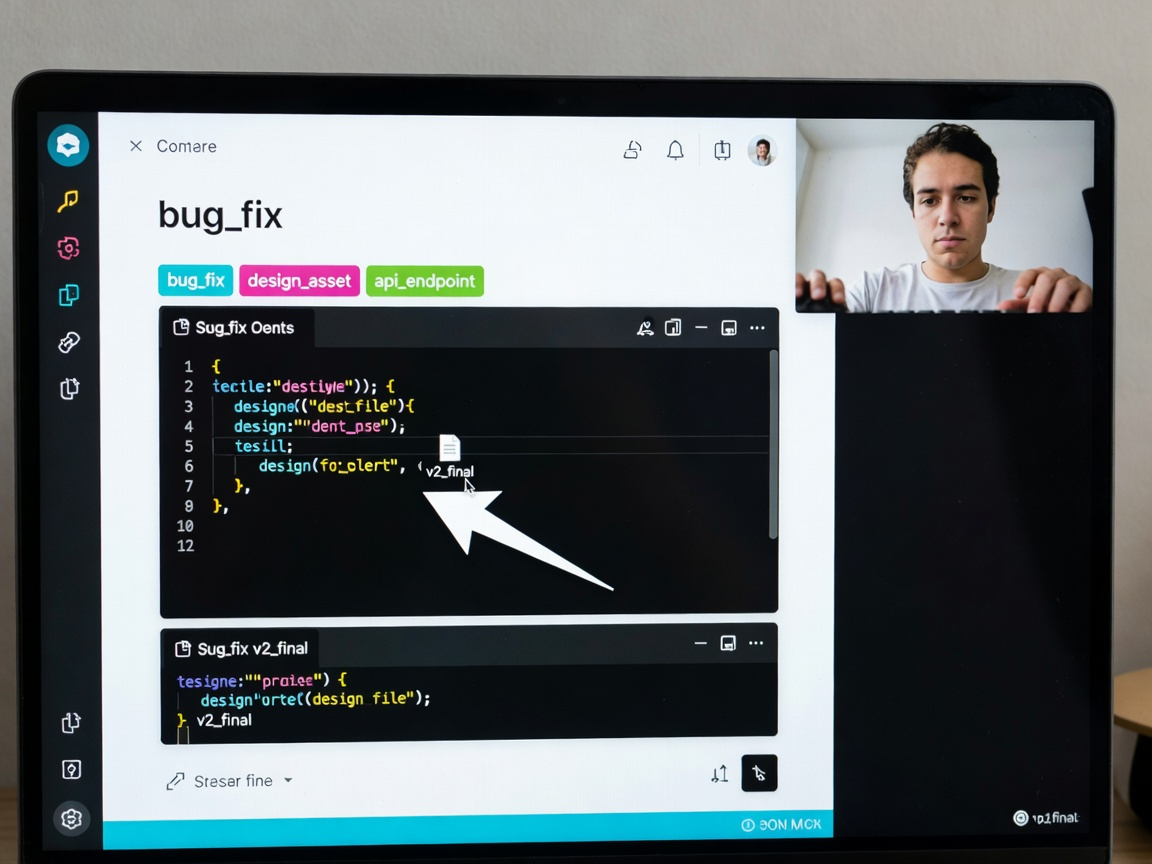
Interviews measure interview skills. That’s it. A work sample measures the job.
The most reliable remote hiring processes replace at least one conversation with a paid, scoped task that mirrors real work. We Work Remotely’s guidance on assessing remote candidates makes the same argument: watch how they handle ambiguity and virtual workflow, don’t just ask about it. This is where you catch the consistency problems no reference will confess to.
Step 7: Build Structured Interview Scorecards
Gut feeling is where discrimination sneaks in and where good candidates slip through. A structured scorecard fixes both. Rate every candidate on the same defined criteria, weighted to the role.
Competency | What you’re scoring | Weight |
|---|---|---|
Self-management | Evidence of unsupervised delivery | High |
Written communication | Clarity, async cadence | High |
Tool fluency | Stack navigation, workflow routing | Medium |
Time-zone overlap | Shared collaboration hours | Medium |
Process discipline | Consistency, checklist adherence | High |
Score independently, then compare. It’s dull and it works, which is the theme of this whole piece. For a deeper dive on running the process consistently, the anatomy of a rigorous remote vetting workflow is worth your time.
Step 8: Run Rigorous References and Background Checks
Here’s my blunt view. If your firm treats a background check as a one-off compliance ritual, you’re just delaying the problem.
The biggest failures aren’t fraud. They’re interpretation mistakes. “No record found” doesn’t mean “clean,” it might mean “not indexed” or “not returned for that search scope,” and treating instant results as conclusive gives you a false sense of certainty. Understand your sequence: what’s verified versus self-reported, how long results take, and crucially what you do when there’s a name mismatch or missing record. Randstad’s process guidance on reference checking flags the selection bias baked into candidate-supplied references, which is why third-party verification earns its keep. If you’re weighing platforms, comparing which remote hiring tools bundle background checks saves a lot of guesswork.
Step 9: Confirm Remote Work Setup and Security Readiness
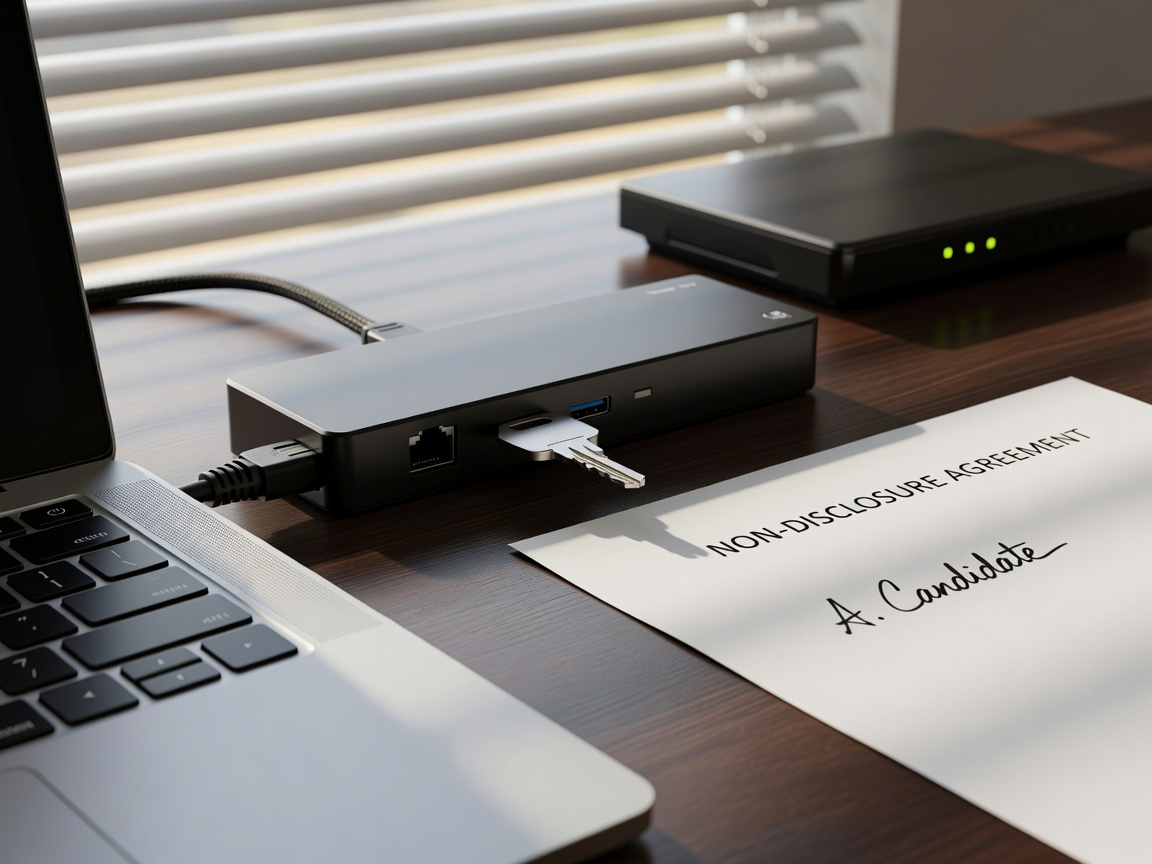
Before an offer, confirm the practical stuff. Reliable connection, secure home setup, NDA signed. ScreenMeet’s security checklist for remote IT onboarding covers validating home setups properly, and it’s worth borrowing from at the screening stage rather than discovering problems in week one. Data protection obligations don’t pause because someone works from their kitchen.
Step 10: Document Every Hiring Decision

Write down why you advanced or rejected each candidate. This isn’t bureaucracy for its own sake. It’s your defence against discrimination claims, your record for when a hire goes sideways, and your feedback loop for improving. A documented recruitment process is one you can actually fix. Tighten your remote-hiring metrics off the back of these notes and every future round gets sharper.
FAQ
How much screening is enough for a remote role? Enough to test autonomy, communication, and real work output with verified references. If you’ve done a work sample and a structured scorecard, you’re most of the way there. There’s a useful discussion on how much vetting depth actually pays off if you want to calibrate further.
Can I skip the work sample for senior candidates? No. Seniority raises the cost of a bad hire, it doesn’t lower the risk of a talk-only interview lying to you.
What’s the single most predictive trait? Process discipline under low supervision. It’s boring. It’s also the difference between a hire that runs itself and one you’re forever chasing.
Conclusion
None of this is glamorous. Defining deliverables, testing async writing, documenting rejections, confirming overlap hours in UTC and GMT. It’s the recruitment equivalent of stretching before you run.
But remote work punishes sloppy process the way nothing else does. The candidate who charms the interview and then quietly falls apart isn’t a rare accident. It’s the default outcome when you screen for presence instead of performance.
So hire with boring specificity. Test the actual work. Verify the actual references. And write down why you decided what you decided.
Do that, and your next remote hire won’t need watching. Which was always the entire point.