Nigeria is no longer just a budget alternative for outsourcing; it is Africa’s most mature tech ecosystem, producing senior-tier expertise that rivals Silicon Valley. When you look to Nigerians developers remote hire options, you aren’t just saving money; you’re gaining access to a tech powerhouse valued at over $15.3 billion. You’ve likely felt the sting of London or New York salary demands, or perhaps you’ve been burnt by unvetted freelancers who disappeared mid-sprint. It’s frustrating to balance rapid scaling with a shrinking engineering budget while worrying about cross-border compliance and local regulations.
We understand that speed and reliability are non-negotiable for your growth. This article reveals how to access Nigeria’s elite tech talent and reduce your engineering spend by up to 60% using a rigorous 72-hour vetting framework. You’ll discover the practical steps to hire a senior developer in under a week, navigate the latest 2026 tax regulations, and build a remote team that stays committed to your mission for the long term. We are moving beyond simple staffing to help you build a high-velocity engineering culture.
Key Takeaways
- Learn why Nigeria’s 100,000-strong pool of engineers is the premier choice for scaling global tech teams in 2026.
- Reduce your engineering payroll by 60% when you choose Nigerians developers remote hire options without compromising on technical rigour.
- Identify senior talent in just 72 hours by using a vetting framework that prioritises live coding and cultural fit over simple CV checks.
- Ensure 100% uptime by learning how elite remote developers use co-working spaces and backup power to bypass local infrastructure challenges.
- Maximise long-term retention by applying managed onboarding strategies that help new hires integrate into your team from day one.
Why Nigeria is the Premier Hub for Remote Developer Talent in 2026
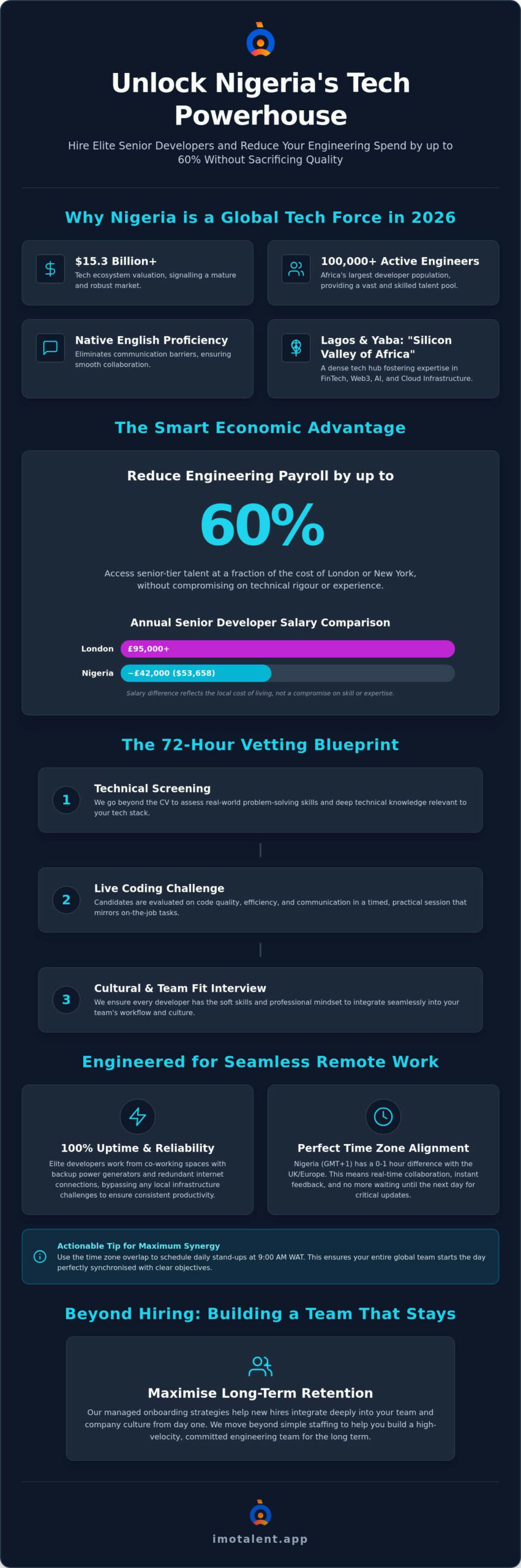
Nigeria has transitioned from an emerging market into a dominant global force for technical expertise. It currently boasts the largest developer population in Africa, with over 100,000 active engineers contributing to a tech ecosystem valued at more than $15.3 billion. This growth isn’t accidental. It has been driven by a massive surge in the FinTech and E-commerce sectors, where developers have had to build robust, high-scale systems for “unicorn” companies like Flutterwave and Interswitch. These professionals are battle-tested, having solved complex problems regarding payment processing and digital logistics at a massive scale. Many CTOs in London and Berlin now prioritise Nigerians developers remote hire strategies because the technical rigour found in Lagos matches that of any European capital. English is the official language in Nigeria, which eliminates the communication barriers often found in other offshore hubs. The Nigerian Tech Advantage is the powerful intersection of massive talent scale, native English proficiency, and the relentless professional grit required to succeed in Africa’s most competitive economy.
The Lagos and Yaba Ecosystem: Africa’s Silicon Valley
Lagos serves as the engine room of this transformation, specifically the district of Yaba. Known as Africa’s Silicon Valley, Yaba is the dense heart of the tech scene, hosting a high concentration of hubs, incubators, and global giants like Google and Meta. This environment fosters a unique culture where developers are accustomed to fast-paced, high-growth settings. It’s no longer just about generalist coding; the talent pool is increasingly specialised. Nigeria now ranks 6th globally for its share of Web3 developers on the Solana blockchain, and you’ll find similar expertise in AI and Cloud Infrastructure. Rapid improvements in Nigeria’s telecommunications infrastructure have ensured that these specialists can stay connected to global workflows without interruption.
Time Zone Alignment for UK and European Teams
One of the most significant benefits of a Nigerians developers remote hire approach is the near-perfect time zone alignment. Nigeria operates on West Africa Time (WAT), which is GMT+1. For UK-based companies, this means there is often zero time difference during the winter and only a one-hour gap during the summer. This allows for real-time collaboration that simply isn’t possible with teams in Southeast Asia or Eastern Europe. There’s no “waiting for the next day” for a critical code review or a bug fix. Your remote staff can be present for every important conversation as they happen.
Actionable tip: Use the 100% time zone overlap to schedule daily stand-ups at 9:00 AM WAT, ensuring your entire global team starts their day with perfect synchronisation and clear objectives.
The Economic Advantage: Comparing Costs and Quality
The biggest hurdle to scaling a modern engineering team is often the sheer cost of local talent. In cities like London or New York, the price of a senior developer has reached a point where it can stifle innovation and drain your runway. Choosing a Nigerians developers remote hire strategy allows you to bypass these inflated rates while maintaining the highest technical standards. You aren’t just saving on base salary; you’re cutting out the massive overheads associated with local hiring. Senior engineers in Lagos are known for their “full-stack” mindset. They don’t just write code; they understand the business logic and the infrastructure required to keep a product running. This versatility means you often get more value from a single hire than you would from a more specialised, more expensive local developer.
Hiring locally comes with “hidden” costs that many managers overlook. Beyond the salary, you’re paying for expensive office space, high national insurance contributions, and complex benefits packages. By shifting to an elite remote model, these costs vanish. You can reinvest those savings directly into your product development or marketing efforts. It’s a strategic move that prioritises output over physical presence.
Salary Benchmarks: Nigeria vs UK and US
In 2026, the gap between local and remote rates remains stark. While a senior developer in London might expect £95,000 or more, a remote senior software engineer in Nigeria typically averages around $53,658 per year. This lower price point isn’t a reflection of lower skill. Instead, it’s a direct result of the local cost of living, where a single person’s estimated monthly costs are roughly $375 excluding rent. The Nigerian government is actively boosting this talent pool through the National Digital Economy Policy and Strategy, which has formalised training for millions of workers through initiatives like the 3MTT programme. Understanding the cost of hiring developers in US vs Africa is now a core part of budgeting for any high-growth company looking to stay lean.
Calculating the Total Cost of Ownership (TCO)
Total cost of ownership goes beyond the monthly payslip. When you build your team, you must factor in recruitment fees, hardware, and management subscriptions. Speed is also a financial factor. Every day a critical role remains unfilled is a day of lost productivity and delayed features. Our 72-hour vetting framework ensures you aren’t wasting weeks on interviews that lead nowhere. By letting IMO Talent handle the administrative burden of cross-border compliance and payroll, you reduce your internal HR costs significantly. If you’re looking to optimise your engineering spend, you might want to see our current pool of vetted developers.
Actionable tip: Factor in the 72-hour hiring speed as a direct cost-saving measure. Reducing your “time-to-hire” by just two weeks can save a mid-sized startup thousands in lost development momentum and recruitment overheads.
The 72-Hour Vetting Blueprint: How to Identify Elite Talent
Speed is a massive competitive advantage in the current tech market. If you take three weeks to interview a candidate, your competitors have already made them an offer. Our framework identifies the right fit in just 72 hours, moving you from a job description to a confirmed hire with clinical efficiency. Most businesses struggle because they rely on manual CV reviews that don’t reveal a developer’s true capability. Instead, we focus on “culture add.” We don’t just want someone who fits into your existing team; we want someone who brings a new perspective and challenges your workflows to improve. A 4-step vetting process is the gold standard for remote hiring because it creates a repeatable, data-driven path to identifying top-tier talent without the typical delays of traditional recruitment.
Step 1: Rigorous Technical Screening
We don’t start with a conversation; we start with code. Every candidate undergoes automated tests for syntax and logic to ensure they meet a baseline of excellence. This is followed by a peer-led technical interview where senior engineers challenge the candidate on their specific stack. It’s vital to assess their ability to explain complex architectural decisions in plain English. We also conduct a deep dive into their GitHub portfolio. We look for code cleanliness, consistent documentation standards, and how they handle pull requests. This ensures that when you pursue a Nigerians developers remote hire, you’re getting an engineer who understands the rigour required for enterprise-level software.
Step 2: Soft Skills and Communication Audit
Technical mastery is useless if the developer can’t communicate effectively in an asynchronous environment. We evaluate reliability, time management, and proactive communication styles. Your remote hires must be comfortable using tools like Slack, Jira, and Loom to keep the team updated without constant supervision. They need to be “remote-ready” from day one.
Actionable tip: During your final interview, ask the candidate: “How do you handle a deadline you know you’re going to miss?” This question tests for transparency and professional accountability. You want a developer who flags issues early rather than someone who “ghosts” when things get difficult.
Step 3: The IMO Talent Matchmaking
We don’t just provide a list of names; we match a developer’s specific experience with your company’s unique challenges. This bespoke approach ensures that remote talent quality assurance is maintained across every placement. We look at the specific nuances of your project to find a developer who has solved similar problems before. The final step is a brief interview with your team to ensure the personal “spark” is there. By the 72-hour mark, you’ll have a senior-level professional ready to integrate into your workflow and start delivering value immediately.
Overcoming Common Challenges in Remote Nigerian Hiring
Infrastructure and legal compliance are the two most common concerns for companies considering a Nigerians developers remote hire strategy. While these hurdles are real, they are entirely manageable with the right approach. Elite talent in Nigeria doesn’t leave their productivity to chance; they treat their work environment with the same technical rigour they apply to their code. You aren’t just hiring a developer; you’re hiring a professional who has already built a redundant system to ensure they stay online. Addressing these challenges early in the recruitment process transforms potential risks into a stable, high-performance partnership.
Infrastructure Resilience: Power and Internet
The “elephant in the room” is often Nigeria’s power grid. However, senior developers who work for international firms operate differently than the general population. They invest heavily in solar inverters and battery backup systems to ensure 99.9% uptime. On the connectivity side, the arrival of high-speed satellite internet like Starlink has been a game-changer. It provides a reliable alternative to local fibre, which can occasionally suffer from maintenance issues. Vetted professionals on our platform are required to prove they have a stable work environment before they ever meet a client. When you interview, ask specifically about their “redundancy plan” for internet outages. A top-tier candidate will immediately list their primary and secondary power and data sources.
Navigating Payments and Compliance
Staying compliant while hiring across borders is vital. As of January 2026, Nigeria has implemented a new tax framework that brings remote workers into the formal system. Individuals present in the country for 183 days or more are considered tax residents. While foreign companies can engage Nigerian talent as independent contractors without local incorporation, you must ensure the payment process is seamless. Paying in USD or GBP is highly attractive to local talent, but it requires a platform that understands the Central Bank of Nigeria’s (CBN) official exchange rates for tax purposes. IMO Talent handles the administrative management and support of these remote workers, ensuring you follow local labour laws without needing a legal team on the ground in Lagos. If you’re ready to bypass the red tape, you can start building your remote team today.
Actionable tip: Use this checklist during your final interview to verify a candidate’s remote work setup:
- Confirm they have a dedicated, quiet workspace.
- Ask for a speed test result from their primary and backup internet connections.
- Verify the capacity of their power backup (e.g., “How many hours can you run your full setup during a blackout?”).
- Ensure they have a professional-grade webcam and noise-cancelling headset for clear communication.
Seamless Integration: Scaling Your Team with IMO Talent
A successful Nigerians developers remote hire journey doesn’t end with a signed contract; it begins there. Many companies fail at this stage because they treat remote staff as “plug-and-play” components rather than vital team members. Onboarding is the most critical phase for ensuring your new engineer delivers value from the first week. Without a structured plan, even the most elite talent can feel isolated, leading to the performance dips or high turnover that many hiring managers fear. We act as your master matchmaker, staying involved long after the placement to ensure the integration is both seamless and productive for both sides.
The First 30 Days: A Best-Practice Onboarding
Setting clear KPIs (Key Performance Indicators) is essential. Your developer needs to know exactly what success looks like in your environment. We recommend assigning a “buddy” from your local team to help with the transition. This person isn’t just there for technical questions; they help with cultural integration and understanding your company’s unwritten rules and communication styles. Regular 1-on-1 sessions are vital to address friction points before they become roadblocks. For a deeper look at these strategies, read our guide on managing remote African developers. This phase is about building trust and ensuring the new hire feels like a core part of the mission.
Actionable tip: Create a “Day One” documentation pack that includes your tech stack overview, Slack channel etiquette, and a list of key stakeholders. Providing this upfront reduces anxiety and lets the developer focus on code from their very first hour.
Why a Managed Talent Subscription is Your Growth Secret
A managed talent solution provides the ongoing support that standard job boards simply ignore. We don’t just place talent and disappear; we monitor performance and ensure long-term engagement. Our platform acts as a bridge between your HQ and your remote Nigerian hub, handling the complexities of local regulations and cultural nuances. High retention rates are built on this foundation of mutual understanding and professional support. This proactive model is exactly why we are considered the premier remote African talent platform. When you choose a managed approach, you aren’t just hiring; you’re building a scalable engineering engine that grows with your business needs. You can scale your engineering team in 72 hours with IMO Talent and start seeing the results of an elite, global workforce.
Build Your High-Velocity Tech Team Today
Nigeria is no longer a best-kept secret in the tech world; it is a strategic necessity for companies that value speed and technical rigour. By tapping into this mature hub, you gain access to battle-tested engineers who are ready to integrate into your workflow immediately. You have seen how a Nigerians developers remote hire strategy can reduce your engineering spend by up to 60% while maintaining the high standards your product demands. Our 72-hour vetting framework removes the risk of poor quality or unreliable hires, ensuring you only meet the top tier of talent.
Scaling your business shouldn’t be slowed down by local recruitment bottlenecks or complex cross-border compliance. With our ongoing talent management and support, we ensure your remote team remains engaged and productive for the long haul. It’s time to stop searching and start building with the right partners. You can start your 72-hour hiring journey with IMO Talent today and secure the senior talent you need to outpace the competition. Your next elite hire is closer than you think.
Frequently Asked Questions
How much does it cost to hire a senior software developer in Nigeria?
The average annual rate for a remote senior software engineer in Nigeria is approximately $53,658. This represents a significant saving compared to UK or US markets, where similar roles often command six-figure salaries. These rates reflect the local cost of living rather than a difference in skill level. By choosing a Nigerians developers remote hire strategy, you can access elite technical expertise while reducing your overall engineering spend by up to 60%.
Are Nigerian developers familiar with UK/US work cultures?
Yes, Nigerian developers are highly attuned to Western work cultures because English is the country’s official language and the primary medium of instruction. Most senior engineers have spent years working with international startups or global tech giants like Google and Meta. They are proficient in standard agile methodologies and use the same project management tools, such as Jira and Slack, that your local team relies on every day.
How do you handle the 1-hour time difference between Nigeria and the UK?
The time difference is negligible and often works in your favour. Nigeria operates on West Africa Time (WAT), which is GMT+1. This means there is either a zero-hour or one-hour difference with the UK, depending on the time of year. This alignment allows for full-day collaboration and real-time communication. You don’t have to worry about the “lag” associated with offshore teams in significantly different time zones.
What tech stacks are most common among Nigerian developers?
Nigerian developers are highly versatile but show particular strength in JavaScript frameworks like React and Node.js, as well as Python and Go. The country has also emerged as a global leader in Web3 and blockchain development. In fact, Nigeria ranks 6th globally for its share of active developers on the Solana blockchain. You will also find deep expertise in mobile development and cloud infrastructure due to the country’s massive FinTech boom.
Is it legal to hire Nigerian developers as remote contractors?
It is perfectly legal and a standard practice for international firms. You can engage Nigerian talent as independent contractors without needing to incorporate a local business entity in Nigeria. As of January 2026, new tax regulations require remote workers to self-assess and file their own returns if they are residents. Using a managed platform ensures that your contracts and payment processes remain compliant with these latest local requirements.
How does IMO Talent ensure the quality of its developers?
We use a rigorous 72-hour vetting framework that goes far beyond a simple CV check. Every candidate undergoes automated technical testing, followed by a peer-led coding interview and a deep dive into their GitHub history. We also conduct a soft skills audit to ensure they can communicate complex architectural ideas clearly. This multi-layered approach ensures that only the top tier of talent is presented to our clients.
Can I hire a full team of developers in Nigeria through your platform?
You can certainly scale from a single hire to a full engineering pod using our placement services. We specialise in matching developers with specific stack experience to your company’s unique technical challenges. Whether you need a front-end specialist or a complete cross-functional team, our platform is designed to facilitate rapid scaling. This managed approach allows you to build a cohesive remote hub in Lagos that functions as an extension of your HQ.
What happens if a remote hire doesn’t work out?
We provide ongoing talent management and support to ensure long-term success, but we understand that sometimes a match isn’t perfect. If a hire doesn’t meet the agreed performance standards during the initial integration phase, we work quickly to identify the friction points. Our managed subscription model includes a replacement process to ensure your project momentum isn’t lost. We stay involved as your talent partner to guarantee that your engineering engine keeps running smoothly.