


Introduction
Regional remote job boards are job sites that filter listings by where an employer can legally hire, which time zones they work in, and which languages and currencies apply. They differ from global boards like We Work Remotely or Remote OK, which pile everything into one feed and leave you to work out who can actually employ you.
Ever spent forty minutes on a cover letter, hit send, then discovered the role was “US-only”?
Yeah. That sting is the whole reason this guide exists.
Remote work was supposed to flatten geography. It didn’t. Tax rules, employer-of-record (EoR) setups, data protection law and plain old time zones still decide who gets hired, and a candidate in Manchester faces different realities from one in Bogotá or Dubai. So the sensible move is to match the board to the place.
I’m writing from Los Angeles, where I’ve watched plenty of US-based recruiters post “fully remote” roles that quietly mean “fully remote, within three states.” Frankly, it’s maddening from the other side too. Below, I’ll walk through what makes a board regional, which ones cover Europe, LATAM and MENA, how to judge them, and how to use them without losing your week to junk.
What Makes a Remote Job Board Regional?
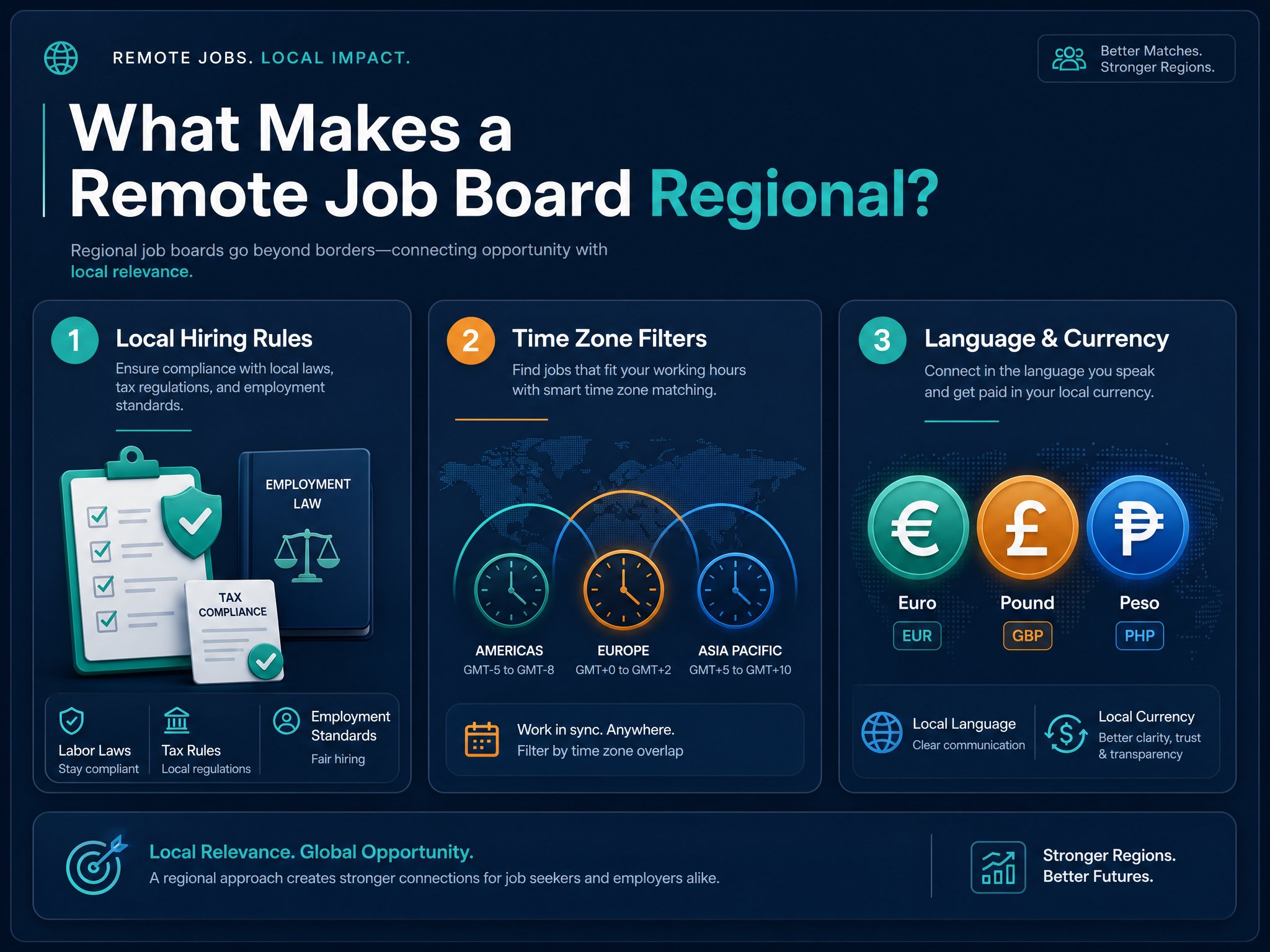
A board earns the “regional” label when its filters reflect real hiring constraints, not just a country dropdown bolted on afterwards. Three things do most of the work.
Local Hiring Rules
Employment law is the quiet gatekeeper. A company hiring in Germany needs a legal entity, or an EoR, or a contractor arrangement that won’t fall foul of false self-employment rules. The UK has IR35 sitting over every contract role like a damp cloud.
Regional boards tend to surface this up front. Listings say “UK payroll” or “EU contractor welcome” instead of leaving you guessing, and Remotify Europe’s comparison of European boards makes the same point: broad US-centric boards rarely filter for UK or EU compliance at all.
Time Zone Filters
“Remote” and “anywhere” are not synonyms. A team in Berlin that holds a 10am stand-up won’t love a hire eight hours behind. Good regional boards let you filter by overlap, such as European time zones, GMT plus or minus two, or Americas working hours, rather than by a vague continent.
Language and Currency
Language matters more than people admit. A French-language customer support role, or a Spanish-speaking sales position, may never appear on an English-only global site. Currency is the same story: being paid in euros, pounds or Mexican pesos changes what a salary figure actually means. Regional boards state it plainly. Global ones often bury it, or skip it.
Which Regional Boards Cover Europe, LATAM and MENA?
Here’s a quick map before the detail. Treat it as a starting point, not scripture, because boards come and go.
Region | Boards worth a look | Why they help |
|---|---|---|
Europe and UK | Remotify Europe, EU Remote Jobs, WFH Jobs | Compliance-aware, European time zone filtering |
Latin America | Get on Board, Torre | Americas time zone overlap, strong tech focus |
MENA | Bayt.com, GulfTalent | Gulf and wider regional employers, local salary norms |
Europe and the UK
For European remote roles, I’d start with EU Remote Jobs and WFH Jobs, then add Remotify Europe’s guidance to decide where else to look. The UK deserves its own search habit. RemoteWorker’s UK guide is useful here, because UK listings often sit in a hybrid grey zone that pure “remote” boards ignore.
That grey zone is real. According to the Office for National Statistics, 28% of working adults in Great Britain hybrid worked in autumn 2024, with London and the information and communication sector leading the pack. Fully remote is the minority. Plan accordingly.
Latin America
Get on Board and Torre suit tech people in the Americas. The big draw is time zone overlap with North American employers, which is why a lot of software and UX designer hiring for US startups flows through LATAM boards. Developers and designers working asynchronously across the continent face far less friction than someone trying to cover a San Francisco morning from Warsaw. If you’re hiring rather than applying, our guide to remote hiring across time zones goes deeper.
Middle East and North Africa
Bayt.com and GulfTalent dominate here. They’re older, more traditional job sites than the slick remote-first boards in Europe, and that’s both good and bad. Good, because employer reach in the Gulf is excellent. Bad, because “remote” is often a tag on a handful of roles rather than the core product. Finance, banking and tech roles in hubs like the UAE are where remote-capable listings turn up most.
How Do Regional Boards Differ from Global Boards?
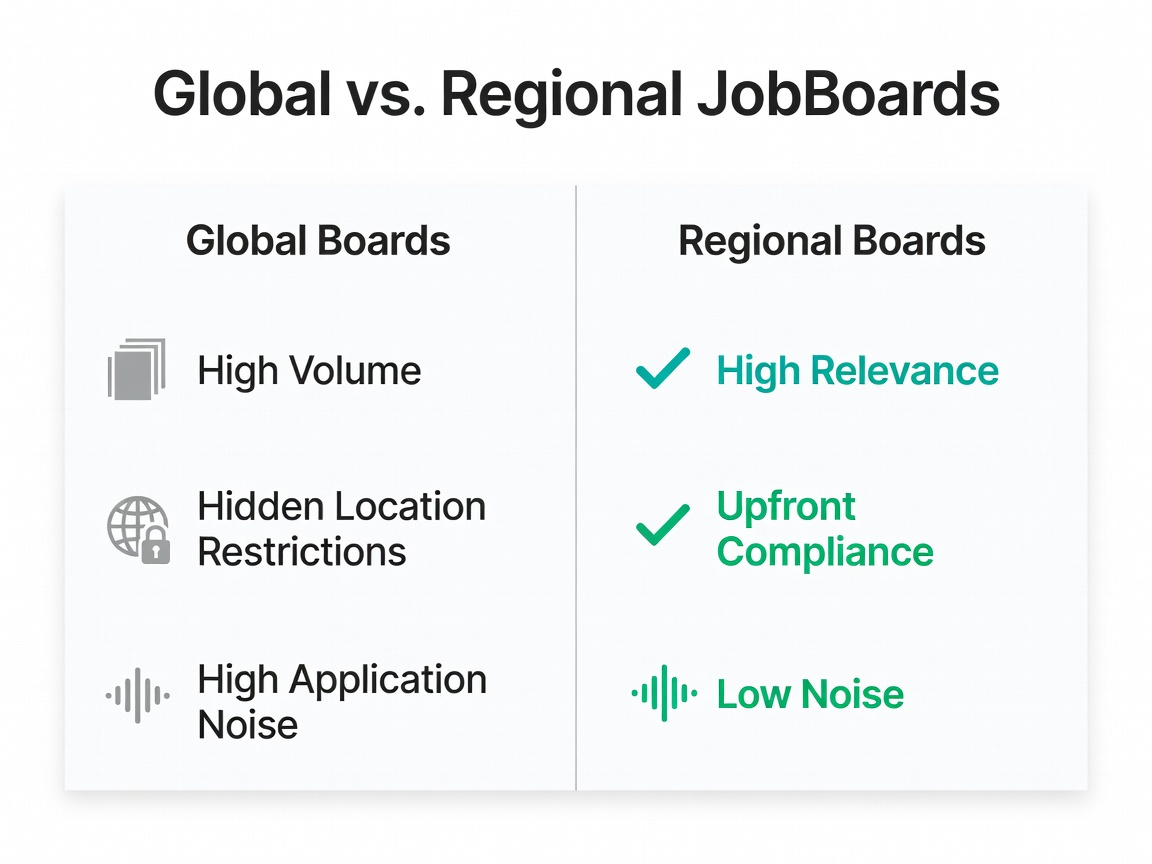
Short answer: global boards sell volume, regional boards sell relevance. Neither is wrong. They just do different jobs.
Volume vs Relevance
We Work Remotely and Remote OK are brilliant for brand visibility and for seeing what the market is paying. Thousands of postings, every category from engineering to marketing. But volume isn’t the same as fit. A regional board might show you a tenth of the jobs, and nine in ten of them are ones you can actually take.
Hidden Location Restrictions
This is the killer. On global boards, “remote” frequently hides a restriction in the small print: US only, EU only, must overlap with Pacific time. JobGlance’s roundup of remote boards flags exactly this, noting that candidates often discover geographic limits late in the process. You’ve already sunk the effort by then.
Application Noise
More listings means more applicants per role, and more recruiters wading through irrelevant CVs. Regional filtering cuts that noise on both sides. Applicants stop wasting time. Recruiters see fewer mismatches. It’s a quieter, kinder system, though not a perfect one.
How Do You Evaluate a Regional Job Board?
I’d judge any board on three things, in this order.
Job Quality
Open ten listings at random. Do they name a salary band? Is the job description specific about the stack, the team, the reporting line? Vague, copy-pasted postings are a red flag. Also check how many are genuinely remote versus “remote-friendly” hybrid roles dressed up for clicks.
Employer Reach
Look at who’s posting. Recognisable employers, a mix of startups and established firms, and spread across sectors like finance, tech and healthcare suggest a board recruiters actually pay for. If every listing comes from one agency, walk away.
Legitimacy Signals
Real boards show company names, link to company career pages, date their postings and remove stale ones. Check for a way to report a listing. If a board lets anyone post anonymously with a Gmail address, treat everything on it as suspect.
Where Do Regional Remote Jobs Cluster?
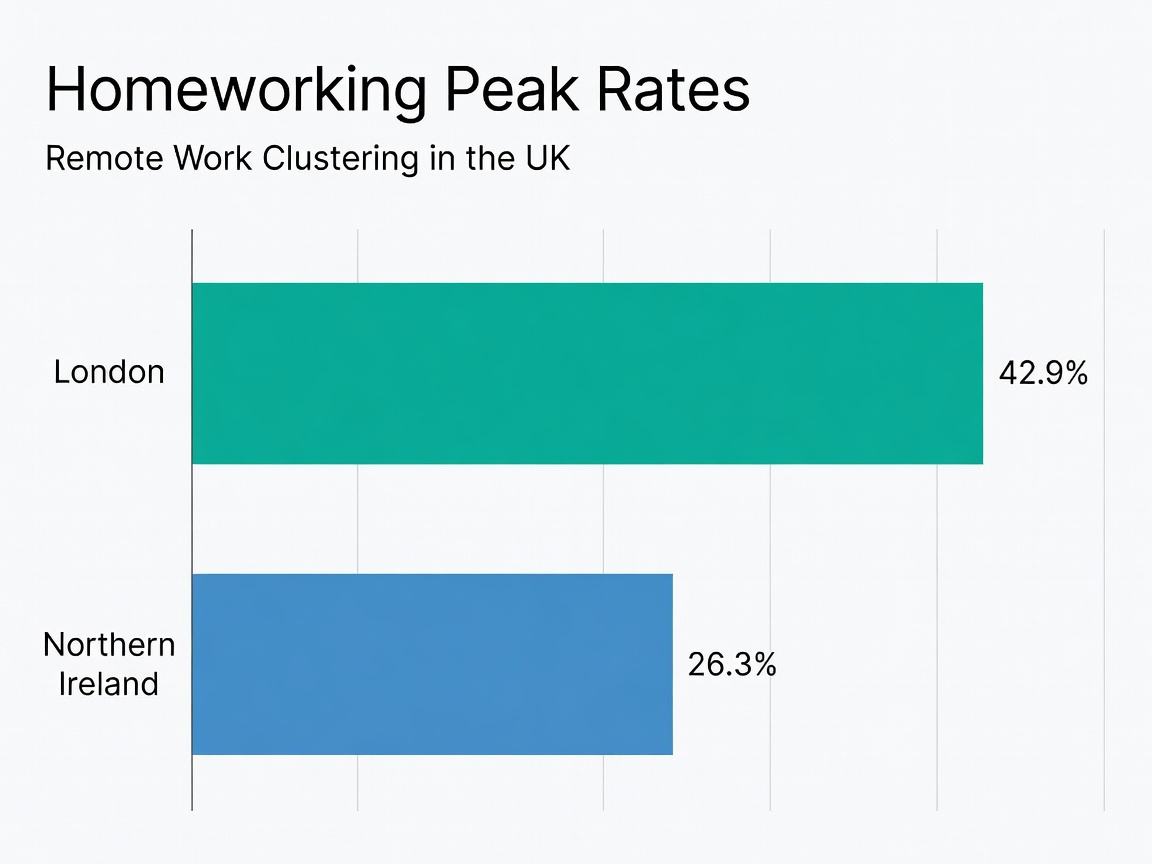
Hard truth: a regional board doesn’t fix geography. Remote postings still bunch around big hubs. London, Manchester, and EU capitals like Berlin, Paris and Amsterdam supply a disproportionate share, because their universities and business ecosystems produce the exact digital skills remote employers want.
Oxford researchers found as much, with remote work failing to bridge the urban-rural divide. The ONS data backs the pattern up too: homeworking peaked in London at 42.9% against 26.3% in Northern Ireland.
So use a regional board to strip out nonsense, not to pretend you’ll suddenly find a Shoreditch salary while living three hours from a city. Realistic expectations save a lot of heartache.
Search and Filter Listings Effectively

Start narrow. Filter by country or region first, then by time zone, then by contract type. Only then search by job title. People do this backwards and drown.
A few habits that pay off:
Search several job titles, since a “UX designer” might be listed as “product designer” or “interaction designer”.
Check whether the board separates fully remote from hybrid.
Read the location line twice. “Remote (EU)” and “Remote (Europe)” can mean different things.
Sort by newest, because roles older than two weeks have usually been half-filled.
Don’t skip company career pages either. Many employers post there first, then syndicate to boards a few days later.
Set Up Alerts Without Missing Roles
Alerts are the closest thing to a free assistant you’ll get. Build two or three tight ones per board rather than one sprawling alert, so you can tell what’s working.
Use the exact phrases recruiters use in titles. Add your region and time zone terms. Set the frequency to daily, not weekly, because good remote roles can collect hundreds of applicants within a couple of days.
One oddity worth knowing: some boards only alert on keywords in the title, not the description. Test it. Create an alert, look at what it sends, then adjust.
Spot Scams Before You Apply

Remote work is catnip for scammers. The standard tells are depressingly consistent: pay far above market for easy tasks, interviews run entirely over messaging apps, requests for bank details or “equipment fees” before a contract, and recruiters using free email domains.
Cross-check. Find the company’s own career pages and see whether the role appears there. Search the recruiter’s name on LinkedIn. Look up the company on Companies House if it claims to be UK-registered. If something smells off, it usually is.
Never pay to apply. Ever.
How Can You Combine Multiple Boards?
Three boards is the sweet spot for most people. One regional board matching your location, one global board for volume and benchmarking, and one niche board for your sector, whether that’s design, finance or engineering.
Keep a simple spreadsheet. Record the role, board, date and status, because the same job will appear on three sites and you’ll otherwise apply twice. Duplicate applications make recruiters wince.
If you’re also weighing curated options, our breakdown of how job boards compare with curated hiring platforms is worth a read, and the guide to the best remote tech job boards covers the global end of the stack.
FAQ
Are regional remote job boards better than global ones? Usually, for fit. They filter for legal hireability and time zones, so you waste less effort. Global boards still win on volume.
Which board is best for remote jobs in Europe? EU Remote Jobs and WFH Jobs are solid starting points, and Remotify Europe’s comparisons help you choose further.
Do regional boards fix the urban-rural gap? No. Listings still cluster in London, Manchester and EU capitals.
How many boards should I use? Two to four. More than that and you’re just creating admin.
How do I know a listing is legitimate? Verify it on the employer’s own career pages, check the recruiter’s identity, and never pay anything upfront.
Conclusion
Regional boards won’t hand you a dream job. What they do is stop you chasing roles you were never allowed to take, and that alone is worth the switch.
Pick one for your region, pair it with a global board, set tight alerts, and stay sceptical about anything that sounds too easy. Then keep going.
So which region are you hunting in?