

Introduction
Regional remote job boards are job platforms that sort listings by where you can legally and practically work, usually by country, continent or time zone, rather than just by the word “remote”. They matter because “remote” is a slippery label. A role marked fully remote can still demand residency in one country, overlap with Central European Time (CET), or a local employment contract. Regional boards cut through that fog. They won’t hand you a job, though, and their biggest weakness is size.
Ever applied to forty “remote” roles and heard back from none? Frequently the problem isn’t your CV. It’s that half of them were never open to you.
That’s the gap regional boards fill. Let’s look at how they work, which ones deserve your time, and how to stack them with bigger platforms without drowning in tabs.
How Do Regional Remote Job Boards Differ From Global Ones?
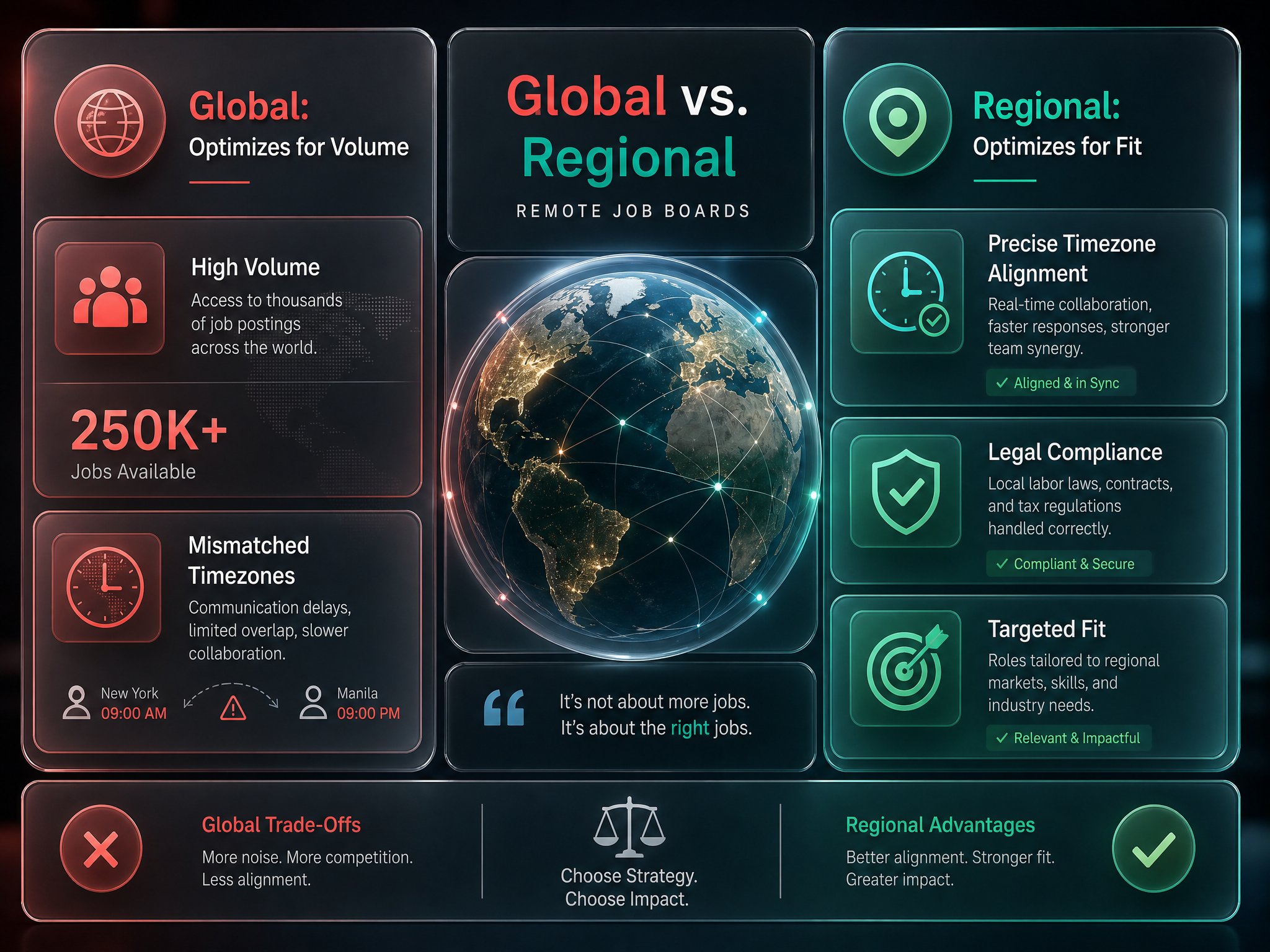
A global board optimises for volume. A regional board optimises for fit. Same idea, different trade.
Filter Precision
On a global platform, the location filter is often an afterthought: “Worldwide”, “Americas”, “Europe”, then a pile of listings that ignore it. Regional boards flip that. The entire catalogue assumes you’re in, or hiring in, a defined area. A board built for Europe doesn’t need an EU filter because everything on it is already pointed that way.
Timezone Fit
Timezones are where remote work quietly falls apart. A team in Berlin and a hire in Lisbon share an office clock, more or less. A team in Berlin and a hire in Manila share about two awkward hours. Regional boards bake this in, so you stop discovering the overlap requirement in the third interview.
Compliance Signals
Hiring across borders is a legal thing before it’s a cultural thing. Tax residency, employer of record arrangements, statutory notice periods. Good regional boards surface these cues early. Watch for:
Explicit “must be resident in” wording rather than vague “EU-friendly” phrasing
Stated working-hours overlap, such as “CET plus or minus two hours”
Mention of contractor versus employee status
Whether the employer sponsors relocation or works with an employer of record
If a board never asks employers to state any of this, it’s a global board in a regional costume.
Why Do Region-Specific Boards Matter?

Job Seekers
Time. Mostly time. Independent reviewers point out that filtering by region saves people from applying to global roles that secretly carry strict legal or onboarding requirements. I’ve watched friends burn whole weekends on that. A UK-focused board beats scrolling past a wall of US-only listings every single time.
Employers
For employers, the draw is a cleaner candidate pool. Post a role on a European board and you’re talking to people already living in compatible time zones, often already familiar with local labour rules. Less screening, fewer dead-end conversations about visas.
Trade-Offs
Now the unglamorous bit. Small databases are the dealbreaker. SaaSHub’s comparison of regional and global boards notes that single-region platforms carry far fewer postings than giants, and fewer postings means the same applicants chasing the same roles. Brand recognition is thinner too, so fewer big-name employers bother posting.
Regional boards are useful filters. They aren’t a secret cheat code. I wouldn’t pay a premium just because a site slaps a region and “remote” on the label.
Which Remote Job Boards Suit Each Region?
Here’s my honest read, with the caveat that boards change owners, pricing and quality faster than most of us update bookmarks.
Region | Boards worth checking | Best for |
|---|---|---|
Europe | EuropeRemotely, Remote Europe, Wantapply, Jobicy (EU filter) | Tech and product roles inside European time zones |
United Kingdom | UK-focused remote boards, plus UK filters on larger sites | Avoiding US-only listings |
Latin America | Remotive and We Work Remotely region filters | US-aligned time zone roles |
Asia-Pacific | Global boards with location filters | Broad search, since niche boards are thin |
Europe
Europe has the strongest niche scene. EuropeRemotely and Remote Europe are the obvious starting points, built around European time zones and, usefully, around the practical question of where employers will actually hire. Wantapply positions itself as a verified board with listings spanning Europe, the Americas and Asia, which helps if you’re trying to dodge ghost jobs. Remote OK and Jobicy are broader, but Jobicy’s EU filter earns its keep.
Europe isn’t one market, mind you. Germany, the Netherlands and Spain each have different hiring cultures, salary ranges and contract rules. Portugal and Cyprus attract plenty of remote professionals for tax and lifestyle reasons, and many employers there lean on contractor arrangements. If you’re looking for remote work in southern or western Europe specifically, read the fine print on each listing rather than trusting the banner.
United Kingdom
The UK is its own beast post-Brexit. Many “European” boards treat Britain as an afterthought, and plenty of “EU-only” roles exclude UK residents entirely. Seek out UK-specific boards or at least UK location filters. Check whether a role means employment through a UK entity or contractor status, because the paperwork differs sharply.
Latin America and Asia-Pacific
Here I’ll be blunt: dedicated niche boards are thinner. For Latin America, most useful roles sit on global platforms where US-based employers want overlap with North American hours, so Remotive’s US listings and similar filters do the heavy lifting. Asia-Pacific is even more fragmented, with language and time zone differences making a single board unlikely to cover it. Use global boards with strict location filters and add local-language sites where you can.
What Makes a Good Regional Job Board?
Vacancy Quality
Look at a dozen listings. Do they include a proper job description, salary ranges, clear responsibilities, a named employer? Or is it recycled copy with a logo? Quality shows in specificity. Boards that curate, rather than just scrape, tend to have fewer expired posts.
Regional Relevance
Does the listing say where you can work, in plain words? A board that lets employers write “remote” and nothing else isn’t regional at all. Relevance also means the right industries for the area: technology and engineering dominate European remote work, for example, while Latin America skews towards customer-facing and developer roles tied to US hours.
Ease of Use
Boring but vital. Can you filter by country, seniority and time zones without a subscription? Do email alerts work? Does applying take you straight to the employer or through three redirects? If the interface fights you, you’ll stop using it within a fortnight.
How Do You Choose the Right Board?
Match Your Region
Start with where you can legally work, not where you’d like to. A candidate in Cyprus targeting German employers needs a board that makes the German side clear, whether that means CET overlap or contractor rules.
Check Listing Volume
Count the live listings in your category before you sign up for anything. Fifty fresh roles in your field is workable. Five, half of them older than a month, isn’t. Larger aggregators like FlexJobs report strong growth in remote postings, which is a reminder that volume sits mainly with the big players.
Weigh Cost Against Value
Free listing options exist on many boards, so paying should have a reason. Subscription sites such as FlexJobs screen for scams, which is real value if you’ve been burned. A small regional board charging a subscription for a few dozen listings? Hard pass. For employers, compare pricing and job packs against how many qualified applicants a single post actually pulls in, and be honest about your hiring budget.
How Do You Combine Boards Effectively?

Use Regional Boards for Leads
Treat EuropeRemotely, Remote Europe and their cousins as lead generators. Scan them daily or set alerts, note employers who hire in your zone, then go to those companies’ own careers pages. Regional sites are a shortcut around irrelevant listings, not your whole job hunt.
Add Global Boards
Then widen out. Global boards carry more large tech names and more roles overall, and some of those quietly accept applicants from your area. If you’re hiring, our guide to remote tech boards covers the global side, and it’s worth understanding the difference between talent marketplaces and job boards before deciding where money goes.
Track Applications
Boring again, but it works. Keep a simple sheet with:
Board and date found
Stated location and time zone requirements
Application date and follow-up date
Outcome
After a month, the numbers tell you which board earns its place. Drop the rest without guilt.
How Can Employers Attract Regional Talent?

Say where you hire. Actually say it: “Netherlands or CET plus one hour, employee contract via our Dutch entity.” That one line does more screening than any questionnaire.
Beyond that, post on one regional board and one global one, include salary ranges, and use any employer branding page to show what remote teams really look like day to day. Candidates in Europe in particular tend to distrust listings with hidden pay. If you need curated rather than open boards, the comparison of remote hiring platforms lays out where each model wins. And if developers are your target, there’s a breakdown of the best regions to hire worth a read.
FAQ
Are regional remote job boards better than global ones? Better at filtering, worse at volume. If you’re in a specific region, they cut wasted applications. They rarely replace a global search.
Which remote job board is best for Europe? EuropeRemotely and Remote Europe are the usual starting points, with Wantapply and Jobicy as useful additions. Check each listing’s residency and time zone rules anyway.
Do regional boards cost money? Many are free for job seekers, while employers often pay per post or via job packs. Be wary of charging seekers for small databases.
Is it worth using more than one board? Yes. Two regional boards plus one or two global ones is enough. More than that and you’re just creating admin.
Conclusion
Regional boards earn their place by saving you from irrelevant listings, not by being bigger or better stocked. Use them to find leads in your time zone, then search broadly, track what works, and don’t pay for a label. Who knows, the best role might turn up on the dullest board of the lot.