
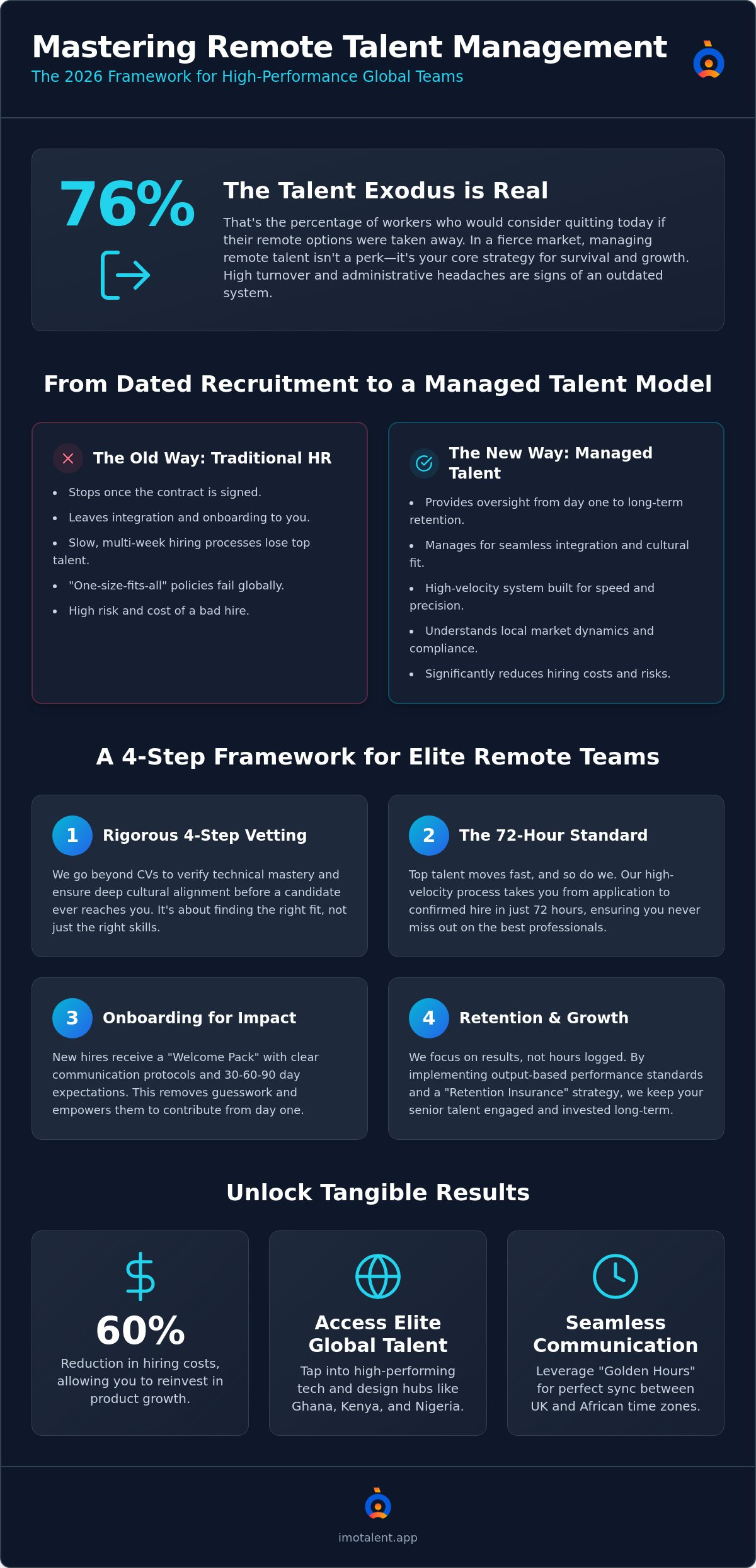
Did you know that 76% of workers would consider quitting today if their remote work options were removed? It’s a stark reality for 2026, where the competition for top-tier skill sets is fierce. If you’re struggling with high turnover or the administrative weight of tracking performance across time zones, you aren’t alone. Mastering talent management remote workers is no longer just a perk; it’s a high-velocity strategy for businesses that refuse to settle for mediocrity. You need a system that handles the complexities of global compliance, such as the latest IRS withholding rules, without slowing down your operations.
We agree that building a distributed team should feel like a growth lever, not a logistical burden. You deserve access to elite professionals without the friction of cultural misalignment or soaring overheads. This guide promises to show you how to build, integrate, and retain elite remote teams by bridging global standards with the unique strengths of the African talent market. We’ll walk through a streamlined management framework that delivers a 60% reduction in hiring costs and ensures your senior tech talent remains loyal and productive for years to come.
Key Takeaways
- Transition from basic hiring to a strategic “managed talent” model that prioritises oversight from the first day through to long-term retention.
- Discover how a 72-hour integration window and a 4-step vetting process can eliminate the administrative lag usually found in global hiring.
- Learn to master talent management remote workers by leveraging “Golden Hours” for seamless communication across UK and African time zones.
- Access high-performing talent in hubs like Ghana and Kenya to reduce hiring costs by 60% without sacrificing technical quality.
- Implement a “Retention Insurance” strategy to keep your senior tech and design experts engaged and invested in your long-term product growth.
What is Talent Management for Remote Workers in 2026?
Talent management has evolved from a passive HR function into a high-speed operational strategy. In 2026, it represents the complete oversight of a distributed workforce, covering everything from the initial vetting process to long-term career growth. When we discuss talent management remote workers, we’re talking about a proactive framework designed to keep elite professionals engaged across borders. It’s no longer about just filling a seat. It’s about building a sustainable ecosystem where global talent thrives.
This year marks the definitive rise of the “Managed Talent” model. Traditional recruitment often stops once a contract is signed, leaving the heavy lifting of integration to the client. Managed talent is different. It focuses on how a new hire fits into your culture and workflow from day one. You aren’t just hiring for skills; you’re managing for seamless integration. Success is now measured by three uncompromising metrics: a 72-hour time-to-hire for vetted candidates, high retention rates for senior roles, and absolute consistency in project output.
The Core Pillars of Remote Management
Effective management starts with a rigorous 4-step vetting process. You need to verify both technical mastery and cultural alignment before an offer is even made. Once they’re on board, your strategy must bridge the physical gap. This means digital onboarding that feels personal and performance monitoring that focuses on results rather than hours logged. We don’t believe in micro-management. Instead, we use clear output targets to maintain high velocity without stifling the autonomy that remote workers value.
Why Traditional HR Fails Distributed Teams
Old-school HR departments often rely on “one-size-fits-all” policies that crumble when applied to a global scale. They struggle with the local context of regions like Africa, where talent hubs in Nigeria, Kenya, and Ghana have unique market dynamics. For example, generic corporate policies won’t help you navigate the 2026 IRS guidance on remote taxation or California’s AB 692 regulations regarding stay-or-pay contracts.
The cost of a bad hire in a remote-first world is too high to ignore. Beyond the financial loss, it disrupts team momentum and creates cultural friction. By moving to a managed model, you can achieve a 60% reduction in hiring costs. This allows you to reinvest that budget into product growth while we handle the administrative complexities of managing your elite remote team.
Building a High-Performance Framework for Global Teams
Speed is the ultimate differentiator in 2026. If your hiring process drags on for weeks, you’ve already lost the top 1% of talent to faster competitors. Building a high-performance framework requires a shift from slow, administrative vetting to a high-velocity integration model. Effective talent management remote workers rely on a system that values momentum without compromising on quality. It’s about creating a plug-and-play environment where elite professionals can start contributing immediately.
The 72-Hour Vetting Standard
We’ve perfected a rigorous 4-step vetting process that identifies elite professionals across Tech, Business, and Design in record time. This isn’t about rushing; it’s about precision. By the time a candidate reaches you, they’ve already passed through rigorous technical assessments and deep cultural screening. An elite facilitator acting as a master matchmaker ensures that technical proficiency is paired with deep cultural alignment and operational readiness. This allows you to move from an initial application to a confirmed hire within a 72-hour window. It keeps your project momentum high and your team growth predictable.
Onboarding for Immediate Impact
Integration doesn’t happen by accident. You need a “Welcome Pack” that clearly defines your communication protocols, toolsets, and cultural norms. Setting clear expectations for the first 30, 60, and 90 days removes the guesswork that often leads to remote burnout. If you want to see how this works in practice, check out our guide on managing remote African developers for a deeper look at the high-performance integration playbook.
Once your team is live, shift your focus to output-based performance standards. Traditional time-tracking is dead; results are the only currency that matters in a distributed setup. You should implement strategies to engage remote employees that prioritise continuous feedback loops over annual reviews. These loops prevent the isolation that often kills productivity in remote roles. Regular syncs and transparent KPIs ensure everyone stays aligned with the company mission. If you’re ready to skip the administrative headache and start scaling, see how we can help you match with vetted talent today. This structured approach ensures your remote hub becomes a high-output engine rather than a management burden.
Navigating Cultural Integration and Communication Sync
Managing global teams isn’t just about software; it’s about people. In 2026, African talent hubs like Nigeria, Kenya, and Ghana have become the strategic gold standard for scaling businesses. These regions offer a unique mix of technical rigour and high English proficiency that few other markets can match. When you’re focusing on talent management remote workers, understanding these cultural nuances is the difference between a high-performing hub and a friction-filled mess. You need more than just a hire. You need a partner who understands how to bridge the gap between your HQ and your remote team.
Trust is built through transparency and shared organisational goals. We’ve seen that companies are now achieving a 60% cost reduction by hiring remote developers from Africa. This isn’t just a budget play. It’s a strategic move to tap into a market that operates with a sense of urgency and excellence. By aligning your remote hub with your core mission, you turn a distributed team into a unified force.
The African Talent Advantage
Communication styles in West and East Africa are often direct and results-oriented. This aligns perfectly with modern tech environments that value speed. You’ll find that leadership styles in these hubs are evolving quickly to match global standards, making integration much smoother than traditional outsourcing models. Leveraging the high English proficiency of the region ensures that conversational and technical language remains clear, reducing the risk of expensive misunderstandings.
Synchronous vs. Asynchronous Workflows
Not every update needs a video call. In fact, too many meetings kill momentum. We recommend identifying “Golden Hours,” which are the 3 to 4 hours of the day where your HQ and your African hub overlap. Use this time for high-impact collaboration and real-time problem solving. For everything else, lean on robust documentation and asynchronous tools.
Actionable tip: Implement a “no-meeting Wednesday” across your entire distributed team. This simple rule protects deep-work productivity and gives your developers the space they need to actually build the product without constant interruptions. It’s a small change that yields massive results in output consistency. By mastering these workflows, you ensure your talent management remote workers strategy remains efficient and scalable.
Actionable Strategies for Remote Employee Engagement and Retention
High turnover is the silent killer of scaling startups. Hiring elite talent is only half the battle; keeping them engaged requires a proactive approach to talent management remote workers that goes beyond a monthly salary. We view our management subscription as a “Retention Insurance” policy. It’s a strategic layer that ensures your team remains stable, motivated, and aligned with your long-term roadmap. When your staff feels supported and integrated, they’re far less likely to be swayed by competitor offers.
The Remote Retention Playbook
Growth is the primary motivator for senior tech and business talent. If they feel stagnant, they leave. You should implement monthly performance check-ins that focus specifically on career trajectory rather than just task completion. By using remote talent placement services, you get a partner who handles the heavy lifting of ongoing support and professional coaching. This ensures that any friction points are identified and resolved before they lead to resignation.
Actionable tip: Offer specific “Learning Stipends” for certifications or advanced technical courses. This keeps your African tech talent at the cutting edge of global standards and shows a direct investment in their individual futures. It’s a low-cost, high-impact way to build loyalty.
Culture shouldn’t feel like a chore. Avoid forced “fun” Zoom calls that drain energy. Instead, build a virtual “water cooler” through dedicated Slack channels for interests like gaming, fitness, or local tech trends. It creates a sense of belonging that bridges the physical distance without being intrusive. When communication feels natural, trust follows.
Handling the Admin Without the Stress
The administrative burden of global hiring is often what breaks a remote strategy. Managing payroll, health benefits, and local tax compliance across multiple African jurisdictions is a massive undertaking for an internal HR team. Global scale-ups are increasingly outsourcing the “management” part of their operations to stay lean and avoid legal pitfalls. It’s about operational efficiency.
A subscription-based management model ensures long-term stability by handling these complexities for you. You don’t need to worry about changing labour laws in Lagos or tax updates in Nairobi. We handle the local compliance and administrative overhead so you can focus on building your product. If you’re ready to stop juggling spreadsheets and start scaling with a stable team, explore our end-to-end management solutions today. This approach turns a logistical nightmare into a streamlined competitive advantage.
Scaling with Confidence: The IMO Talent Advantage
Scaling a business requires more than just filling vacancies; it requires a partner who understands the deep mechanics of talent management remote workers. IMO Talent acts as your elite facilitator, navigating the complexities of the African market so you don’t have to. We provide a curated network of professionals who are ready to hit the ground running from day one. This isn’t a passive marketplace where you sift through endless resumes. It’s a high-velocity engine designed for businesses that value precision and speed above all else.
One of the most significant advantages of this model is the financial efficiency it brings to your balance sheet. By leveraging our vetted network, you can achieve a 60% cost reduction compared to traditional UK or US hiring. This isn’t just about saving money. It’s about strategic reinvestment. That extra budget can be funnelled directly back into your product development, marketing, or core infrastructure. You get elite skills at a fraction of the cost, allowing you to scale faster and more aggressively than your competitors.
Your 72-Hour Growth Engine
Whether you need senior tech leads, creative design experts, or business specialists, we provide a 72-hour placement turnaround. This speed ensures you never lose momentum during a critical growth phase. We’ve already handled the rigorous vetting and technical assessments, so you can focus on the final match. If you’re still weighing up the financial side of your expansion, we’ve put together a comprehensive look at the cost of hiring developers in US vs Africa to help you justify the move to your board.
A partnership beats a generic platform every time. While some tools offer a “one-size-fits-all” HR dashboard, we provide ongoing support and a managed talent model that ensures long-term stability. This human-centric approach is why our retention rates for senior talent remain so high. We bridge the gap between global standards and local expertise, ensuring your remote hub remains a core part of your success for years to come. Ready to scale? Let IMO Talent find your next remote powerhouse.
Future-Proof Your Global Operations
Effective talent management remote workers is the difference between a struggling startup and a high-velocity scale-up. You now have the framework to move beyond basic hiring and into a model that prioritises integration, cultural sync, and long-term retention. By focusing on results rather than hours and leveraging the “Golden Hours” of collaboration, you can build a distributed team that feels like a single unit. It’s time to stop letting administrative burdens slow you down.
You can access our curated network of vetted African professionals across Tech, Business, and Design while achieving a 60% cost reduction on senior roles. We handle the complexities of local compliance and provide ongoing administrative management, so you can focus entirely on your product roadmap. This isn’t just a recruitment service; it’s a strategic partnership designed for speed and stability.
Start building your elite remote team in 72 hours with IMO Talent. Your next phase of global growth is ready to begin, and we’re here to help you lead it with confidence.
Frequently Asked Questions
How do you handle performance management for remote workers in different time zones?
We prioritise output-based results over hours logged to ensure high performance across different time zones. By identifying “Golden Hours” where your HQ and your remote hub overlap, you can schedule essential real-time collaboration. For the rest of the day, use clear documentation and asynchronous workflows to keep projects moving. This approach to talent management remote workers ensures that distance never slows down your production cycle.
What are the main benefits of hiring remote talent from Africa?
African talent hubs offer a unique combination of high English proficiency, technical rigour, and a results-oriented work ethic. Markets in Nigeria, Kenya, and Ghana are specifically well-aligned with UK time zones, making real-time collaboration much easier than with Asian or Eastern European hubs. Beyond the cultural and linguistic fit, you gain access to an elite pool of professionals who are used to working at a high velocity.
How does IMO Talent ensure the quality of its vetted professionals?
We use a rigorous 4-step vetting process that filters for technical mastery, cultural alignment, and operational readiness. Every candidate in our network has already passed deep technical assessments and behavioural interviews before you ever see their profile. This ensures that only the top 1% of talent makes it through to the final matching stage. We act as an elite facilitator, so you don’t have to worry about the quality of your new hires.
Can I hire business and design talent as well as tech developers?
Yes, we provide placement for elite professionals across Tech, Business, and Design disciplines. Whether you need a senior software engineer, a high-end UI/UX designer, or a strategic business analyst, our network is ready to support your growth. We focus on specialized roles that require a high degree of expertise and a proven track record in global environments.
What is the typical turnaround time for a remote placement?
We offer a 72-hour turnaround time for vetted candidate placements. Because we maintain a “ready-to-work” network, we can skip the weeks of traditional recruitment and move straight to the final match. This speed allows you to scale your team almost instantly when a new project or growth phase begins. You get the talent you need without the usual administrative delays.
How do you manage payroll and local compliance for African remote workers?
We handle all payroll, benefits, and local tax compliance through our end-to-end administrative management subscription. You won’t need to navigate the specific labour laws of different African jurisdictions yourself. Our system ensures that your remote team is paid on time and stays fully compliant with local regulations. This removes the administrative burden from your internal HR team entirely.
What strategies help with the long-term retention of remote employees?
Our “Managed Talent” model acts as a form of retention insurance by providing ongoing support and professional coaching. We recommend offering “Learning Stipends” for certifications and implementing monthly career-focused check-ins. When your staff feels that you are invested in their individual growth, their loyalty increases significantly. This proactive talent management remote workers strategy keeps your senior professionals engaged for the long term.
Is it really possible to reduce hiring costs by 60%?
Yes, businesses typically see a 60% cost reduction when hiring senior roles through our network compared to UK or US rates. This saving comes from the lower overheads in African talent hubs rather than a compromise on quality. By reducing your hiring costs, you can reinvest that capital into your product development or marketing to accelerate your overall growth.