Right, so someone typed “IMÒ vs Deel vs Globalization-Partners” into a search bar somewhere, probably a founder trying to figure out how to pay a developer in Lagos without accidentally breaking Nigerian labour law, and landed here. Fair enough. Here’s the direct answer before anything else: these three aren’t actually competing for the same job, which is the bit most comparison articles get wrong by shoving them into one neat ranking table and calling it a day.
Deel and Globalization Partners (usually shortened to G-P) are Employer of Record platforms, meaning they become the legal employer of your worker in a country where you have no entity, handling payroll, tax withholding, and statutory benefits on your behalf. IMÒ, on the other hand, isn’t an EOR at all. It’s a talent-sourcing and vetting platform that specialises in matching companies, mostly in the UK, US and wider European market, with pre-vetted African professionals across engineering, design, and business roles. So if you’re choosing between “who do I hire through” and “who do I employ through,” you’re actually asking two different questions, and this piece answers both.
I’ve spent a fair amount of time poking around global employment tooling for clients scaling remote teams, and the confusion usually starts because people assume every platform in this space does everything. It doesn’t. Some solve the finding great people problem. Others solve the legally employing people problem. A few try to do both badly. Let’s sort out which is which.
Comparison Table
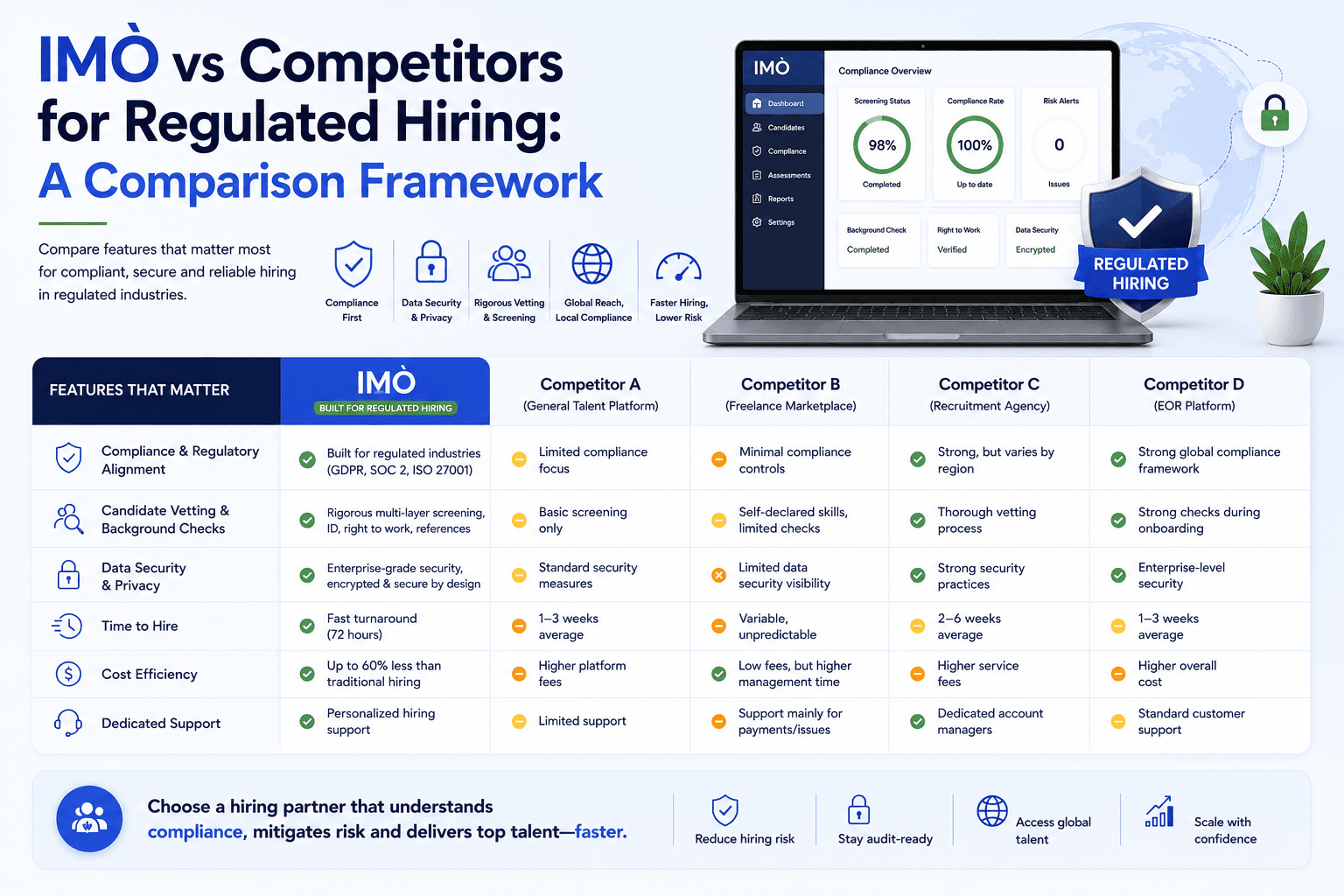
Criteria | IMÒ | Deel | Globalization Partners |
|---|---|---|---|
Core Model | Vetted talent marketplace and recruitment | Global EOR, payroll, and contractor management platform | Enterprise EOR built on wholly-owned entities |
Country Coverage | Curated hubs across Africa, remote-ready for UK/US/EU clients | 150+ countries | 180+ countries |
Pricing Starting Point | Project-based, roughly 60% cheaper than local hiring | EOR from around $599/month, contractors from $49/month | Custom quote, historically premium tier |
Onboarding Speed | As fast as 72 hours | Self-serve, typically a few days | Sales-led, roughly 5 to 15 days |
Best Suited For | Startups needing vetted talent fast without recruitment overhead | Scale-ups managing contractors and employees across many countries | Large enterprise wanting maximum legal defensibility |
Entity Ownership | Not applicable, doesn’t act as legal employer | Mix of owned entities and local partners | Predominantly wholly-owned legal entities |
IMÒ
Talent Sourcing and Vetting Process
Here’s the thing nobody tells you about hiring internationally: the compliance side is only half the battle. The other half, arguably the harder half, is actually finding someone competent. Recruitment agencies charge eye-watering fees for this. Job boards drown you in applications that don’t match the brief. IMÒ takes a different route entirely, running candidates through a multi-stage bootcamp that tests technical skill, communication, and cultural fit before anyone even lands in the talent pool. Only the professionals who clear that bar, roughly the top slice of applicants, get surfaced to clients.
What strikes me about this model is how it sidesteps the usual gamble of open marketplaces, where you’re sifting through hundreds of profiles hoping the reviews aren’t fabricated. IMÒ has already done that filtering. You’re not evaluating raw applicants, you’re choosing between people who’ve already proven themselves against a fairly rigorous standard, which is a meaningfully different experience from scrolling through a freelance directory at midnight. For a deeper look at how this curated approach stacks up against wide-open platforms, there’s a useful breakdown comparing curated talent pools against open marketplaces that’s worth a read if you’re weighing quality against speed.
Pricing and Cost Savings
Cost is where IMÒ makes its loudest argument, and it’s not subtle about it. The pitch is roughly 60% savings compared to hiring locally in the UK or US, which, if you’ve priced out a senior React developer in London recently, isn’t a small claim. It’s a genuinely large one. The pricing model itself is project-based rather than the tiered per-seat structure you’d see on an EOR platform, meaning costs flex with what you actually need rather than locking you into a subscription for headcount you might not keep.
I’d temper the enthusiasm slightly, though. Cost savings on paper don’t account for the management overhead of running a distributed team across time zones, even ones aligned to GMT+1, which IMÒ’s African talent pool largely is. It’s a smaller gap than working with teams in, say, Southeast Asia, but it’s not zero. Anyone assessing the real economics should look at how platform fees compare against alternatives like Toptal before assuming the headline number tells the whole story.
Coverage and Ideal Team Size
IMÒ isn’t trying to be everywhere, and that’s arguably its strength rather than a limitation. The geographic focus sits squarely on Africa, drawing from talent hubs in Nigeria, Kenya, Ghana, and a handful of other markets, which means if your hiring plan involves Latin America or Southeast Asia, you’re looking at the wrong platform entirely. Where it does shine is with small to growing teams, founders who need two or three strong engineers without spinning up a full recruitment function, or scale-ups testing whether distributed teams can actually move product forward.
Ideal team size here tends to sit in the single digits to low double digits per engagement. It’s not built, at least not yet, for the kind of bulk hiring sprees that enterprise workforce planning sometimes demands. If that’s your situation, a framework for comparing platforms on cost efficiency for bulk remote hiring might be more directly useful.
Deel
Global Payroll and EOR Structure
Deel built its reputation on speed, and the global payroll architecture reflects that. It supports over 150 currencies, including crypto payouts, which sounds like a gimmick until you’ve got a contractor in Argentina who genuinely prefers being paid that way given the peso’s volatility. The EOR side works through a blend of owned entities and local partner networks, meaning coverage is broad, but the depth of direct legal ownership varies by country. That’s worth knowing because entity ownership affects how much liability sits with Deel versus a third-party local partner in any given jurisdiction.
For companies hiring across a genuinely mixed bag of countries, say five employees in Germany, a contractor in the Philippines, and a small team in Brazil, this structure works because it consolidates everything into one dashboard rather than juggling five separate local payroll services. The trade-off is that not every country runs on Deel’s own infrastructure, so compliance depth can feel slightly less airtight than a provider running exclusively on wholly-owned entities.
Contractor Management and Pricing
Deel’s contractor management is genuinely one of its stronger offerings, priced from around $49 per contractor monthly, with EOR services starting near $599. That’s transparent, which is more than can be said for most providers in this space. The catch, and this is where third-party reviews consistently flag friction, sits in the FX markups on currency conversion, sometimes running between 0.6% and 2%, plus occasional country-specific surcharges that don’t always show up in the initial quote.
None of that makes Deel a bad contractor management platform. It just means the advertised price and the actual invoice can drift apart slightly, something finance teams handling international employees should budget for rather than get blindsided by three months in.
Onboarding Speed and Platform Usability
This is genuinely where Deel pulls ahead of both competitors, and it’s not close. Reviewers across the board, not just Deel’s own marketing, consistently praise the self-guided onboarding flow and interface that treats global hiring like software rather than paperwork. You can set up payroll countries, configure pay rules and approval chains, and have someone paid within days rather than weeks. Compare that to the sales-led, document-heavy process that enterprise-grade providers tend to run, and the usability gap becomes obvious fast.
Whether that speed matters depends entirely on your situation. A ten-person startup hiring its first international employee benefits enormously from not needing a dedicated HR hire just to manage the process. A 5,000-person enterprise with existing HRIS infrastructure might value governance over speed, which is exactly the segment where the next platform earns its keep.
Globalization Partners
Wholly-Owned Entity Model and Compliance
Globalization Partners built its entire value proposition around one structural decision: owning its legal entities outright in the vast majority of its 180-plus country footprint, rather than leaning on local partners the way many competitors do. That matters more than it sounds like on first read. When a provider owns the entity directly, liability allocation is clearer, there’s no subcontractor handoff to worry about, and the legal employer relationship stays entirely inside one company’s walls. For industries where a compliance misstep could mean serious regulatory exposure, financial services, healthcare-adjacent businesses, anything touching sensitive data across European markets, that entity ownership model isn’t a nice-to-have. It’s the entire reason to pick G-P over a cheaper alternative.
I’ll admit some scepticism about how much this actually matters for a fifteen-person startup hiring its first overseas employee. It probably doesn’t, not enough to justify the price premium. But for a large enterprise managing employment contracts across a dozen jurisdictions simultaneously, where a single classification error could trigger investigations from multiple labour authorities at once, the extra licensing depth behind wholly-owned entities earns its cost. Similar logic shows up when comparing structural approaches across the wider remote platform and recruitment agency landscape.
Enterprise Pricing and HRIS Integration
G-P doesn’t publish pricing, and that’s deliberate. The sales-led, custom-quote model is built around enterprise procurement processes, where a company expects a tailored proposal rather than a self-serve checkout. This pricing opacity is the single most-cited frustration in third-party reviews, and it genuinely prices out smaller businesses that might otherwise appreciate the compliance rigour but simply can’t justify the enterprise-tier spend.
Where G-P earns back some goodwill is in HRIS integration depth. Native syncing with Workday, SAP SuccessFactors, UKG, and ADP means large enterprise clients already running those systems don’t need to duct-tape a new tool onto existing human resources infrastructure. That’s a genuinely different value proposition from a self-serve platform bolting on API access as an afterthought.
Implementation Timeline and Support Model
Setup with G-P typically runs five to fifteen days, involving manual oversight and a more traditional, high-touch enterprise structure rather than a self-guided flow. That’s slower than Deel by a wide margin, and it’s a deliberate trade-off rather than a shortcoming. The support model leans heavily on dedicated account teams and legal advisory, the kind of white-glove service that mid-market and enterprise buyers expect when hundreds of thousands of pounds in annual global payroll are on the line.
Smaller teams often find this pace frustrating, understandably so, since a fortnight of onboarding feels glacial next to Deel’s near-instant setup. But conservative industries, ones where getting employment law wrong carries real financial consequences, tend to view that same slowness as due diligence rather than delay.
Pros & Cons
Laying these three side by side without the marketing gloss makes the trade-offs a lot clearer:
IMÒ wins on cost and speed for sourcing talent, but doesn’t function as an EOR, so you’re still responsible for however you structure the employment relationship afterward.
Deel wins on usability and self-serve breadth, but FX markups and surcharges mean the advertised price isn’t always the final one.
Globalization Partners wins on legal defensibility through wholly-owned entities, but the custom pricing and slower onboarding shut out anyone without enterprise-level budget.
All three have gaps that matter depending on company stage: IMÒ lacks EOR licensing entirely, Deel’s partner-reliant coverage varies by country, and G-P’s cost structure punishes smaller headcounts disproportionately.
How Do You Choose the Right Platform for Your Hiring Need?
Start with the actual bottleneck, not the platform’s homepage. If the problem is “I can’t find good engineers fast enough,” that’s a sourcing problem, and no amount of EOR licensing solves it. That’s IMÒ territory. If the problem is “I have candidates lined up but no legal way to pay them compliantly across borders,” that’s an employment infrastructure problem, and you’re choosing between Deel and G-P based on how much governance you actually need versus how fast you need to move.
Company size matters more than most founders initially admit. A ten-person team doesn’t need wholly-owned entities in Germany. A 3,000-person enterprise absolutely might, particularly if regulators in the European market have already shown interest in how contractor classification is handled. Budget honesty helps too. There’s no point falling in love with G-P’s compliance depth if the quote comes back at a number that makes your finance director wince.
Which Platform Fits Which Type of Business?
A bootstrapped founder in London trying to build a product team without burning through runway is the clearest IMÒ candidate, someone who needs vetted developers or designers fast and doesn’t have the internal bandwidth to run six rounds of technical interviews themselves. A Series B startup scaling into eight new countries within a year, juggling contractors and full employees simultaneously, fits Deel’s self-serve model almost perfectly. And a listed enterprise with existing Workday infrastructure, operating across dozens of jurisdictions with zero appetite for compliance risk, is exactly who G-P built its entire platform around.
Final Verdict
None of these three deserves to be crowned the universal winner, because they’re not actually fighting over the same job. Choose IMÒ if your bottleneck is finding brilliant, vetted talent quickly and affordably, particularly if tapping into Africa’s growing professional ecosystem fits your team’s needs. Choose Deel if you already have your pipeline sorted and want a flexible, transparent platform to handle payroll and contractor management without enterprise-level bureaucracy. Choose Globalization Partners if you’re operating at a scale where compliance errors carry real financial and reputational risk, and you’d rather pay a premium than gamble on a leaner alternative. For a broader sense of where these platforms sit against other options entirely, the comparison with Andela, Arc, and traditional recruitment agencies is worth a look too.
Can You Use IMÒ, Deel and Globalization Partners Together?
Actually, yes, and this is more common than people assume. A fair number of scale-ups source talent through IMÒ, then run those hires through Deel’s EOR or contractor management structure to handle the legal employment side properly. IMÒ finds and vets the person, Deel becomes the compliant vehicle for paying and employing them. It’s a genuinely sensible combination because it separates the two problems, sourcing and employment, into the tools actually built for each. Layering G-P into that same stack is less common, mostly because its enterprise pricing and slower onboarding don’t suit the leaner teams typically using IMÒ in the first place. There’s a more detailed breakdown of how this layered approach plays out in practice within the piece on scaling global workforces with IMO Talent.
What Happens If You Outgrow IMÒ or Deel?
Growth has a funny way of exposing the limits of whatever got you to this point. Companies that started with IMÒ for a handful of hires sometimes find, a year or two in, that they need broader country coverage than the African-focused talent pool offers, at which point layering in a wider EOR provider or expanding through Deel’s country coverage becomes the natural next step. Similarly, businesses that leaned on Deel’s self-serve model for early international hiring sometimes hit a ceiling once regulators start paying closer attention, or once headcount in a single country crosses a threshold where local entity ownership starts looking safer than a partner-reliant model. That’s usually the point where G-P, or a comparable enterprise-grade provider like WorkMotion, enters the conversation. Outgrowing a platform isn’t a failure of that platform, it’s just a sign the company’s risk profile changed.
FAQ
Is IMÒ an Employer of Record? No. IMÒ is a talent-sourcing and vetting marketplace, not an EOR. It matches companies with pre-vetted African professionals but doesn’t act as the legal employer, so you’ll still need a separate compliance mechanism, whether that’s your own entity or a platform like Deel, to handle contracts and payroll.
Why is Globalization Partners so much more expensive than Deel? The premium reflects G-P’s wholly-owned entity infrastructure across most of its country coverage, which reduces reliance on local partners and tightens liability allocation. Deel uses a mixed model of owned entities and partnerships, which keeps costs lower but occasionally means less direct control in specific jurisdictions.
Can a small startup realistically use Globalization Partners? Technically yes, but the custom enterprise pricing rarely makes financial sense below a certain headcount. Most small teams find Deel or a leaner alternative more proportionate to their actual risk exposure at that stage.
Does IMÒ handle payroll at all? Not directly. IMÒ’s dashboard focuses on talent and task management rather than running country-specific payroll, which is why many clients pair it with a dedicated payroll or EOR platform once hiring moves beyond initial placement.