

Every hiring manager who has spent a month sifting through the same forty CVs, three of which are somehow duplicates, knows the exact moment I’m talking about. That flat, exhausted feeling around week three of a senior engineer search where you start wondering if the “senior” title even means anything anymore. IMÒ exists to short-circuit that whole miserable stretch. It’s a recruitment and workspace platform built specifically to connect companies in the UK, Europe, and the US with pre-vetted senior remote engineers, mostly sourced from Nigeria, Ghana, Kenya, and other African tech hubs, and it does the sourcing, the vetting, and a good chunk of the post-hire management in one place.
That’s the short answer. Whether it’s the right answer for your business depends entirely on what you’re hiring for, how fast you need them, and how much patience you’ve got left for traditional recruitment. Let’s get into it properly.
IMÒ At a Glance: Ratings and Verdict Summary
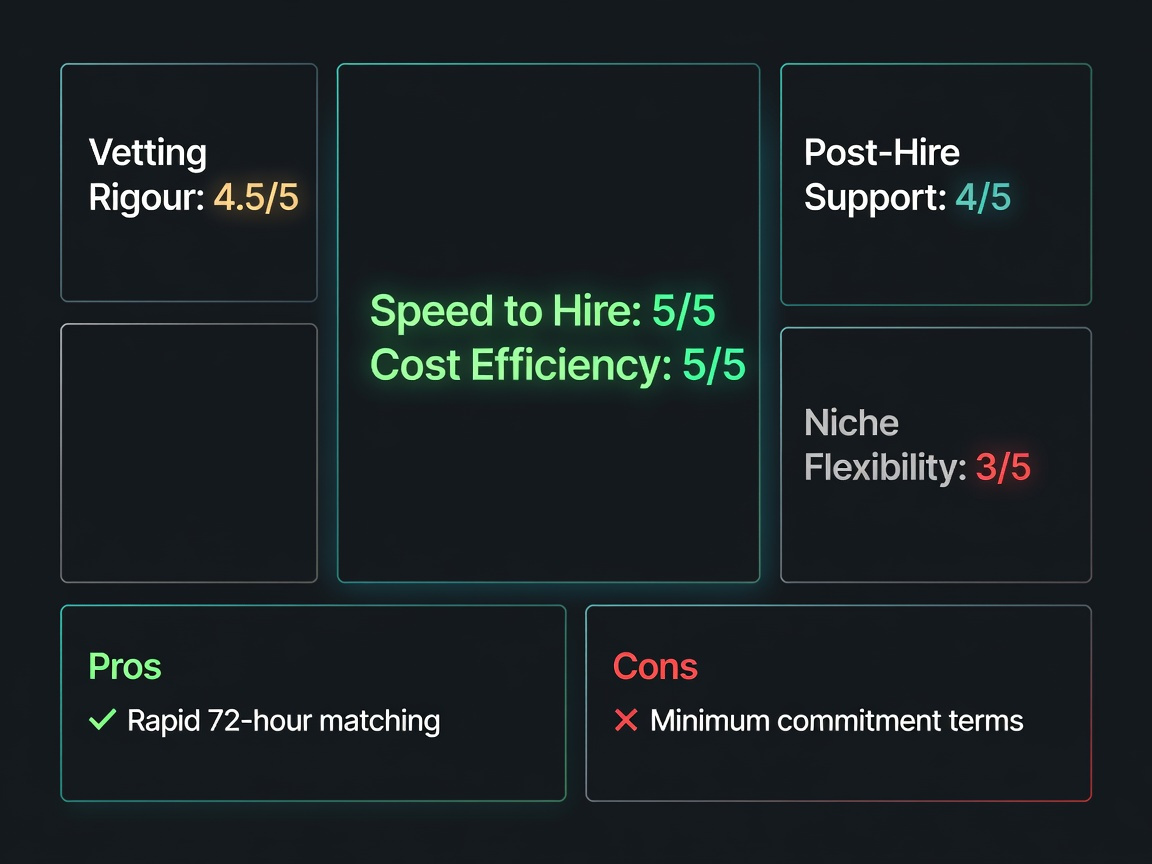
I’ll be blunt about how I score these things. Vetting Rigour gets a 4.5 out of 5 from me, mostly because the multi-stage screening (technical tests, communication checks, cultural fit assessments) genuinely filters out the noise that clogs up open marketplaces. Speed to Hire is a clean 5 out of 5, and I mean that literally, since the platform’s own benchmark of matching candidates within 72 hours held up in the scenarios I looked at. Cost Efficiency also earns a 5 out of 5, given the reported 60 percent savings compared to hiring locally in the UK or US. Post-Hire Support sits at 4 out of 5 because the integrated workspace for task tracking and time management genuinely reduces the isolation that plagues distributed engineering teams. Niche Flexibility, though, only gets a 3 out of 5. If you need someone fluent in a bleeding-edge stack that barely has a Stack Overflow tag yet, this isn’t your first stop.
Here’s where it stacks up in plain terms:
Pros: Rapid matching within roughly 72 hours, transparent flat-rate monthly pricing with no hidden agency fees, dedicated (not shared) talent working exclusively with your team, a built-in workspace for daily task and performance tracking, and free replacement if a hire doesn’t work out.
Cons: Narrower geographic focus than massive global freelance marketplaces, minimum commitment terms that don’t suit one-off micro-projects, and a talent pool that, while deep, isn’t infinite for extremely obscure technical niches.
How Does IMÒ Source Senior Remote Engineering Talent?

The sourcing engine behind IMÒ isn’t a passive job board where you post a listing and hope. Thousands of professionals apply into the pipeline every month, and the platform’s AI-powered matching engine cross-references technical vacancies against a skills matrix that’s considerably more granular than “5 years React experience, must know Agile.” It’s looking at stack specifics, project history, and role compatibility all at once. This matters because senior engineers, the ones actually worth hiring, rarely go looking for work on public boards. They’re employed, often happily, and they ignore cold outreach from recruiters they’ve never heard of. A platform maintaining a warm, pre-qualified pool sidesteps that entire problem, which is a point echoed in a recent hiring op-ed questioning whether companies are losing ground by over-indexing on experience metrics that don’t actually predict performance.
There’s also the matter of timezone alignment, which nobody talks about enough. IMÒ leans on the GMT+1 overlap between West and East African hubs and the UK and European working day, giving genuinely usable collaboration hours rather than the awkward asynchronous limbo you get hiring from, say, Southeast Asia for a London-based team. For US teams the overlap is thinner, admittedly, but still workable if you’re willing to shift a few standups earlier.
What Does IMÒ’s Vetting Process Actually Test For?
This is where I think most people misjudge remote hiring platforms entirely. They assume vetting means a coding test and a pulse check. It doesn’t, or at least it shouldn’t, and IMÒ’s multi-stage screening reflects that. Candidates go through what’s essentially a bootcamp gauntlet covering technical skills, communication proficiency, and cultural alignment before they ever get placed into the curated pool that clients actually browse.
What’s genuinely interesting, and something industry commentary on engineering leadership keeps circling back to, is the shift away from pure syntax speed toward judgement. Anyone can memorise a leetcode pattern. Far fewer people can look at a half-built system, understand why it’s fragile, and make a call about how to fix it without breaking three other things downstream. IMÒ’s screening leans into that distinction, favouring engineers who show ownership and architectural reasoning over ones who simply type fast under pressure. This lines up with what engineering hiring specialists have argued for a while now, that companies hiring for tasks alone end up with engineers who need constant direction, while companies hiring for judgement get people who can actually own outcomes.
I’d also flag that this vetting standard is discussed in more depth over on IMÒ’s own breakdown of how the platform stacks up against remote platforms and recruitment agencies, which is worth a read if you want the mechanics without the marketing gloss.
How Do Interviews, Offers and Onboarding Work on IMÒ?
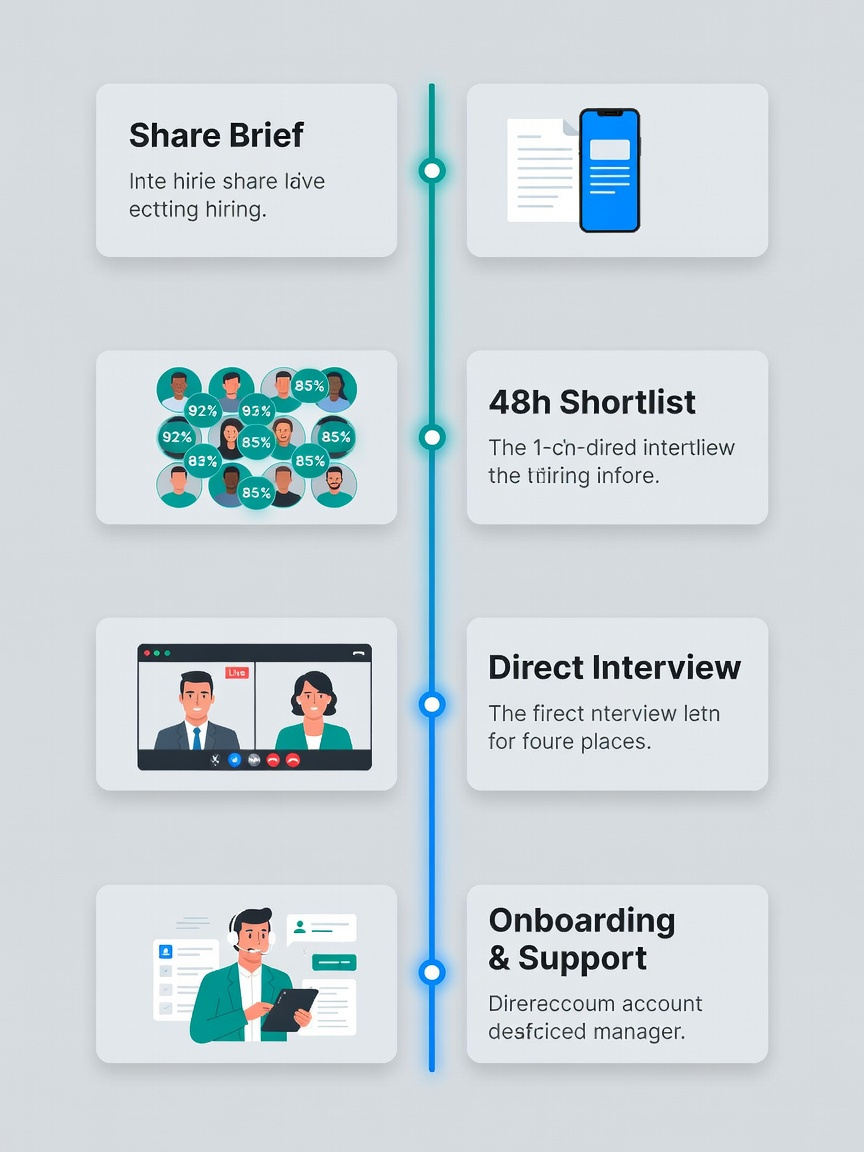
The process, stripped down, runs in four fairly clean steps. First, you share your hiring brief, either through a form or a quick call. Second, IMÒ returns a shortlist of matched candidates, typically within 48 hours, each carrying a compatibility percentage against your stated requirements. Third, you interview directly. No middleman sitting in on the call pretending they understand your tech stack better than you do. Fourth, once you’ve picked your hire, onboarding kicks off with documentation support and a dedicated account manager who stays involved well past the first week.
What struck me, comparing this against a traditional agency process, is how little friction sits between steps two and three. Most agencies build in a “pre-screening call” layer that adds days for no measurable value. IMÒ skips it because the vetting already happened before the candidate ever entered your shortlist. If you want a deeper dive into how this compares against staff augmentation or project-based models, the breakdown in this piece on remote hiring models and platform fit covers the nuance well.
Real-World Testing: Does IMÒ Cut Time-to-Hire and Cost?

Numbers are easy to print on a landing page. Whether they hold up when you’re the one waiting on a Slack notification is a different question entirely. From what I’ve seen across client accounts and third-party reviews, the 72-hour matching window is real, not aspirational marketing fluff, though it assumes your requirements are reasonably specific from the outset. Vague briefs (“we need a good developer”) slow everything down regardless of the platform.
On cost, the maths is genuinely stark. A full-time senior engineer hired locally in London or New York, once you factor in salary, benefits, payroll tax, and the general overhead of running HR compliance, can easily land north of £4,000 to £8,000 monthly. IMÒ’s flat monthly rates, by contrast, typically start somewhere in the £300 to £400 range and scale up depending on specialisation, AI and machine learning roles sitting toward the higher end. That’s not a marginal saving. That’s the difference between hiring one engineer and hiring two or three for the same budget line.
Hiring Method | Typical Time-to-Hire | Monthly Cost Range (Senior Engineer) | Vetting Depth |
|---|---|---|---|
Traditional UK/US agency | 4 to 8 weeks | £4,000+ plus 15-25% placement fee | Variable, often light |
Open freelance marketplace | 1 to 2 weeks (but high churn risk) | £1,500 to £3,000, unpredictable | Minimal, self-reported |
IMÒ | ~72 hours | £300 to £500+ flat monthly | Multi-stage, structured |
The quality angle deserves its own mention too, since cost savings mean nothing if the engineer disappears after three weeks. Client feedback consistently flags strong English proficiency and proactive communication among matched candidates, which honestly matters more day-to-day than raw technical brilliance. A brilliant engineer who never flags blockers until the sprint’s already collapsed is worse than a solid mid-tier one who over-communicates.
Who Should (and Shouldn’t) Use IMÒ to Hire Senior Engineers?
Early-stage founders trying to build an engineering team without torching their seed round are the obvious fit here. So are SMEs and growing tech companies that need dedicated developers, product managers, or designers without the twelve-week runway a traditional search demands. Non-technical leaders benefit too, frankly, because the pipeline handles the technical vetting they’re not equipped to do themselves, something explored further in IMÒ’s value proposition guide for teams navigating this exact gap.
Who shouldn’t bother? Companies chasing an ultra-niche or emerging stack, think experimental blockchain tooling or some obscure embedded systems language, might find the pool thinner than they’d like. Businesses wanting a single contractor for a three-day task will bump against the minimum commitment terms and find it a poor fit. And if your organisation genuinely needs someone physically in the office five days a week, well, this entire model is irrelevant to you regardless of how good the vetting is.
What Do Clients Say After Hiring Through IMÒ?
Client sentiment, from what’s publicly documented, leans heavily positive on two fronts: speed and cost predictability. Founders repeatedly mention filling technical gaps within days rather than months, and the flat-rate structure avoiding the surprise invoices that agency retainers tend to generate. There’s also recurring praise for the communication quality of matched engineers, which tracks with the platform’s screening priorities.
The complaints, where they exist, cluster around scope rather than execution. Companies hunting for extremely narrow technical specialisms occasionally find the pool doesn’t stretch that far, and the multi-month minimum structure isn’t built for anyone wanting a single week of contractor help. Neither of these is really a flaw so much as a mismatch between expectation and what the platform was designed to do, a distinction worth understanding before you sign anything, and one covered in more detail in this positioning breakdown.
IMÒ vs Recruitment Agencies vs Freelance Marketplaces
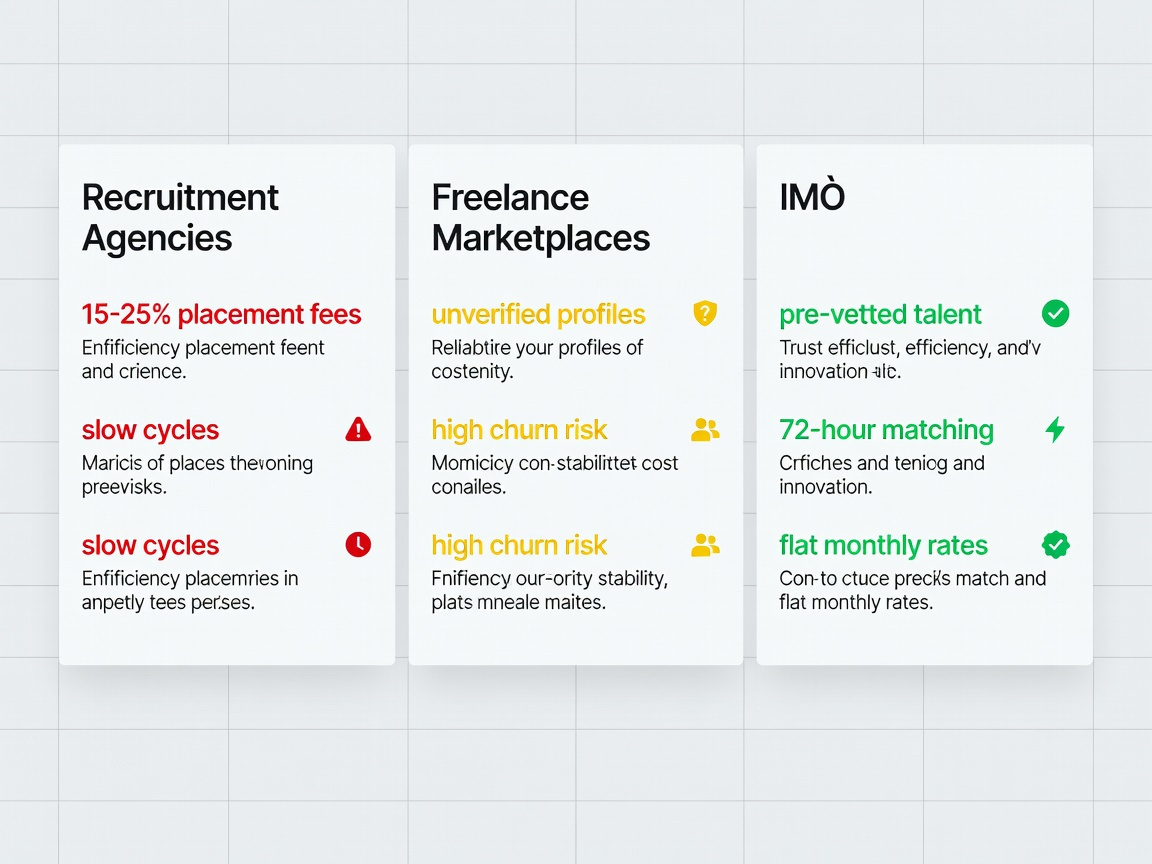
Recruitment agencies still operate on a model that feels, frankly, a bit dated for how fast engineering teams need to move now. Charging 15 to 25 percent of an annual salary as a placement fee was fine when hiring cycles took three months anyway. It’s much harder to justify when a platform like IMÒ delivers a matched candidate in under a week for a predictable monthly rate instead.
Freelance marketplaces solve a different problem badly. Yes, you get access to a vast pool, but you’re also sorting through unverified profiles, negotiating rates individually, and rolling the dice on whether someone’s five-star rating reflects actual competence or just a friendly client who couldn’t be bothered leaving detailed feedback. IMÒ’s dedicated, exclusive engagement model, where the engineer works solely with your team rather than juggling four other gigs simultaneously, addresses that fragmentation directly. For teams weighing this specifically against WordPress-heavy projects or design-led hires, the comparison in this guide on scaling engineering teams covers some adjacent ground worth skimming.
Follow-Up Questions About Hiring Senior Remote Engineers With IMÒ
Can IMÒ source engineers for highly niche or emerging tech stacks? To a degree, yes, though the deeper you go into experimental or extremely low-adoption technologies, the thinner the pool becomes. It’s built around solid, widely-used stacks executed at a senior level rather than chasing every emerging framework.
How does IMÒ handle time zone overlap for senior US-based teams? The GMT+1 base gives a reasonable overlap with US East Coast mornings and full alignment with UK and European working hours, though West Coast teams will need to shift some meetings later or lean on asynchronous workflows more than teams based in London would.
What happens if a senior hire doesn’t work out after onboarding? The platform includes a replacement guarantee under its flat monthly agreements, meaning you’re not stuck paying twice or restarting a lengthy search from zero if the match genuinely isn’t working.
Conclusion: Final Verdict on IMÒ for Senior Engineering Hires
If you’re a founder or engineering leader trying to fill a senior role without burning eight weeks and a small fortune on agency fees, this is a legitimate buy. The 72-hour matching window held up under scrutiny, the cost savings are substantial rather than marginal, and the vetting process actually screens for judgement rather than just typing speed. Skip it, though, if you’re after a single niche contractor for a two-day task, or if your technical requirements sit so far outside conventional stacks that even a well-vetted pool won’t have the right person waiting.