Introduction
Most employers pick a hiring route the way they pick a gym: on the strength of the brochure. Then they wonder why nothing changes.
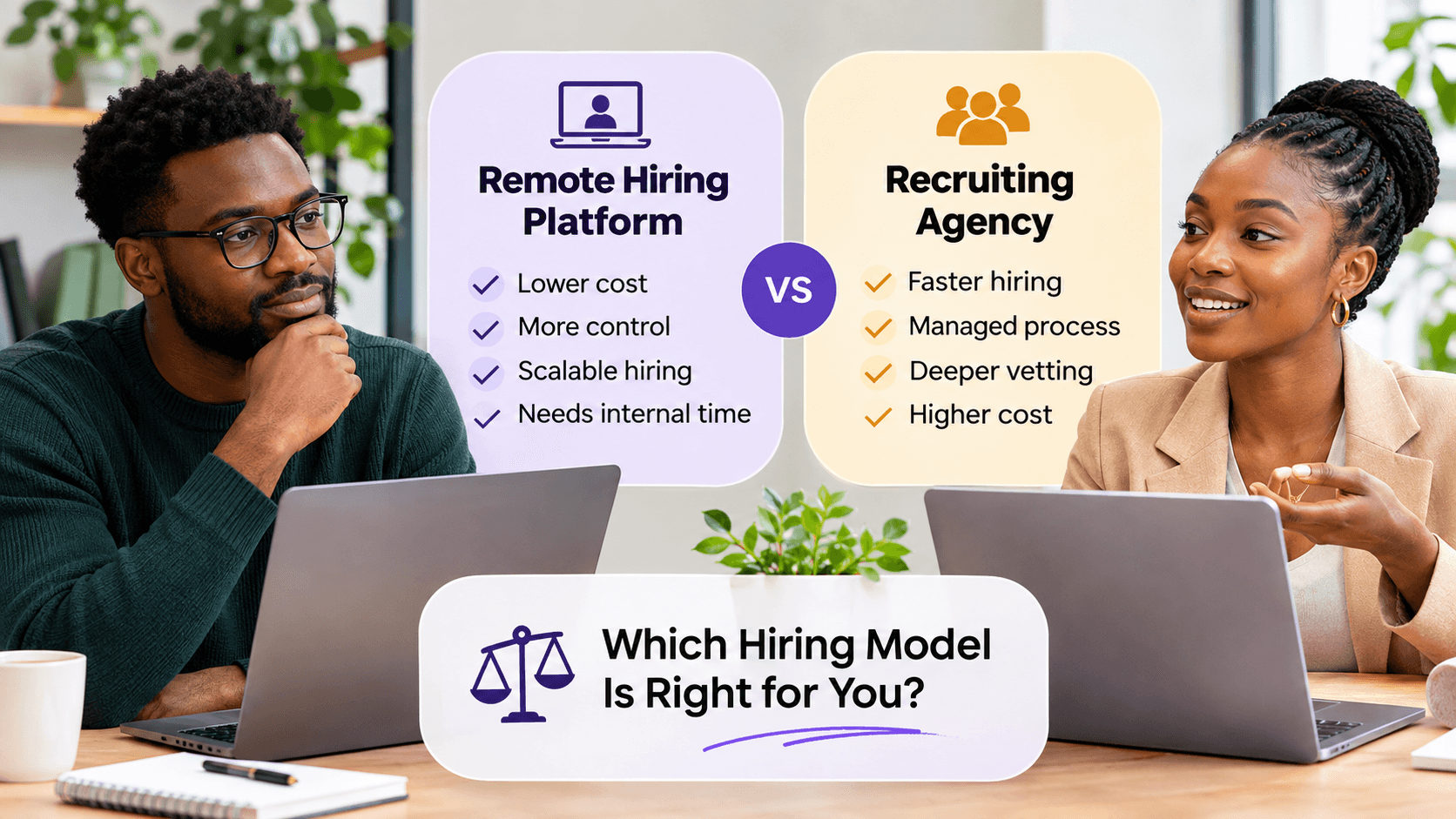
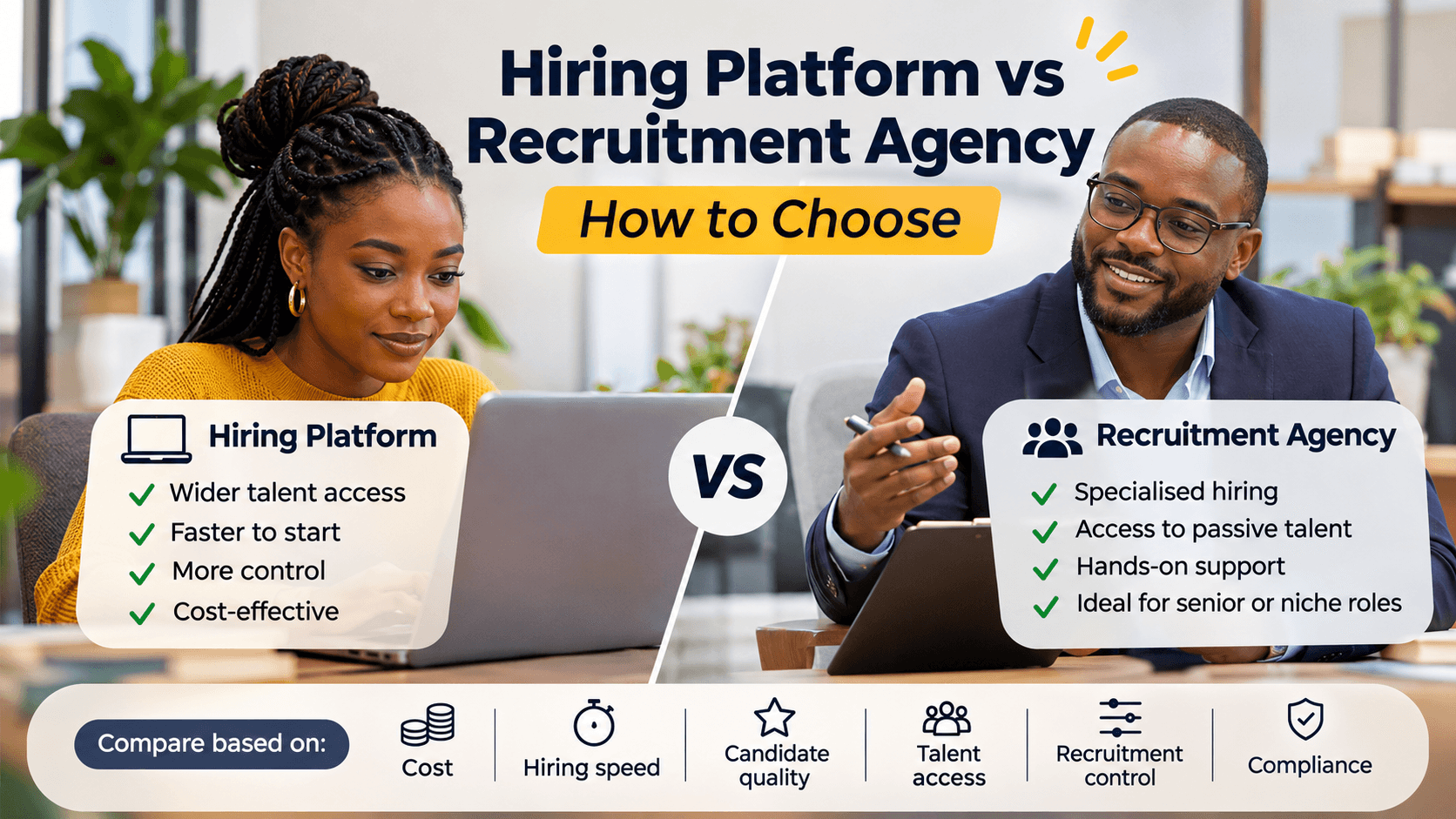
To choose between a remote hiring platform and a recruitment agency, compare six key factors: cost, hiring speed, candidate quality, talent access, recruitment control and compliance. Remote hiring platforms are often suitable for businesses seeking scalable, cost-effective recruitment, while agencies may be better for specialised, confidential or executive searches.
Understanding how remote hiring platforms and recruitment agencies source and screen candidates can help employers determine which approach best fits their hiring needs.
The best choice depends on your hiring volume, internal recruitment capacity, budget and the complexity of the roles you’re filling. Some businesses may also benefit from combining both approaches to balance efficiency with specialised recruitment support.
How Do Hiring Platforms and Recruitment Agencies Differ
How platforms work
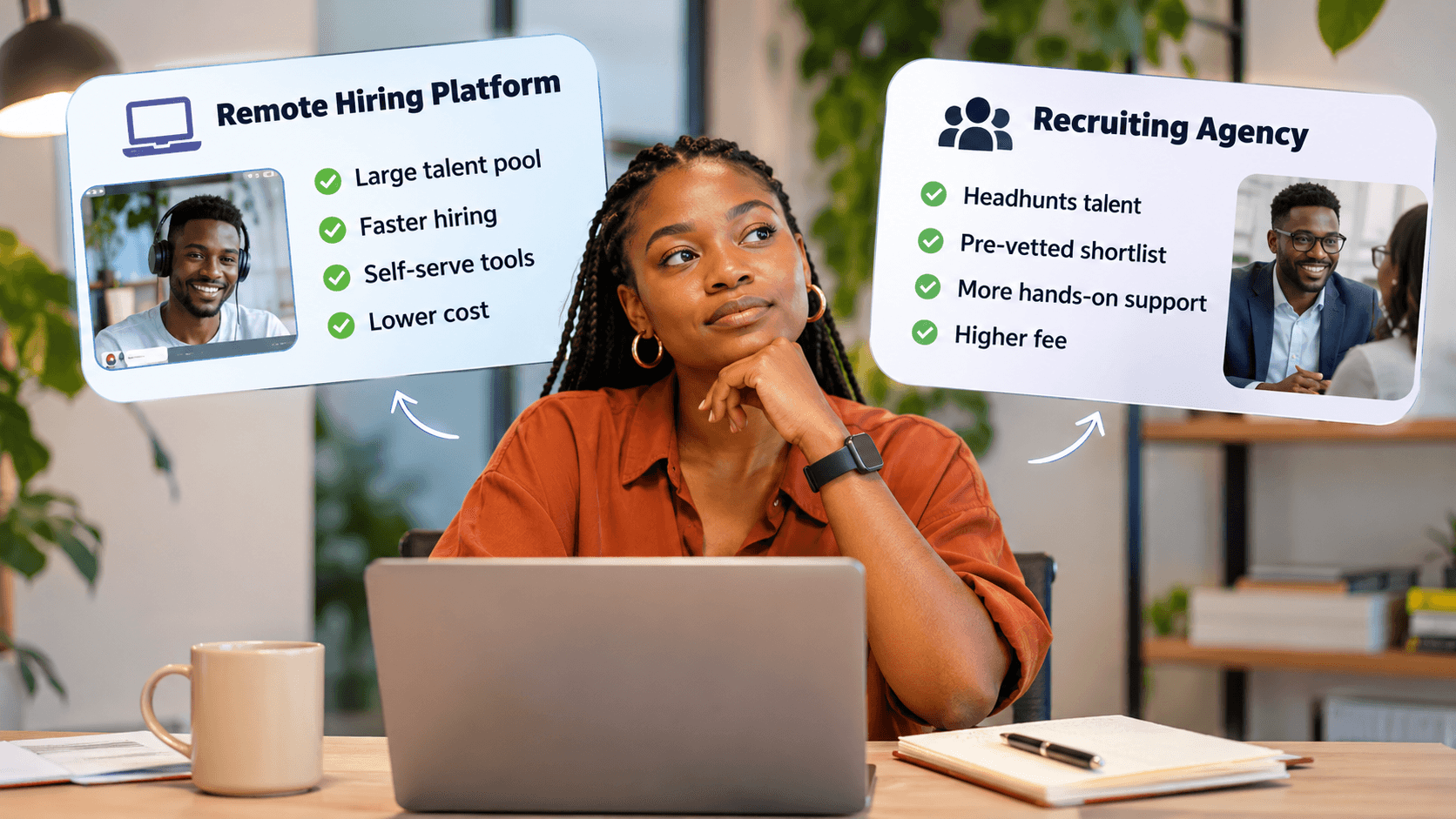
A hiring platform is software you operate yourself. You post a listing, pull in applications from job boards and your careers page, and move people through an ATS pipeline. Some are applicant tracking systems with multiposting bolted on. Others are remote hiring platforms or talent marketplaces that hand you a pool of pre-vetted professionals. You pay a subscription, or a sponsored listing fee, and your own team does the work.
Which means the effort lands on you. That’s the trade.
How agencies work
A recruitment agency (or recruitment consultancy, same animal) does the legwork for you. Consultants take a brief from the hiring manager, search their database, approach people directly, screen them and send over a shortlist. Fees come in two main flavours. Contingency means you pay only if you hire, usually 15% to 25% of first-year salary according to this cost analysis. Retained searches mean you pay in stages, win or lose, and they suit senior or hard-to-fill roles.
Where each performs best
Platforms shine on repeatable, high-volume or mid-level hiring where your team can handle the interview load. Agencies earn their money on niche specialist roles, confidential replacements, and markets where the best candidates never apply to adverts at all. Passive talent is the agency’s real edge. Everything else is mostly convenience.
What Criteria Should You Use to Compare Both Routes?
Here’s the whole comparison in one place before we dig in.
Criterion | Hiring platform | Recruitment agency |
|---|---|---|
Cost model | Flat subscription or listing fees | Percentage of salary, on placement |
Speed | Fast to start, slower to screen | Slower to start, faster to shortlist |
Candidate access | Applicants plus platform pool | Applicants plus the consultant’s network |
Control | High, you own the pipeline | Lower, they own the relationships |
Compliance | Your responsibility, tools help | Shared, depends on the contract |
Total cost
Price the full year, not the first invoice. An ATS stack typically runs somewhere around £320 to £500 a month, per that same cost analysis, so a few thousand pounds a year buys unlimited roles. An agency on 20% charges £10,000 for a £50,000 hire. One placement. Ten hires a year makes the gap enormous.
But count your own time too. Internal recruiter hours aren’t free, and a platform that needs a dedicated person to run it is cheaper on paper than in life. Work out cost per hire on both routes using real numbers from your last twelve months.
Speed and candidate quality
SHRM’s benchmarking puts median time-to-fill for non-executive roles at 39 calendar days. Use it as a baseline, not a promise. Platforms get the advert live in minutes, yet the volume problem is brutal: recruiting statistics show that of every 1,000 applications, roughly 75 get screened, 32 are interviewed and 5 become hires. That’s a lot of noise to wade through.
Agencies compress the noise. A good consultant hands over four suitable candidates, not four hundred applications. Quality, though, depends entirely on the individual, and I’ve seen “specialist” consultancies send CVs that clearly never got read. Ask for placement history in your exact niche.
Talent access, control and compliance
Access is where agencies justify themselves: relationships with people who aren’t looking. Control runs the other way. On a platform, you see every application, every score, every rejection. With an agency, you see what they choose to show you.
Compliance deserves a sober look. Right-to-work checks, equal opportunities records and data handling under UK GDPR sit with you as the employer, whichever route you pick. A platform gives you audit trails. An agency contract can shift some liability, but only if the wording says so. Read it.
Who Does a Recruiter Actually Work For?
Their fee. Full stop.
The recruiter’s client is the company, true, but being the client doesn’t mean being looked after. A contingency consultant is paid when a placement lands, so the incentive is a quick close, not your best long-term fit. Candidate and employer both get treated as inputs to a deal. I’m not saying consultants are cynical (plenty are brilliant). I’m saying don’t mistake a commission-driven relationship for advocacy, and structure the arrangement so incentives line up: guarantee periods, rebates, clear exclusivity terms.
That’s one reason I’d keep the core process in-house.
How Do You Test a Platform Against Your Real Workflow?
Don’t spend four months admiring ATS demos. Demos are theatre. Every vendor’s sample company has conveniently perfect job stages and tidy data.
Instead, hand each vendor your messiest real role and make them build it. Watch what happens:
Can they replicate your actual approval chain, including the awkward second sign-off?
How many clicks does it take a hiring manager to leave interview feedback?
Does multiposting reach the job boards you really use, or just the famous ones?
Can you export your candidate data cleanly if you leave?
“Perfect for your size” means nothing. Pick the tool that does the job without the sales pitch, and check peer feedback on Gartner Peer Insights to see whether real users hit the same snags you did. For a fuller scoring sheet, this evaluation checklist is a handy companion.
Why Should AI Screening Claims Not Drive Your Decision?
Because every vendor now has them. Workable, for instance, gets described as having an AI screening agent. Cool. Does it make hiring easier? That’s the only question.
Automation is real, and McKinsey estimates up to 30% of work hours could be transformed by 2030. Fine. But a futuristic feature list tells you nothing about whether the shortlist is any good. Run a blind test: take fifty past applications, include people you hired and people you rejected, and see whether the screening tool ranks them sensibly. If it can’t beat a tired human with a coffee, it’s decoration. Also ask how scores are produced. If the vendor can’t explain, your compliance exposure just went up.
Follow This Decision Framework to Choose Your Route
Work through these in order. Stop when you hit a clear answer.
Volume. Hiring more than a handful of roles a year? Platform first, because fixed fees beat percentage fees quickly.
Capacity. Does someone on your team have real hours to screen and interview? If not, price in agency help or a managed service.
Candidate pool. Will the best candidates actually see an advert? If they’re all employed and quiet, a search consultancy has the edge.
Sensitivity. Confidential replacement or a senior permanent role? Retained search.
Proof. Pilot on one role. Measure time-to-fill, interview-to-offer ratio and first-year retention, then decide.
If you want a second opinion on structure, the pricing decision framework takes a similar angle from the budget side.
When Should You Combine a Platform With an Agency?
Often, honestly. Run the platform as your default and bring an agency in for the roles it can’t fill. If a post has sat for six weeks with a weak pipeline, that’s your trigger. Give the consultancy a defined brief, a capped fee and a time limit, and keep the candidate data flowing back into your own ATS so you don’t lose the relationship. There’s a useful walk-through on combining both routes if you want the mechanics.
One warning. Don’t let three agencies and your own advert all chase the same role without ground rules, or you’ll end up arguing over who “owns” a candidate.
What Should You Ask Before You Sign Anything?
Put these to the vendor or consultancy, and write down the answers.
What is the total cost over twelve months, including add-ons, renewals and per-seat charges?
What happens if the hire leaves within the guarantee period?
Who owns the candidate data and relationships once the contract ends?
Can you show me a placement or customer in my sector, with a reference I can call?
How do you handle right-to-work checks and equal opportunities data?
Vague answers are answers. For comparing how each model screens, candidate vetting in platforms versus agencies is worth a read.
FAQ
Is a hiring platform cheaper than a recruitment agency?
Usually, once you hire more than one or two people a year. Subscription fees are flat, while agency fees scale with salary. The catch is your own team’s time, which platforms don’t remove.
Do recruitment agencies find better candidates?
Sometimes. Agencies reach passive talent that never answers adverts, which matters for specialist roles. For general roles, the difference is smaller than their marketing implies.
Can I use both at once?
Yes, and many organisations do. Keep the platform as the main pipeline and use an agency on a clear, time-limited brief for hard searches.
How long should I trial a platform?
Weeks, not months. One live role, your real workflow, and a measurable outcome.
Conclusion
Compare on cost, speed, quality, access, control and compliance. Test with your own messy roles. Ignore the AI gloss unless it saves you actual hours. Run hiring in-house on a platform that fits how you work, and pay an agency only where the platform falls short. That’s the whole game.