Introduction
Effective remote talent onboarding and retention are essential to building a productive and sustainable remote workforce. A structured onboarding process helps new hires understand their responsibilities, integrate into the organisational culture and develop strong working relationships.
Beyond onboarding, businesses must prioritise employee engagement, career development, performance management and employee experience to reduce employee turnover and improve long-term retention.
For employers hiring through remote talent platforms such as IMÒ Talent, combining effective recruitment with a strong talent management strategy can support long-term workforce stability.
But hiring great talent is only half the job. What happens after they join your team matters just as much.
Imagine hiring a highly skilled remote professional, only to spend their first week sorting out login credentials, clarifying responsibilities and scheduling meetings that could have been emails. By the third week, their enthusiasm is fading. The problem isn’t their ability; it’s the environment they’ve been brought into.
Good onboarding shouldn’t leave people guessing, and effective retention shouldn’t begin when someone is about to resign.
Let’s fix that.
How Do You Onboard Senior Remote Engineers Effectively?
You give them the tools to work, a way to understand the system, and a human to ask. Everything else is decoration.
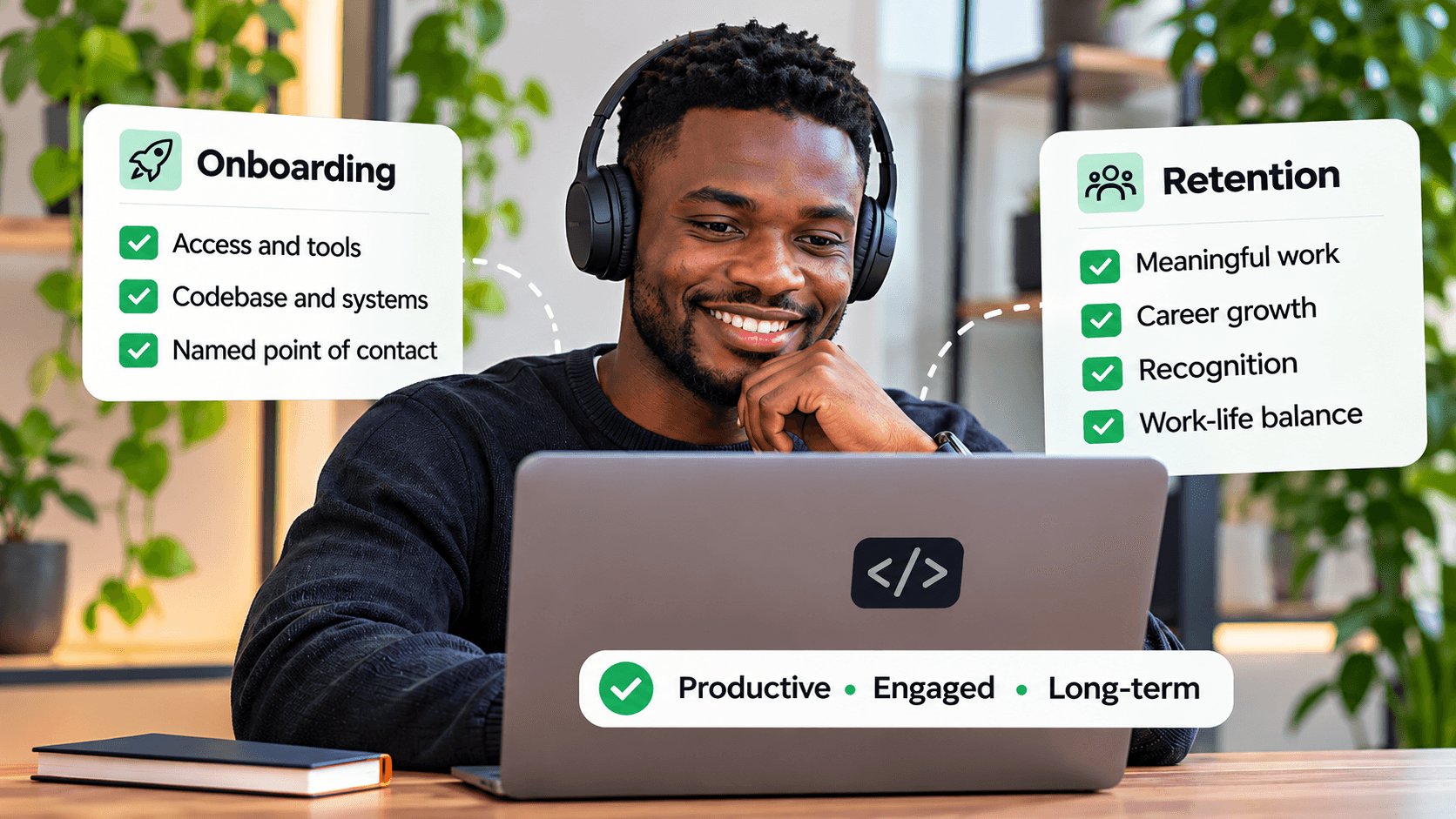
Access Before Ceremony
I have watched teams hold a lovely virtual welcome lunch for someone who still couldn’t open the repository. Embarrassing, frankly.
Repository permissions, the CI/CD pipeline, the staging environment, the ticketing system, the secrets manager, the on-call rota (read-only at first): all of it should work before the first stand-up. Ceremony can come later, once the person has actually shipped something and has a reason to enjoy the lunch.
A Map of the Codebase
A senior engineer doesn’t need a tutorial on how to write a function. They need to know why the billing service talks to the legacy queue, which module everyone is afraid of, and where the tests lie to you.
So write the map. One page covering architecture, service boundaries, data flow, deployment path and known mess. Add a recorded video walkthrough of 20 minutes, made by whoever knows the system best. Rough is fine. Rough and honest beats polished and stale.
One Named Point of Contact
Not a “buddy programme” with a rotating cast. One person, named in the first message, with a stated response time.
Why? Because the questions that cost the most time are the ones too small to schedule a call about and too specific to find in Confluence. A remote engineer will sit on those for hours rather than bother a stranger. A named contact removes the hesitation.
Why Does a Slow Ramp-Up Cost So Much?
Because you pay the full price of a senior engineer while receiving a fraction of the output, and the damage doesn’t stop at the invoice.
Salary Paid Without Output
Look at what the market asks for. One listing from Dandy wants 4+ years in implementation, technical onboarding or remote support at $95k, roughly £75,000. A remote backend role elsewhere lists $75k to $115k, so around £59,000 to £91,000. Those are real salary bands for people who are supposed to be useful quickly.
Every week of drift is salary spent on someone who is, in practice, still reading. Run the sum on a three-month ramp that should have been six weeks. It’s uncomfortable.
Senior Judgement Wasted on Busywork
This one stings more. You hired judgement, the ability to look at a messy system and say “don’t build that, fix this instead.” Then you hand over a vague ticket and a pile of low-stakes chores.
The judgement goes unused, and it dulls. Senior people notice when nobody wants their opinion.
Early Attrition Risk
Short tenure is already the norm in this field. Zippia-based figures suggest around 45% of software developers stay one to two years, and LinkedIn data puts tech attrition near 13.2%. A muddled first month hands them a reason to join that statistic early.
Remote makes it worse, since nobody sees the quiet disengagement until the resignation lands.
What Should Happen Before Day One?
Three things: kit and accounts ready, admin finished, and a first problem chosen. If any is missing, day one is wasted.
Equipment and Accounts
Laptop shipped (or a stipend agreed) at least a week early. Email, chat, repository, cloud console, password manager and VPN provisioned and tested. Test them with a dummy login, because “it should work” has ruined many a Monday.
Local logistics matter here. Customs delays, power cuts, patchy broadband: if you hire across borders, ask about the person’s actual working setup and cover the gaps.
Admin and Contracts
Platform-hired engineers usually arrive with a contract in place, but check the details anyway. Who handles payroll, tax and invoicing? Is the arrangement a contractor agreement or an employer of record model? Sort the paperwork and forms before the start date so the engineer isn’t chasing finance in week one.
First Problem Selected
Pick it in advance. Small enough to finish in two weeks, real enough to matter, and touching enough of the system to teach something. A bug in a live service is better than a sandbox exercise.
Build a 30-60-90 Day Plan
A plan helps only if it stays loose. Think of it as three handovers of responsibility rather than a checklist.
Days 1-30: Orient and Ship
Week one is access, the codebase walkthrough and meeting the named contact. By week two, a first pull request should be open. Ship something small to production inside the month. That single act proves the pipeline, the review process and the working relationship in one go.
Days 31-60: Own a Scope
Now hand over a defined area: a service, a feature or a reliability goal. Write down what they decide alone and what needs a conversation. Senior developers thrive when the boundary is explicit.
Days 61-90: Lead and Improve
Ask them to fix something about how the team works. A flaky test suite, a clumsy deployment step, an onboarding doc that misled them. Fresh eyes are a short-lived resource, so use them. They might also lead a design review or mentor the next hire.
How Do You Avoid Micromanaging Senior Hires?
Judge outcomes, draw clear lines around ownership, and answer questions quickly. Then leave them alone.
Outcomes, Not Activity
Green status dots and hours logged tell you nothing about a staff-level engineer. Agree on results: a migration complete, latency down, an incident process rewritten. Check those.
Clear Ownership Boundaries
Micromanagement often grows out of ambiguity. When nobody knows who owns the payments module, everyone hovers over it. Name the owner, and the hovering stops.
Fast Answers, Light Check-Ins
One weekly one-to-one, thirty minutes, set by the engineer’s agenda. Between those, respond to questions within a few hours. Speed of reply is a better trust signal than any status meeting.
Track Time to First PR
Measure one thing early: days from start date to first merged pull request. It’s crude, but it exposes friction brilliantly. If the number creeps past ten working days, something is broken, usually access, documentation or an unclear first task.
Don’t turn it into a leaderboard. Treat it as a smoke alarm for your onboarding process.
Pair New Hires with Mentors
Mentor and named contact can be the same person, though they needn’t be. A mentor handles the slower questions: how decisions really get made, who to talk to before proposing a change, what the unwritten rules are.
For seniors, flip the usual direction. Pair them with someone who has been at the company for years, so context moves one way and fresh critique the other.
Overcome Remote-Specific Onboarding Challenges
Isolation first. Buffer’s research found 52% of remote workers report feeling disconnected, and 61% blame meeting overload. So don’t answer isolation with more meetings. Answer it with a few well-chosen ones and an active written culture.
Time zones are next. Agree on a daily overlap window of three or four hours, then work asynchronously outside it. Write decisions down. A decision made in a call and never recorded didn’t happen, as far as the person in another time zone is concerned.
Then there’s visibility. Remote engineers can’t absorb context by sitting near people, so share it deliberately: architecture decision records, short weekly updates, open design docs. Terminal’s engineering research is a useful read on how remote teams are shifting their habits.
How Do You Keep Senior Remote Engineers Past 90 Days?
Give them meaningful work, fast answers and room to grow. Money matters, but it isn’t the first lever.
Stack Overflow’s developer survey data shows 35% of developers rank structured onboarding as a driver of employer appeal, and flexibility and learning opportunities weigh heavily in staying decisions (56% and 53%). That fits what I see: people leave when the work gets murky, not when the coffee budget shrinks.
Gallup’s global workplace findings put worldwide engagement near 20%, a sobering baseline. Beat it by keeping documentation useful, retros honest, and promotion paths visible even for contractors. Spend effort there, not on gimmicks or elaborate onboarding software.
Concrete retention tactics for platform-hired senior engineers
Career-growth check-ins at months 3 and 6. Ask: what do you want to be doing in a year? Map the answer to a real project. This prevents the “great work, no direction” exit.
Run a stay-interview at day 60. Four questions, 30 minutes: What energizes you here? What drains you? What would make you consider leaving? What should I fix first? Log answers and act within two weeks.
Publish a contractor promotion path. Define levels (contractor → senior contractor → team lead → conversion offer) with criteria anyone can read. Surprising but common: contractors churn hardest when they can’t see a future.
Time renewal conversations at day 75 of a 90-day contract. Never negotiate in the last week — engineers treat a rushed renewal as a signal they’re replaceable.
Grant ownership of one visible system by week 6. Senior engineers stay when their name is on something with users, not when they’re ticket-switching.
Route them into retros and design reviews from week 2. Exclusion from decision-making is the top reason strong hires quietly disengage.
A short comparison helps:
Retention lever | Worth the effort? | Why | How to execute |
|---|---|---|---|
Up-to-date documentation | Yes | Cuts guessing | Give new hires 4 paid hours in week 1 to fix the worst docs they hit |
Replies within hours | Yes | Builds trust | Dedicated Slack channel + manager SLA: answer within 4 working hours |
Clear ownership | Yes | Prevents hovering | Name one system as theirs by week 6; announce it to the team |
Visible growth path | Yes | Gives contractors a future | Published levels + 3/6-month check-ins mapped to real projects |
Early renewal conversations | Yes | Removes end-of-contract anxiety | Open renewal talks at day 75 of 90, in writing |
Branded swag and gamified tools | Rarely | Doesn’t fix the job | Skip; redirect budget to the items above |
Summary
The cheapest retention win for senior remote engineers is structural, not emotional: give them a named system to own, a documented path forward even as contractors, and renewal talks early enough to feel like a plan rather than a test. Do those three things and the 90-day mark becomes a formality.
What Do Platform-Hired Engineers Need That Employees Do Not?
A platform gets someone in the door. IMÒ Talent’s approach to senior remote engineers shows how vetting and matching happen before you ever see a CV, which is exactly why your side of the work should concentrate on the first problem and the first month.
Platform hires often arrive as contractors, so they lack the informal belonging that employees pick up. Give them the same access, the same documentation and the same voice in design decisions. Be clear about contract length and renewal early. Uncertainty about the next quarter quietly erodes commitment.
Cross-border arrangements add admin: payroll, tax, invoicing, benefits equivalents. This guide to managed onboarding covers how a partner can absorb much of that, and IMÒ’s value proposition for senior hiring explains where the platform’s job ends and yours starts. For long-term stay rates, the retention guide for African remote workers is worth bookmarking.
FAQ
How long should onboarding a senior remote engineer take?
Plan for 90 days in total, but expect a first merged pull request within two weeks and real ownership of a scope by day 60.
Do senior engineers need a formal onboarding programme?
They need a light one: access, a codebase map, a named contact and a first problem. Heavy programmes waste their time.
What is the biggest onboarding mistake?
Vague expectations. Hiring senior judgement and then giving it unclear work is the costliest error.
Does onboarding software help?
Occasionally, for admin and forms. It does little for retention, which depends on the quality of the work.
How should contractors differ from employees in onboarding?
Very little in practice. Same access, same documentation, same say in decisions. Differences belong in the contract and payroll logistics only.
Conclusion
Strip the process back. Working access before day one, a map of the system, one person to ask, and a real first problem. Then give clear ownership and get out of the way.
The platform hands you a capable engineer. Whether that engineer is still contributing a year from now comes down to whether the job lets them do good work without constantly guessing.
So what’s the first thing a new senior hire would trip over in your setup?