
Introduction
Contract recruitment means you hire someone for a defined period or project, usually through an agency or platform that bills you a day rate, while permanent recruitment means an open-ended employment relationship where you pay a one-off placement fee (or nothing, if you go direct) and then carry the full cost of employing that person. Contract gives you speed and flexibility. Permanent gives you stability and institutional memory. Neither is cheaper by default, and anyone who tells you otherwise is selling something.
That’s the short answer, and it’s the one I’d want if I were a hiring leader staring at an approved requisition and a deadline. The longer answer is messier, because the real differences sit in who carries the risk, who owns the relationship, and how honest the middleman is about all of it. I’ve sat on both sides of this. I’ve written the job specs, chased the candidates, and watched a “quick contract” quietly turn into a three-year dependency. So this is a UK-flavoured, slightly opinionated walk through the trade-offs, with figures where they exist and complaints where they don’t.
What Separates Contract from Permanent Recruitment?
Before we get into the detail, here’s the gist of it in one table — how contract and permanent recruitment differ across the dimensions that actually matter when you’re deciding (or when you’re weighing up working with an agency or platform to source either).
Contract vs permanent recruitment at a glance
Dimension | Contract | Permanent |
|---|---|---|
Employment terms | Fixed-term, limited company, umbrella or agency engagement with a defined end date | Open-ended contract of employment on your payroll |
Cost | Higher headline day rate (often including markup via an agency), but no ongoing running costs | Lower daily cost, but salary plus employer NI, pension, holiday pay, sick pay and training |
Risk | You can exit without a redundancy process; compliance risk around IR35 and employment status | You carry bad-hire cost and redundancy liability, but retain skills and knowledge |
Flexibility | High — scale up or down quickly as workload demands | Lower — exit requires notice, consultation or dismissal grounds |
Security for the worker | No sick pay, pension or guaranteed pay between assignments | Statutory rights, pension, notice, paid leave |
Typical use case | Projects, maternity cover, peak demand, specialist skills for a defined period | Core roles, long-term growth, roles needing business knowledge |
Agency/platform role | Often runs payroll and bills a marked-up hourly or daily rate | Deployed for sourcing, screening and permanent placement |
With that picture in mind, here’s what each of those dimensions looks like in practice.
Employment Terms
A permanent employee has an open-ended contract of employment. Notice periods, statutory rights, pension auto-enrolment, holiday pay, sick pay, the lot. They sit on your payroll and, in a very real sense, on your headcount. Contract workers are different animals. Some are fixed-term employees on your payroll, with an end date written in. Others are contractors operating through their own limited company, or umbrella company workers paid via PAYE through a third party, or agency temps on the agency’s books. Same desk, wildly different legal wrapper. People blur these together constantly, and that blurring is where most of the trouble starts. Fixed-term deserves a special mention, because employers assume it’s a clean way to avoid commitment. It isn’t quite. Staff kept on successive fixed-term contracts for four years or more default to permanent status unless you can objectively justify the arrangement. And non-renewal legally counts as a dismissal, which brings notice requirements or the need for a fair reason once someone has two years’ service.
Who Carries Cost and Risk
With permanent hiring, you carry nearly everything. Salary, employer National Insurance, pension contributions, training, the cost of a bad hire, redundancy if things turn. In return you get retention, loyalty (when it works) and a person who learns your business. With contract, you pay a premium to hand much of that risk to someone else. The day rate looks eye-watering next to a salary divided by working days. But you’re buying the right to walk away without a redundancy conversation. Contractors, for their part, carry the gap risk: no pay between assignments, no sick pay in most cases, no employer pension. They price that in, and fair enough.
Where Agencies and Platforms Fit
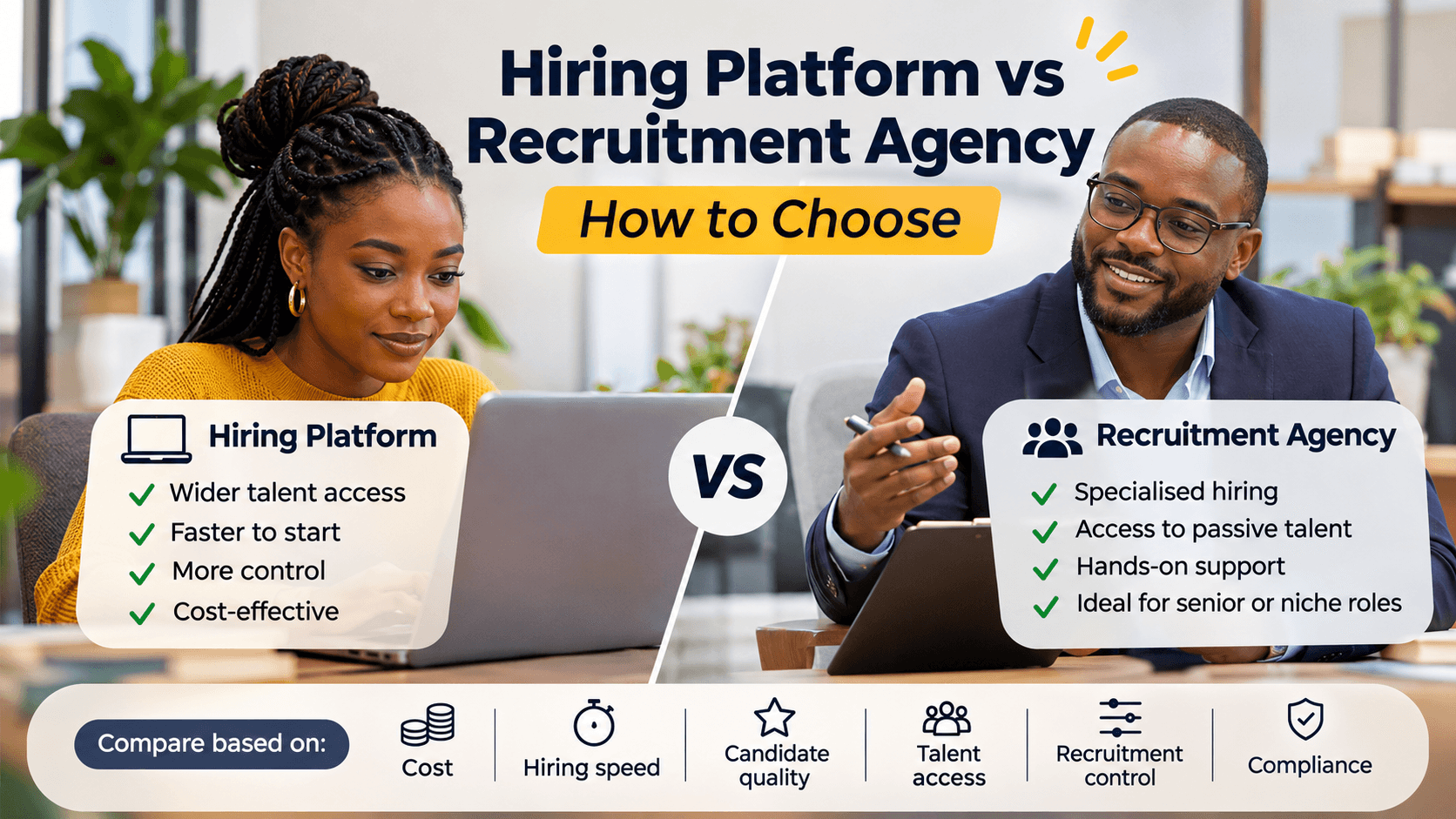
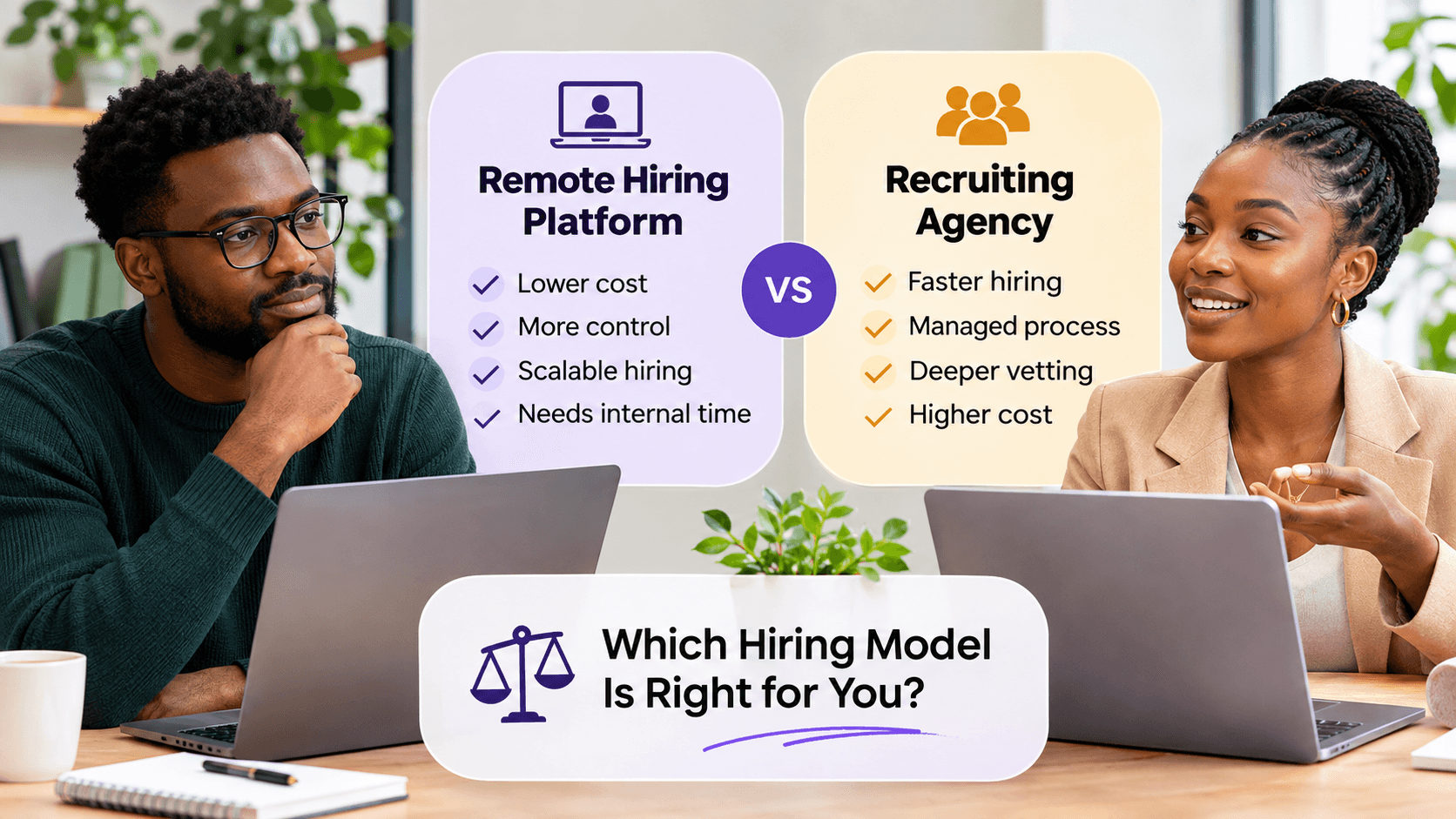
Agencies sit between you and the candidate, sourcing, screening and (for contract staffing) often running payroll and billing you a marked-up rate. Platforms, by contrast, tend to expose the role and the terms directly, with the matching done by software, a vetting layer, or both. The UK recruitment and staffing industry contributes an estimated £41.3 billion in GVA, so this is no sideshow. It’s a big, established machine, and not every part of it is equally transparent. An employer of record is a third flavour. It employs someone on your behalf, legally, while you direct their daily work. Handy for cross-border hires. Not a magic cure for compliance, though.
How Do the Costs Compare for Employers?
Here’s the thing people skip: you can’t compare a day rate to a salary without loading the salary. So let’s load it.
Cost element | Permanent (direct hire) | Permanent (agency placement) | Contract via agency |
|---|---|---|---|
Upfront fee | None, but advertising and time | Typically a percentage of first-year salary | None |
Ongoing markup | None | None | Built into the day rate |
Employer NI, pension, benefits | Yours | Yours | Usually the agency’s, priced into the rate |
Notice or exit cost | Yours | Yours, with a rebate window | Short notice, minimal |
Replacement risk | Yours | Partly covered by guarantee | Agency swaps the worker |
Agency Fees and Margins
A permanent placement fee is commonly set as a percentage of the candidate’s starting salary, and it varies by sector and seniority, so I won’t pretend there’s one number. Ask for it in writing before you share a single CV. Contract recruitment works differently: the agency’s margin hides inside the rate it bills you, which means the markup can be invisible unless you ask what the worker is actually paid. Ask. Many won’t volunteer it, and the good ones won’t flinch when you do.
Payroll and Onboarding Costs
Permanent hires land on your payroll and trigger employer NI, pension contributions, equipment, software seats, and an onboarding period where productivity is, let’s be honest, patchy. For benchmark, the CIPD puts the median cost per hire at £3,500 for senior managers and £2,000 for other employees. That’s before you count salary. Contract workers placed via an agency skip most of this, since the agency handles payroll, though you still pay for the ramp-up in time.
Hidden Replacement Costs
Nobody budgets for the hire that leaves in month five. A permanent departure means starting the requisition again, paying again, training again. Many agencies offer a rebate or replacement guarantee on a permanent placement fee, typically on a sliding scale over the first few months. Read the clause. Some guarantees fall away if the person leaves for “reasons outside the agency’s control”, which can cover a startling amount of ground.
Which Model Suits Candidates Better?
Pay, Benefits and Security
Contract rates look glorious on paper. A day rate that annualises well above a comparable salary is common, and it’s tempting. But you’re covering your own holiday, your own sick days, your own gaps, and in some cases your own pension and insurance. Strip those out and the gap narrows fast. Permanent roles offer security that people undervalue until they need it. Notice periods. Statutory redundancy pay. A salary that arrives whether the pipeline is quiet or not. Just don’t mistake that for immunity. 27% of surveyed employers made redundancies over the past year, up from 17% the year before, so job security is a spectrum, not a guarantee. And here’s where I’ll plant a flag. Calling self-employment “safer” because layoffs are happening is wishful thinking. When budgets tighten, contractors are usually the first to go, and with no notice period to soften it. I’d rather have a clear permanent role than an agency’s breathless contract pitch any day.
Flexibility and Career Growth
Contract work buys you variety, fast skill-stacking and the ability to say no. Permanent roles buy you progression, sponsorship, a manager who knows your work, and a route into leadership. Choose based on where you are. Early career? A couple of contracts can accelerate learning. Mid-career with a mortgage and a plan to lead teams? Permanent usually wins. Only about 5% of working-age employees in the UK are in temporary employment, against 95% in permanent positions. Worth remembering when someone tells you contracting is “the future of work”. It’s a sizeable niche, not the mainstream.
Tax and Self-Employment Reality
Working through your own limited company means dividends, corporation tax, accountant fees and a close eye on IR35 status. Working through an umbrella means PAYE with the umbrella’s fees deducted. Neither is the free lunch the headline rate implies. Check what you’d take home after all of it, and compare that against a salary plus benefits. Do the sums properly. Then do them again.
When Should Employers Hire Contract Staff?
When the work has an edge. A migration project with a go-live date, maternity cover, a specialist skill you need for ten weeks, a spike in demand you can’t yet justify turning into headcount. Contract is the right tool for bounded work. It’s also useful when you simply can’t forecast. 46% of organisations plan their workforce in an ad hoc manner, and 24% plan only up to six months ahead. If that’s you, committing to permanent hires on a shaky forecast is its own gamble. Just don’t use contract to paper over a role that plainly isn’t going away. That’s three years of premium rates for a job that should have been permanent.
When Does Permanent Hiring Make More Sense?
When the work is core and continuing. Product engineers, finance leads, customer success, anything where knowledge compounds. A permanent hire learns your quirks, builds client relationships and carries context that walks out the door with every contractor.
It also makes sense when competition for talent is brutal. Around 52% of organisations report heightened competition for skilled candidates, and strong people often want the stability of a permanent offer. Offer flexibility alongside it, because flexible working is now table stakes for most advertised roles.
Why Is Contract-to-Hire Often a Red Flag?
Contract-to-hire promises a trial run with a conversion at the end. Sometimes it’s genuine, and sensible for both sides. Often it’s not. I’ve seen the version where a candidate says no to a contract and suddenly the “permanent” role they were chasing turns out to be a contract after all. That isn’t a clever alternative. It’s a bait-and-switch. If a role is advertised as permanent, it should be permanent, and if the terms change after the candidate declines, you should be asking what else is being changed quietly. Three things to demand before you agree to any contract-to-hire arrangement:
The conversion salary, stated in writing, and the point at which conversion happens.
Whether the agency charges a conversion fee, and how much, so no one is surprised later.
What happens if neither side wants conversion, including notice and payment terms.
Without those, “contract-to-hire” is just a contract with a rumour attached.
What Compliance Risks Should You Check?
Employment status first. Get it wrong and you face back-taxes, penalties and claims for holiday pay, so check IR35 and the substance of the working relationship, not merely the paperwork. Then the Agency Workers Regulations: temps who’ve completed twelve weeks in the same role are entitled to the same basic pay and conditions as comparable employees. Then fixed-term rules, covered above, which quietly convert long-running arrangements into permanent ones. Add the legislative weather. 43% of HR leaders expect direct cost and operational impacts from the Employment Rights Act, and 26% plan to reduce hiring because of it. Whatever your model, assume the rules will tighten and build in time to review contracts regularly. Get proper legal advice for anything borderline. A blog won’t cover you.
How Do You Spot Transparent Recruiters?
Frankly, it’s easier than the industry would like. They put the terms in writing. Rate, duration, location, hours, who the end client is, what the fee is. All of it.
Here’s my pet hate: the recruiter who rings, asks if you’re interested, then never sends the details. I’m not making a career decision on a vague phone pitch. Put the terms in writing or don’t bother. If a recruiter can’t tell you the rate range and the client’s sector in an email, ask what they’re hiding, or whether they even have a live role. For employers, transparency means the same in reverse. A clear fee schedule, a stated replacement guarantee, honest timelines, and a willingness to show how candidates were sourced. And if the recruiter leans on AI to screen candidates, ask how. Only 16% of HR and resourcing teams use AI for job descriptions or screening, so it’s still an area where practice varies wildly. Agencies don’t get a free pass just because they’re the usual middleman. If a platform or a direct approach makes the role and the terms visible, I’d use it every time. Our guide on how to choose between hiring platforms and agencies goes into the evaluation questions in detail.
Why Choose IMO Talent?
Because the terms are on the table from the start. IMÒ Talent is a platform for hiring pre-vetted remote talent, and it’s built around visible roles and visible terms, which is precisely what I’ve been grumbling about for the last thousand words. If you want a straight comparison, there’s a useful piece on how IMÒ differs from a standard recruitment agency. Cost matters too. Agency markups and placement fees add up, and the cost comparison between remote hiring platforms and recruiting agencies lays out where the numbers land. And if you’re weighing full-time remote staff rather than short-term contractors, this guide to hiring full-time remote staff with IMÒ is worth a read. It isn’t the right tool for every hire. For a three-week local contract in a regulated sector, you’ll probably want a specialist agency. For remote, skills-led roles where you want clarity, it’s a strong option.
FAQ
Is contract recruitment more expensive than permanent?
Per day, yes. Over a year, not necessarily. A contractor’s rate includes the agency markup and the risk they carry, but you avoid employer NI, pension, benefits, onboarding and exit costs. Load a salary properly before comparing.
What is a placement fee?
It’s the charge an agency makes when you hire a permanent candidate it introduced, usually calculated as a percentage of first-year salary. Always confirm the percentage and the replacement guarantee in writing.
Can contractors become permanent?
Yes, through conversion or direct hire. Check the agency’s conversion terms first, because some charge a fee, and some restrict you from hiring the worker directly for a set period.
Is contract-to-hire a good idea?
Only when the conversion terms are clear from the start. Without a stated salary, timeline and fee, it can be a stalling tactic.
Which is safer for candidates?
Permanent, generally. Notice periods and statutory redundancy pay offer a cushion that contractors rarely get. But safer isn’t safe: redundancies are rising, so keep your skills current either way.
Conclusion
Contract and permanent hiring solve different problems. Use contract for bounded work, uncertain demand and specialist bursts. Use permanent for core roles where knowledge compounds and retention pays you back. Treat contract-to-hire with suspicion until the terms are written down. Whichever way you go, insist on transparency: fees, rates, status, notice, all in black and white. Recruiters, platforms and agencies that can’t manage that haven’t earned your time. So which would you choose, the clear permanent offer or the clever contract pitch?