Remote hiring gives businesses access to talent beyond their immediate location, but managing distributed employees introduces risks that are easier to overlook when people rarely meet in person.
Common remote employee management red flags include poor communication, inconsistent performance, weak accountability, skills gaps, disengagement, unclear expectations and misalignment with the way a team works. The best way to reduce these risks is to address them throughout the employee lifecycle from candidate screening and hiring to onboarding, performance management and ongoing support.
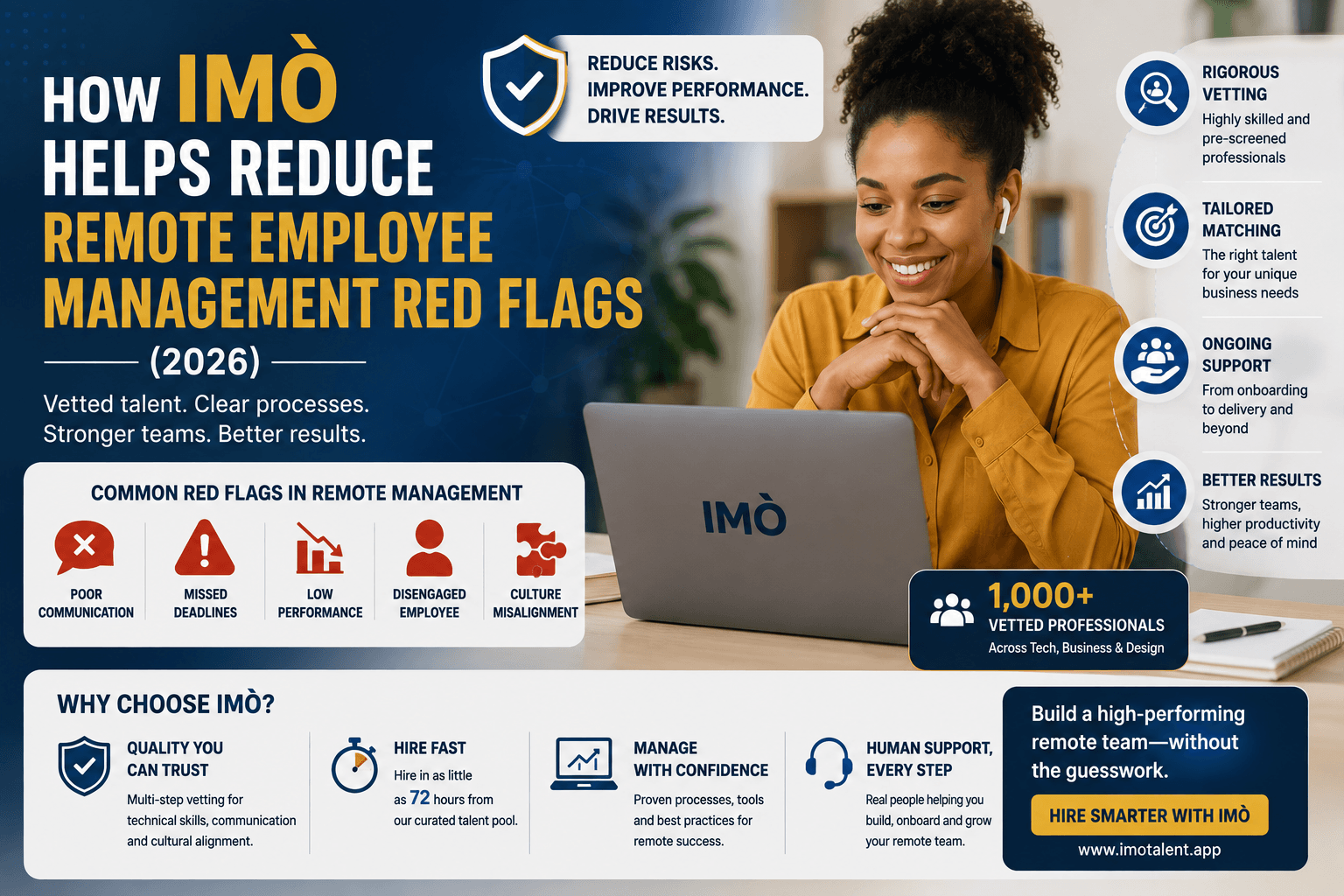
IMÒ Talent helps companies reduce these risks by connecting them with vetted remote professionals, assessing candidates before they enter the talent pool, matching talent to specific business needs and supporting companies during onboarding and delivery. IMÒ currently states that its network includes more than 1,000 vetted professionals and that candidates are screened for technical ability, communication and cultural alignment.
Quick Answer: How Does IMÒ Reduce Remote Hiring and Management Risks?
IMÒ helps companies reduce common remote workforce risks through:
- Rigorous candidate vetting
- Skills and communication assessments
- Tailored talent matching
- Structured onboarding support
- Clear role and performance expectations
- Ongoing support after hiring
- Early identification of engagement issues
- Access to remote-ready professionals
IMÒ’s current hiring process includes sourcing, assessment and vetting before professionals enter its curated talent pool. Companies can then interview candidates and receive support as they move into onboarding and delivery.
What Are Red Flags in Remote Employee Management?
A remote employee management red flag is a behaviour, pattern or operational issue that may indicate a problem with performance, communication, engagement or role alignment.
One missed message is not necessarily a red flag.
Managers should look for consistent patterns, such as repeated missed deadlines, unexplained communication gaps or a continuing decline in work quality.
Remote teams require particular attention because managers cannot rely on physical proximity to notice problems.
Some of the most common warning signs include:
- Repeated missed deadlines
- Poor or inconsistent communication
- Declining work quality
- Lack of accountability
- Difficulty working independently
- Unclear understanding of responsibilities
- Low meeting or project participation
- Repeated failure to apply feedback
- Skills that do not match the role
- Signs of disengagement
- Poor documentation
- Difficulty collaborating across locations or time zones
Identifying these issues early makes them easier to address.
Why Remote Employee Management Requires a Different Approach
Managing remote employees should not mean trying to recreate an office through constant calls, status updates and employee monitoring.
Distributed teams need different systems.
Managers have fewer opportunities to observe work informally, so expectations, ownership and communication need to be more explicit.
For example, a manager may not immediately notice that an employee has misunderstood a project unless there are clear milestones and check-ins.
Likewise, an employee who is struggling may not be able to turn to the person sitting next to them for immediate help.
Effective remote management therefore depends heavily on:
- Clear expectations
- Reliable communication
- Documented processes
- Defined ownership
- Measurable outcomes
- Appropriate support
- Regular feedback
It also starts before the person joins the company.
Hiring someone who is poorly suited to remote work creates management problems that even an excellent manager may struggle to solve.
7 Common Remote Employee Management Red Flags
1. Candidate Skills Do Not Match the Role
One of the earliest risks appears during recruitment.
CVs and interviews provide useful information, but they do not always show how someone will perform in real working conditions.
A candidate may look strong on paper but lack the technical knowledge, communication ability or independent working skills required for the position.
For remote roles, companies should evaluate more than qualifications.
Look at:
- Relevant technical or professional skills
- Communication
- Problem-solving
- Ability to work independently
- Previous work or projects
- Responsiveness to feedback
- Understanding of the role
- Remote-working readiness
A structured assessment process reduces the likelihood of discovering major skills gaps after hiring.
2. Communication Becomes Inconsistent
Communication problems can quickly become operational problems in distributed teams.
A few hours between responses may be completely normal, particularly across time zones.
The warning sign is a recurring pattern that interferes with work.
Examples include:
- Repeatedly ignoring important messages
- Failing to communicate blockers
- Missing scheduled meetings without explanation
- Providing incomplete updates
- Waiting until deadlines have passed before reporting a problem
- Leaving teammates uncertain about project status
The solution is not to demand instant responses to every message.
Teams need agreed communication standards.
Employees should know which channels to use, when a response is expected and what qualifies as urgent.
3. Deadlines Are Repeatedly Missed
Everyone misses a deadline occasionally.
A pattern of missed deadlines without communication or improvement requires attention.
Before assuming the employee is the problem, investigate the cause.
Ask:
- Was the deadline realistic?
- Was the assignment clear?
- Did the employee have the information they needed?
- Were there external dependencies?
- Did priorities change?
- Did the employee raise the problem early?
- Is workload becoming unreasonable?
If the same problem continues after expectations and support are clarified, the issue may indicate a deeper performance or accountability problem.
4. Work Quality Starts Declining
A sudden or sustained drop in work quality can indicate several problems.
The employee may be unclear about expectations, overwhelmed, disengaged or lacking a required skill.
Look for patterns such as:
- Increasing errors
- Repeated rework
- Incomplete deliverables
- Less attention to detail
- Failure to apply previous feedback
- Reduced ownership of assignments
Managers should respond by identifying the cause rather than jumping immediately to a conclusion.
A performance problem may require clearer feedback.
A skills gap may require training.
A workload problem may require reprioritisation.
5. Accountability Is Weak
Remote teams need employees who can take appropriate ownership of their responsibilities.
Accountability does not mean completing every task without help.
It means communicating clearly about progress, problems and commitments.
Possible warning signs include:
- Repeated excuses without corrective action
- Hiding mistakes
- Blaming teammates for routine issues
- Failing to follow through on agreed actions
- Requiring frequent reminders for established responsibilities
Strong remote employees usually communicate early when something goes wrong and take part in finding a solution.
6. Engagement Declines
Remote disengagement is not always obvious.
An employee may continue attending meetings while becoming increasingly disconnected from their work or team.
Potential signs include:
- A noticeable drop in participation
- Reduced initiative
- Limited interaction with colleagues
- Repeatedly missing team activities
- Lower work quality
- Less communication than usual
- Lack of interest in goals or development
These signals should prompt a conversation rather than an assumption.
Changes in behaviour can have many causes.
IMÒ has also highlighted the importance of identifying disengagement signals early in distributed African teams and providing ongoing support after placement rather than treating recruitment as complete once a contract is signed.
7. The Employee and Role Are Poorly Aligned
Sometimes the employee is capable but the role is still a poor match.
For example, someone who performs well with clear instructions may struggle in a position requiring constant ambiguity and independent decision-making.
Another employee may have excellent technical skills but find a highly client-facing position difficult.
This is why matching should consider more than a list of technical skills.
Companies should evaluate:
- Role responsibilities
- Seniority
- Communication requirements
- Working style
- Time-zone requirements
- Independence required
- Team structure
- Business objectives
The earlier these requirements are defined, the easier it becomes to select the right person.
How IMÒ Helps Minimize Remote Employee Management Red Flags
1. Rigorous Vetting Before Hiring
Preventing management problems starts with candidate selection.
IMÒ does not position its talent pool as an unrestricted database of applicants. Its current process involves sourcing professionals and putting applicants through assessments before successful candidates enter the curated talent pool.
According to IMÒ’s current website, its vetting process assesses technical or business capabilities as well as communication, and only successful candidates become part of its job-ready network.
This can help companies reduce risks such as:
- Hiring someone without the required skills
- Discovering major communication problems after hiring
- Spending significant internal time screening unsuitable applications
- Selecting candidates solely from CV claims
Vetting cannot guarantee that every hire will succeed.
It does, however, provide employers with more information before they make the hiring decision.
Questions employers should still ask
Even when candidates have been vetted, employers should conduct their own interviews.
Ask:
- What outcomes will this person own?
- Have they handled comparable responsibilities?
- How do they approach ambiguous tasks?
- How do they communicate blockers?
- What does effective remote collaboration look like to them?
- How do they prefer to receive feedback?
Vetting and employer interviews should complement one another.
2. Matching Candidates to the Actual Business Need
Hiring a strong candidate is not enough.
You need the right candidate for the specific role.
IMÒ describes its service as providing tailored matching based on the company’s needs and assessing skills and cultural alignment as part of the process.
This matters because remote performance problems can begin with mismatched expectations.
A technically strong software developer might still be a weak choice for a role requiring daily client presentations.
A talented junior employee may struggle if the company actually requires someone capable of independently leading a function.
Before requesting candidates, define:
- Core responsibilities
- Essential skills
- Desired experience
- Expected outcomes
- Working hours or overlap requirements
- Communication requirements
- Level of independence
- Management structure
A precise hiring brief makes effective matching much easier.
3. Faster Access to Pre-Vetted Talent
Lengthy recruitment processes create another type of operational risk.
Important projects may remain understaffed while existing employees absorb additional work.
IMÒ currently advertises access to more than 1,000 vetted professionals across technology, business and design and says companies can hire from its talent pool in as little as 72 hours.
Speed should never replace proper evaluation.
The advantage of a pre-vetted pool is that some of the initial screening has already happened before the employer starts interviewing.
The company can therefore focus more of its time on assessing the candidates most relevant to its specific role and business environment.
4. Structured Onboarding Support
A successful hire can still fail because of poor onboarding.
New remote employees need more deliberate onboarding because they cannot learn everything through office observation.
An effective remote onboarding process should cover:
- Role expectations
- First-week priorities
- Communication channels
- Working hours and overlap expectations
- Company documentation
- Access to necessary systems
- Security requirements
- Key stakeholders
- Performance expectations
- 30-, 60- and 90-day goals
IMÒ’s current service describes support continuing through onboarding and delivery rather than ending at candidate selection. Its 2026 onboarding guidance also emphasizes structured remote onboarding, including infrastructure readiness, communication expectations and performance milestones.
Good onboarding reduces ambiguity before it turns into poor performance.
5. Clear Performance Expectations
One of the biggest mistakes in remote management is measuring whether someone appears busy instead of whether useful work is being completed.
Remote performance management should focus primarily on outcomes.
Managers should define:
- What the employee owns
- What success looks like
- Which deadlines matter
- How work quality will be evaluated
- Which KPIs are relevant
- How often progress will be reviewed
- When problems should be escalated
For example, instead of:
“Be online throughout the day.”
A better expectation might be:
“Resolve priority customer tickets within the agreed service level and provide an update before the daily handover.”
The second expectation is measurable and connected to the employee’s actual job.
6. Regular Check-Ins Without Micromanagement
Remote management requires visibility, but visibility should not become surveillance.
Managers can use structured check-ins to understand:
- What has been completed
- What is currently in progress
- Whether anything is blocked
- What decisions are needed
- Whether priorities have changed
- Where the employee needs support
A simple weekly check-in might ask:
- What did you complete?
- What are you working on now?
- What is blocking you?
- What do you need from me?
- What should we prioritise next?
This gives managers useful information without requiring constant status messages.
7. Ongoing Support After Placement
Recruitment does not end when the employee starts work.
Early performance, onboarding and engagement have a major influence on whether a new remote hire succeeds.
IMÒ’s current materials describe ongoing assistance after matching and onboarding, including continued support during delivery. Recent IMÒ guidance also describes an ongoing support layer intended to identify engagement problems and help companies address issues after placement.
That support is particularly useful when an employer is building a distributed team in a market it does not know well.
8. Better Communication Across Distributed Teams
Communication problems cannot be solved simply by buying another application.
Managers first need communication rules.
A remote team should know:
| Situation | Recommended Approach |
|---|---|
| Urgent operational issue | Direct message or call |
| Routine project update | Project management tool |
| Important decision | Document it in a shared system |
| Complex discussion | Video or voice call |
| Non-urgent question | Asynchronous message |
| Performance discussion | Private one-to-one meeting |
The exact applications will vary between companies.
Popular remote teams may use tools such as Slack or Microsoft Teams for messaging, Zoom or Google Meet for meetings, and systems such as Notion, Jira, Linear, Asana or ClickUp for documentation and project management.
The important part is consistency.
Employees should not have to search across six applications to find one decision.
9. Supporting Engagement and Retention
Remote employees can feel disconnected when their only interaction with colleagues involves tasks and deadlines.
Managers should intentionally create opportunities for connection.
Useful approaches include:
- Regular one-to-one meetings
- Peer mentorship
- Recognition for good work
- Professional development
- Team discussions
- Informal social interaction
- Clear career progression
- Opportunities to contribute ideas
Recognition does not need to be elaborate.
Specific feedback such as “Your documentation reduced the time the support team spent resolving this issue” is often more useful than a generic “great job.”
Managers should also watch for changes in behaviour.
A previously engaged employee who suddenly stops contributing may need support, clarity or a conversation about workload.
10. Continuous Learning and Development
Remote employees need opportunities to develop just as office-based employees do.
Training may include:
- Role-specific courses
- Technical workshops
- Communication training
- Mentorship
- Leadership development
- Peer learning
- Industry webinars
- Certifications
- Cross-functional projects
Development benefits the employee while also reducing the risk that their skills become misaligned with evolving business needs.
Managers should discuss development during regular performance conversations rather than treating training as an occasional perk.
Remote Employee Red Flag Checklist
Managers can use this checklist during weekly or monthly reviews.
| Area | Healthy Signal | Potential Red Flag |
|---|---|---|
| Communication | Regular, useful updates | Repeated unexplained silence |
| Deadlines | Meets commitments or flags risks early | Repeated missed deadlines |
| Work quality | Stable or improving | Persistent decline |
| Accountability | Owns outcomes and mistakes | Repeated blame or excuses |
| Collaboration | Works effectively with colleagues | Increasing isolation or friction |
| Initiative | Solves appropriate problems independently | Requires constant prompting |
| Feedback | Applies constructive feedback | Repeats the same issues |
| Engagement | Participates appropriately | Sustained withdrawal |
| Skills | Performs role requirements | Persistent fundamental gaps |
| Documentation | Keeps work accessible | Information regularly gets lost |
Do not make employment decisions from one isolated incident.
Look for patterns, document examples and discuss concerns directly with the employee.
A 30-60-90 Day Framework for Managing a New Remote Hire
First 30 Days: Learn and Integrate
Focus on:
- Company orientation
- Role clarity
- Tools and systems
- Communication expectations
- Team introductions
- Initial training
- Small, well-defined deliverables
At this stage, managers should expect questions.
The goal is understanding rather than complete independence.
Days 31–60: Build Independence
The employee should begin handling more responsibilities without constant guidance.
Evaluate:
- Work quality
- Communication
- Deadline reliability
- Application of feedback
- Problem-solving
- Collaboration
Address gaps before they become habits.
Days 61–90: Demonstrate Ownership
By this stage, expectations should be clearer.
Evaluate whether the employee can:
- Own key responsibilities
- Solve routine problems
- Communicate risks early
- Deliver consistent work
- Collaborate effectively
- Meet agreed performance goals
A 90-day review gives both the employer and employee an opportunity to discuss what is working and what needs to change.
How to Handle a Remote Employee Red Flag
Identifying a red flag is only useful if managers respond appropriately.
Step 1: Verify the Pattern
Do not act on assumptions.
Collect specific examples.
Step 2: Discuss It Directly
Explain what you have observed and give the employee an opportunity to provide context.
Step 3: Clarify Expectations
Define exactly what needs to change.
Step 4: Agree on Support
Determine whether the employee needs training, clearer instructions, resources or management support.
Step 5: Set a Review Point
Agree on measurable improvements and a date to review progress.
Step 6: Document Important Conversations
Maintain appropriate records of performance expectations and agreed actions.
A fair process helps distinguish temporary difficulties from persistent performance problems.
How to Prevent Remote Management Problems Before They Start
The most effective approach is prevention.
Before hiring:
- Define the role precisely.
- Identify essential skills.
- Use structured interviews.
- Assess job-relevant abilities.
- Discuss remote working expectations.
- Verify important candidate information where appropriate.
During onboarding:
- Establish communication rules.
- Provide system access early.
- Define responsibilities.
- Introduce key colleagues.
- Set initial goals.
- Explain how performance will be measured.
During employment:
- Review goals regularly.
- Give feedback early.
- Document processes.
- Track outcomes.
- Support professional development.
- Address recurring problems promptly.
Good remote management is a system, not a single tool.
Frequently Asked Questions About Remote Employee Management
What are the biggest red flags in remote employees?
Common red flags include repeated missed deadlines, unexplained communication gaps, declining work quality, failure to apply feedback, weak accountability and persistent disengagement. Managers should look for patterns rather than judging employees from isolated incidents.
How do you know whether a remote employee is actually working?
Focus on agreed outcomes instead of trying to observe every hour worked. Clear deliverables, deadlines, quality standards and role-specific KPIs provide better evidence of performance than online status.
How can companies reduce the risk of a bad remote hire?
Use clear job requirements, structured interviews, relevant skills assessments, candidate verification where appropriate and a deliberate onboarding process. Pre-vetted talent networks can reduce some of the initial screening work.
How does IMÒ vet remote talent?
IMÒ states that applicants go through a vetting process involving technical or business and communication assessments before successful candidates enter its curated talent pool. Its website also says professionals are screened for technical skills, communication and cultural alignment.
How quickly can companies hire through IMÒ?
IMÒ currently advertises hiring in as little as 72 hours from its pool of vetted professionals, although the actual timeline will depend on the role, employer requirements, interviews and candidate availability.
Does IMÒ support companies after they hire?
Yes. IMÒ’s current website describes dedicated support from onboarding through delivery, as well as documentation and ongoing help during the hiring and onboarding process.
How should managers measure remote employee performance?
Measure results relevant to the role, such as project completion, work quality, customer outcomes, sales performance or deadline reliability. Avoid treating online presence or message volume as a substitute for productivity.
How often should managers check in with remote employees?
The right frequency depends on the employee and role. New employees may require more frequent support, while experienced team members may need less. Regular one-to-one meetings combined with asynchronous project updates usually provide better visibility than constant monitoring.
How do you keep remote employees engaged?
Set clear goals, provide useful feedback, recognise good work, create opportunities for professional development and maintain regular communication. Employees should understand how their work contributes to broader company objectives.
What should you do when a remote employee becomes unresponsive?
First establish whether the behaviour is unusual and check whether there is an urgent personal or technical issue. If the pattern continues, discuss expectations directly, document the problem and follow your company’s performance or HR procedures.
Build a Stronger Remote Team With IMÒ Talent
Remote work does not have to mean accepting greater uncertainty.
The strongest approach begins with selecting the right people, setting clear expectations and supporting them with good remote-management practices.
IMÒ Talent connects companies with vetted professionals across technology, business and design. Its current talent network includes more than 1,000 vetted professionals, with candidates assessed before entering the curated pool and support available through onboarding and delivery.
Instead of waiting until performance problems appear, build systems that reduce the likelihood of those problems from the beginning.