

What if the most talented Python developers for your team aren’t in London or New York at all, but across the African continent, working in a time zone that actually aligns with your working day? If you’ve been wrestling with sky-high salaries, recruitment cycles that drag on for months, and the nagging worry about remote reliability, you’re not alone. Most hiring managers in the UK are facing exactly the same wall. This Hire Python Developers in Africa: The 2026 Resource Guide is built to knock it down.
Here’s the reality: Africa’s tech ecosystem has matured rapidly. Hubs like Lagos and Nairobi are producing senior-level Python engineers with deep expertise in AI, backend infrastructure, and data engineering. The talent is genuinely elite, and it’s no longer a well-kept secret among the world’s fastest-scaling companies.
In this guide, you’ll discover exactly how to access that talent pool without the guesswork. We’ll walk you through where to find pre-vetted Python developers, what a rigorous vetting process should actually look like, how to cut your payroll costs by up to 60%, and how to get a qualified developer integrated into your team in as little as 72 hours. Practical steps, honest advice, no jargon.
Key Takeaways
- Africa’s tech hubs — particularly Lagos and Nairobi — are producing senior-level Python engineers capable of competing with the best talent in London or New York, often at a fraction of the cost.
- This Hire Python Developers in Africa: The 2026 Resource Guide shows you exactly how to cut your engineering payroll by up to 60% without compromising on the quality or seniority of your hires.
- A structured vetting process — covering communication, culture fit, live coding, and architecture reviews — is the difference between a great hire and a costly mistake; you’ll learn what that process should look like in practice.
- With the right framework in place, you can have a pre-vetted Python developer integrated into your team in as little as 72 hours — no lengthy recruitment cycles required.
- Managing a remote African engineering team effectively comes down to smart integration strategies and the right operational support, from compliance and payroll through to day-to-day team culture.
Why Africa is the Top Destination to Hire Python Developers in 2026
The global race for Python talent has reached a breaking point. Demand has outpaced supply in traditional markets, and the gap is widening fast. As artificial intelligence, machine learning, and data engineering have moved from niche disciplines to core business functions, the Python programming language has become the backbone of it all. Every company wants Python engineers. Not enough markets can produce them quickly enough.
Africa can. And in 2026, it’s no longer a bold claim. It’s simply where the numbers point.
Breaking Down the 2026 Talent Shortage
London-based engineering teams are competing with fintech scale-ups, AI startups, and FAANG-adjacent firms for the same shrinking pool of local Python developers. Salaries have climbed sharply. Recruitment timelines have stretched. And the developers who do accept offers are often poached within six months. It’s an exhausting cycle that’s quietly draining engineering budgets and slowing product roadmaps.
Meanwhile, Africa’s developer population has grown substantially across the continent’s major tech hubs. Lagos, Nairobi, Accra, and Cape Town are producing engineers with serious backend credentials, not junior developers learning on the job, but professionals with production-grade experience in Django, FastAPI, cloud infrastructure, and data pipelines. Africa has quietly become the new frontier for high-performance backend engineering, and the world’s fastest-scaling companies have already taken notice.
The Strategic Advantage for UK Businesses
Here’s where UK hiring managers have a genuine structural edge. Nigeria operates on West Africa Time, which sits just one hour ahead of GMT and aligns almost perfectly with a standard UK working day. Kenya runs on East Africa Time, three hours ahead. That means real-time collaboration, live code reviews, and synchronous stand-ups without the scheduling acrobatics that come with hiring across US time zones.
Beyond the calendar, English is the primary professional language across Nigeria, Kenya, and Ghana. Business communication, technical documentation, and stakeholder updates don’t require translation layers. The working culture in these hubs reflects shared standards around delivery, accountability, and agile practices.
Then there’s the financial case. The cost of hiring developers in the US vs Africa is stark. UK firms working with African talent consistently report cost reductions of up to 60% compared to local or US-based equivalents, without stepping down in seniority or technical depth. For any scale-up managing runway carefully in 2026, that’s not a marginal saving. It’s a strategic advantage that compounds over time.
This is precisely why this Hire Python Developers in Africa: The 2026 Resource Guide exists. The opportunity is real. The talent is ready. The question is whether your hiring process is set up to access it.
Inside the African Python Ecosystem: Frameworks and Hubs
Africa’s tech scene isn’t one monolithic market. It’s a collection of distinct, specialised hubs, each with its own engineering culture, industry focus, and technical strengths. If you’re serious about finding the right Python developer for your team, understanding where to look and what each hub produces is half the battle.
Lagos, Nigeria: The Silicon Lagoon
Lagos has earned its nickname. Nigeria’s commercial capital is home to one of Africa’s most vibrant fintech ecosystems, with companies like Paystack, Flutterwave, and Kuda driving serious demand for production-grade Python engineers. The developers coming out of Lagos are typically battle-tested in high-transaction, high-reliability environments. If your product handles payments, financial data, or complex backend logic, Lagos is where you look first.
Nairobi, Kenya: The Silicon Savannah
Nairobi’s engineering community has built its reputation on mobile-first services and agricultural technology. M-Pesa’s legacy runs deep here, and it’s shaped a developer culture that prioritises lightweight, efficient code that performs under real-world constraints. Python’s data science stack is particularly strong in Nairobi, with engineers who understand how to move from raw data to deployable models in production systems, not just academic notebooks.
Cape Town, South Africa: Enterprise Python and AI Research
Cape Town sits at the more enterprise end of the spectrum. Its universities and research institutions have produced a strong pipeline of Python engineers with experience in AI research, machine learning infrastructure, and large-scale data architecture. Companies building sophisticated AI-driven products often find their strongest candidates here.
Cairo, Egypt: North Africa’s Rising Force
Cairo is rapidly closing the gap. Egypt’s engineering graduates are technically rigorous, and the city’s proximity to European time zones makes it an increasingly attractive option for UK businesses. The Python community there is growing fast, particularly in backend development and cloud-native applications.
Collectively, these hubs are part of Africa’s rapidly growing economy and workforce, which continues to attract global investment and produce technical talent at a scale that most Western markets simply can’t match right now.
Most Popular Python Frameworks in Africa
Knowing which frameworks African developers work with daily helps you write better job briefs and ask sharper interview questions. Here’s what’s dominant across the continent’s major hubs:
- Django and Flask: Still the workhorses of African fintech and e-commerce. Most senior Lagos and Nairobi developers have shipped production Django applications at scale. Flask tends to appear in lighter microservice contexts or rapid prototyping environments.
- FastAPI: Adoption has accelerated significantly as teams move towards modern API architectures. Developers who list FastAPI experience are typically comfortable with asynchronous Python and type annotations, which signals a higher level of technical maturity.
- Pandas and NumPy: Particularly prominent in Nairobi’s data engineering community. Engineers using these tools daily are usually comfortable moving between data wrangling, pipeline construction, and feeding models in production.
Specialised Skills to Look For
Beyond frameworks, the most valuable African Python developers in 2026 bring a combination of skills that map directly to modern engineering challenges:
- Asynchronous programming: Critical for building systems that handle concurrent requests without bottlenecks. Look for hands-on experience with
asyncio, FastAPI’s async capabilities, or Celery for task queuing. - Cloud-native Python: Strong candidates will have deployed and maintained Python applications on AWS, GCP, or Azure. Serverless experience is a genuine differentiator.
- AI model integration and LLM wrappers: As AI features move from nice-to-have to core product functionality, developers who’ve integrated OpenAI APIs, LangChain, or similar tooling into real applications are increasingly rare and valuable.
This Hire Python Developers in Africa: The 2026 Resource Guide is designed to help you move past generic job postings and target the specific technical profiles that will actually move your product forward. If you want to explore what a matched, pre-vetted Python developer from these hubs looks like in practice, browse Africa’s top Python talent and see the calibre for yourself.
The Business Case: 60% Savings Without Quality Compromise
Let’s talk numbers. Not vague promises about “significant savings,” but the actual financial reality of what it means to build a Python engineering team with African talent in 2026. Because once you see the full picture, it’s hard to justify doing it any other way.
Salary Benchmarks for 2026
A senior Python developer in London is commanding anywhere between £70,000 and £110,000 per year in base salary alone, and that’s before you factor in National Insurance contributions, pension obligations, and the recruitment fees that typically run at 15 to 20 per cent of first-year salary. The equivalent senior-level engineer in Lagos or Nairobi, with comparable production experience and the same technical depth we covered earlier, commands a fraction of that figure.
Here’s a rough breakdown of what the market looks like across experience levels:
- Junior Python developers (1 to 3 years): Strong foundational skills, typically working with Django or Flask in production environments. Rates are significantly below UK junior equivalents.
- Mid-level developers (3 to 6 years): Comfortable with cloud infrastructure, asynchronous Python, and API design. Often the sweet spot for teams that need reliable delivery without senior-level overheads.
- Senior developers (6+ years): Architecture experience, team leadership capability, and deep specialisation in areas like data engineering or AI integration. These are the profiles that generate the most dramatic cost comparisons.
One factor worth understanding is currency stability. Because African developers are typically compensated in local currencies or USD-pegged contracts, UK businesses are largely insulated from domestic salary inflation. Hiring remote developers from Africa effectively acts as a hedge against the relentless upward pressure on UK engineering salaries. Your costs stay predictable while local market rates continue climbing.
The Total Cost of Ownership Picture
This is where most cost comparisons fall short. Monthly salary is only part of the story. A London-based senior Python developer carries a full TCO that includes employer National Insurance, pension contributions, equipment, desk space in an increasingly expensive office market, and the hidden cost of a three to six month recruitment cycle every time someone leaves.
Remote African talent removes most of that overhead in one move. No office allocation. No employer NI at UK rates. Faster placement, which means your product roadmap isn’t sitting idle while HR processes grind forward. IMO Talent’s 72-hour placement model is specifically built to eliminate that dead time.
The 60 per cent cost reduction that companies consistently report isn’t a marketing figure plucked from thin air. It reflects the genuine difference in total employment cost, not just the salary line.
Quality Metrics: Africa vs. The World
Here’s the concern that every honest hiring manager raises: cheaper must mean lower quality somewhere. It’s a fair instinct. And it’s also exactly why vetting matters more than geography.
The solution isn’t to lower your technical bar. It’s to apply the same bar, rigorously, regardless of where a candidate is based. Standardised technical assessments, live architecture reviews, and structured communication evaluations don’t care where someone is working from. What they surface is capability, and capable engineers exist in Lagos and Nairobi at the same density as anywhere else.
Global brands scaling with African engineering teams aren’t doing so out of desperation. They’re doing it because the engineers they’ve found are genuinely excellent, and they’ve reinvested the savings directly into product development, faster iteration cycles, and expanded team capacity. That’s the compounding advantage this Hire Python Developers in Africa: The 2026 Resource Guide is pointing you towards. The savings aren’t an end in themselves. They’re fuel.
There’s also something worth naming about the professional mindset you’ll encounter. African tech professionals operating in competitive hubs like Lagos and Nairobi are building careers in markets where the bar is high and the competition is fierce. That drives a hunger for growth and a commitment to delivery that you’ll feel immediately once someone is integrated into your team.
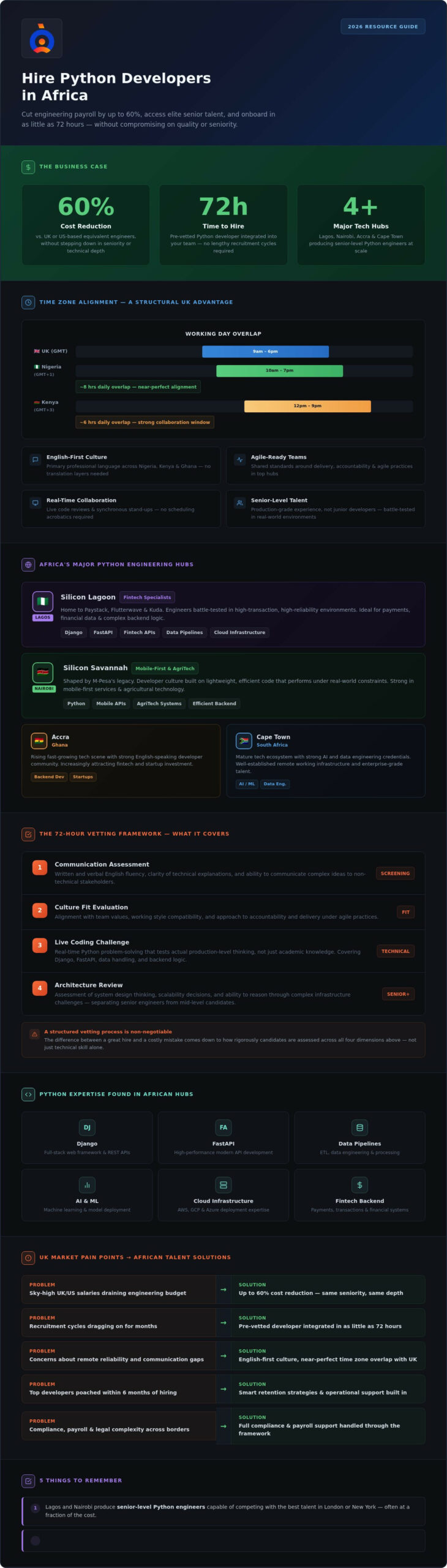
Vetting and Hiring: The 72-Hour IMO Talent Framework
Most hiring processes are built for a world that no longer exists. Weeks of back-and-forth, generic technical tests, and gut-feel interviews that tell you very little about how someone actually writes code under pressure. IMO Talent’s framework is built differently. It’s a four-stage process designed to surface elite Python engineers fast, and get them contributing to your team within 72 hours of placement.
Step 1: Communication and Culture Fit Screening
Before a single line of code is reviewed, every candidate goes through a structured communication assessment. This isn’t a box-ticking exercise. It’s a deliberate filter for the things that sink remote hires: unclear written communication, mismatched expectations around delivery, and cultural friction that shows up three months in. Only candidates who clear this stage move forward. The technical pipeline stays clean because the human layer is already sorted.
Step 2: Rigorous Technical Testing
This is where IMO Talent’s process separates itself from the “check their GitHub” approach that passes for vetting on most platforms. Candidates complete live coding assessments and architecture reviews built around real-world engineering scenarios, not abstract puzzles. The goal is to see how someone thinks when a system breaks, not whether they can reverse a linked list on a whiteboard.
How to Vet Python Skills Specifically
If you’re running your own technical evaluation alongside IMO Talent’s process, here’s what actually matters for Python specifically:
- Clean code and PEP 8 compliance: Sloppy formatting is a signal. A developer who writes readable, consistently structured Python is a developer who works well in teams. Ask to see production code samples, not polished portfolio pieces.
- Real-world problem-solving: Set scenarios that mirror your actual engineering challenges. If your product handles high-volume API requests, test for that. Generic algorithm questions tell you almost nothing about production readiness.
- Actionable tip: Build a short take-home assignment that uses a simplified version of your actual codebase. Ask candidates to extend a feature or fix a realistic bug. What you’re looking for isn’t perfection; it’s how they approach an unfamiliar system and communicate their thinking.
Step 3: The Matchmaker Phase
Technical capability alone doesn’t make a great hire. IMO Talent’s matchmaker stage aligns shortlisted candidates with your specific team dynamics, product stage, and working culture. A developer who thrives in a fast-moving startup environment isn’t automatically the right fit for a team running structured two-week sprints. This stage ensures you’re not just getting a skilled engineer; you’re getting the right one.
Step 4: Rapid Onboarding and Integration
Once matched, the focus shifts to integration. Candidates arrive with context about your stack, your team’s communication norms, and your delivery expectations. There’s no cold-start period where someone’s figuring out how you work while your roadmap waits.
The 72-Hour Guarantee
Traditional recruitment cycles run three months on average. That’s three months of delayed features, overloaded existing engineers, and compounding opportunity cost. IMO Talent’s pre-vetted talent pool eliminates that dead time entirely. Because screening, testing, and matching happen before you ever make a request, the process of finding your developer is already done. What’s left is alignment and placement, and that takes 72 hours.
Speed is a competitive advantage in 2026. The teams scaling fastest aren’t waiting for the perfect hire to emerge from a six-week process. They’re moving quickly with confidence because their vetting framework is airtight. That’s exactly what this Hire Python Developers in Africa: The 2026 Resource Guide is designed to help you build.
Ready to skip the recruitment cycle entirely? Access IMO Talent’s pre-vetted Python developers and get your first placement within 72 hours.
Managing and Retaining Your African Python Team
Getting a great developer placed in 72 hours is only the beginning. The real competitive advantage comes from keeping them engaged, supported, and growing within your team long-term. Retention is where most remote hiring strategies fall apart, not because the talent isn’t there, but because the operational framework around it isn’t.
Done well, managing a remote African Python team feels no different from managing a co-located one. Done poorly, you’ll be back in the recruitment cycle within six months. Here’s how to make sure it’s the former.
Integration Strategies That Actually Work
Remote developers don’t become part of the team by accident. Inclusion has to be deliberate. From day one, your African Python developer should be in your team’s Slack channels, attending your sprint ceremonies, and named in your internal documentation as a full team member, not a contractor sitting at the edges.
Practical steps that make a measurable difference:
- Assign a named internal buddy for the first 30 days, someone who can answer “how do we do things here” questions without it feeling like a formal process.
- Include remote developers in social rituals, whether that’s a Friday end-of-week channel, team shoutouts, or virtual coffee catch-ups. Small gestures compound quickly into genuine belonging.
- Document your engineering culture explicitly. Don’t assume shared context. Write down your code review norms, your definition of done, your preferred communication style. A developer in Lagos shouldn’t have to guess what “good” looks like on your team.
The Role of Managed Services
One of the biggest friction points for UK businesses hiring African talent is the operational complexity that sits underneath the relationship: payroll in a different jurisdiction, compliance with local employment law, equipment provisioning, and ongoing HR support. Most hiring managers don’t have bandwidth for that, and they shouldn’t need to.
IMO Talent’s end-to-end management subscription handles this layer entirely. Payroll, compliance, and operational support are managed on your behalf, so your team lead is focused on sprint velocity, not invoice processing. This is the managed service advantage that most hiring guides completely ignore, and it’s the difference between a remote hire that feels seamless and one that creates administrative drag from week one.
Performance Monitoring Without Micromanaging
Clear KPIs matter more in remote settings than in any other. Vague expectations breed anxiety and misaligned effort. Set measurable outcomes at the sprint level: features shipped, code review turnaround time, bug resolution rate. Review them regularly and visibly, so your developer always knows where they stand.
Avoid the trap of tracking activity rather than output. Monitoring hours logged tells you very little. Tracking delivered value tells you everything.
Long-Term Retention Secrets
Retention in remote engineering teams comes down to two things: growth and recognition. Developers who feel challenged and seen stay. Those who feel like a resource, rather than a person, leave.
Build regular one-to-one sessions into your rhythm, not just performance check-ins, but genuine conversations about career direction, technical interests, and what they’d like to work on next. Rotate them onto projects that stretch their skills. If someone has been building Django APIs for 18 months and wants to move into data engineering, give them a path to do that within your team rather than watching them find it elsewhere.
Practical support matters too. Providing a hardware stipend or contributing to high-speed internet costs removes real-world friction that affects daily performance. It’s a small investment that signals you’re serious about the relationship. For a deeper look at the operational side of keeping remote African developers performing at their best, read the high-performance integration playbook from IMO Talent’s team.
Scalable Growth with Managed Solutions
One of the underappreciated advantages of building your Python team through IMO Talent’s subscription model is flexibility. If your product roadmap accelerates, you can scale up quickly, drawing from a pre-vetted pool without restarting the recruitment process from scratch. If priorities shift and you need to resize, the African talent market’s structure means you’re not locked into the rigid employment commitments that come with local hires.
This scalability is particularly valuable for scale-ups managing uncertain growth trajectories. You build the team you need now, with the confidence that you can adjust as your business evolves. That’s the kind of operational agility that this Hire Python Developers in Africa: The 2026 Resource Guide is ultimately pointing you towards: not just a smarter first hire, but a smarter way to build engineering capacity over time.
Ready to scale your Python team with elite African talent? Hire your Python developer today and have someone contributing to your roadmap within 72 hours.
Build Your Future-Proof Engineering Team Today
The global talent landscape has shifted. This Hire Python Developers in Africa: The 2026 Resource Guide has shown that the continent isn’t just a cost-saving alternative; it’s a primary source of elite technical talent. By tapping into hubs like Lagos and Nairobi, you gain access to senior-level Python engineers who work in your time zone and share your professional standards. You don’t have to choose between speed, quality, and budget anymore.
With a 72-hour placement guarantee and a pre-vetted pool of senior talent, you can bypass the traditional three-month hiring slog. You’ll save up to 60 per cent on payroll while keeping your product roadmap on track. It’s time to stop fighting over a shrinking local talent pool and start building with the world’s fastest-growing tech workforce. Scale your backend team with elite African Python developers now and see how quickly your engineering capacity can grow.
The right talent is ready to help you build what’s next. We’re here to make the match happen.
Frequently Asked Questions
What is the average salary for a Python developer in Africa in 2026?
African Python developers offer a 60 per cent cost reduction compared to equivalent roles in the UK or US. While specific rates vary by seniority and location, hiring from hubs like Lagos or Nairobi allows you to secure senior talent for the price of a junior local hire. This cost efficiency is a core pillar of our Hire Python Developers in Africa: The 2026 Resource Guide.
How do you handle time zone differences when hiring in Africa?
Time zone alignment is one of the biggest advantages of hiring from the continent. Nigeria operates on West Africa Time, which is just one hour ahead of the UK, while Kenya is three hours ahead. This overlap ensures your remote developers can join stand-ups and collaborate in real-time throughout the standard working day without scheduling hurdles.
Is Python a popular language among African developers?
Python is currently one of the most widely used languages across Africa’s major tech hubs. It’s the primary choice for the continent’s booming fintech sector and the rapidly expanding AI research community in Cape Town and Nairobi. You’ll find a deep pool of talent skilled in everything from backend infrastructure to complex data science pipelines.
What are the legal requirements for hiring remote workers in Africa?
Legal requirements vary by country, but using a managed service provider eliminates the need for you to set up local entities or manage foreign tax laws. We handle all compliance, payroll, and local employment regulations on your behalf. This allows you to scale your team without needing a deep understanding of the legal landscape in every African jurisdiction.
How quickly can I hire a vetted Python developer through IMO Talent?
You can have a pre-vetted Python developer integrated into your team in as little as 72 hours. Our network is already screened and tested, which means we skip the traditional months-long recruitment cycle. This high-velocity approach is a key feature we highlight in our Hire Python Developers in Africa: The 2026 Resource Guide.
Do African developers have experience with modern frameworks like FastAPI?
Yes, African developers are highly proficient in modern frameworks like FastAPI, Django, and Flask. Many senior engineers in Lagos and Nairobi have spent years building high-speed microservices and transaction-heavy fintech platforms. They stay current with global engineering trends and contribute actively to the open-source community, ensuring they bring modern best practices to your codebase.
How does IMO Talent ensure the technical quality of its developers?
We use a multi-stage vetting process that includes live coding assessments and deep architecture reviews. Our technical bar is set to global standards, ensuring every developer in our network can handle production-grade challenges. We don’t just check CVs; we verify hands-on problem-solving skills and clean code practices through rigorous technical evaluations.
Can I hire a full team of Python developers at once?
Yes, you can scale an entire engineering team quickly through our pre-vetted network. Whether you need a single senior lead or a full squad of backend engineers, our platform is designed for rapid, scalable growth. We ensure that every team member is technically proficient and culturally aligned with your existing workflow to ensure immediate productivity.