

Introduction
The best non-marketplace channels for hiring full-time remote staff worldwide are remote-first job boards, talent communities and portfolio sites, and direct LinkedIn sourcing, with an Employer of Record (EOR) stepping in afterwards to handle payroll and compliance. Map your coverage by deciding how many overlap hours a role truly needs, grouping countries into time bands around UTC, and then matching each channel to the regions where it actually works.
Most hiring teams get this backwards. They pick a country because it looks cheap, post a job, and only later discover that nobody on the team is awake when the production server falls over. Coverage is a design problem, not a sourcing problem.
Freelance marketplaces such as Upwork and Fiverr don’t fix this either. They’re built around gigs and bidding, which suits a one-off logo and suits a stable engineering hire about as well as a taxi suits a mortgage. If you want someone who stays for years, you need channels where people go looking for employment, not tasks.
So here’s how I’d do it.
What Are the Best Non-Marketplace Channels for Full-Time Remote Hiring?
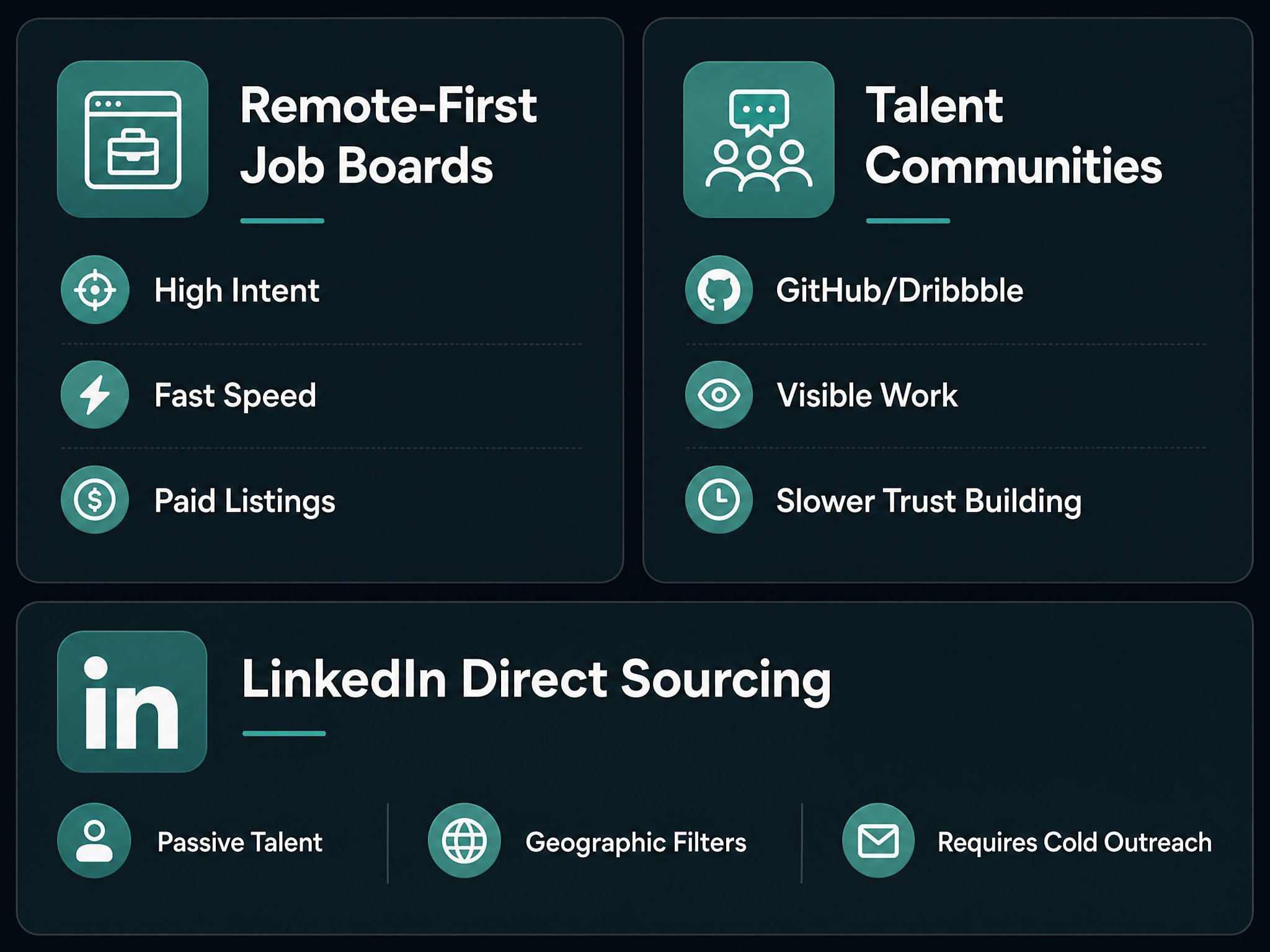
Three, really. Each one has a different cost, a different speed, and a different kind of candidate. If you want the wider landscape of options beyond marketplaces, this roundup of alternatives to freelance marketplaces covers more ground than I can here.
Remote-First Job Boards
Start with We Work Remotely or Remote OK if you’re hiring for tech, design or growth. Yes, postings cost money. Pay it. Reaching people who are actively hunting for fully remote jobs beats wading through a hundred freelance bids from people who’ll vanish when a better gig turns up.
Recruitment.com’s list of remote job boards is a handy sanity check on which boards suit which sectors. FlexJobs and Virtual Vocations vet their listings harder, which weeds out scams and gig work, so the audience skews towards people who want stability. Wellfound (the old AngelList Talent) is the one I’d reach for if the role suits a scrappy startup and the candidate has to thrive on chaos.
The limit? Boards are broad. You’ll get applicants from everywhere, which sounds lovely until you realise you’ve got 400 CVs and no idea which ones sit within four hours of your team.
Talent Communities and Portfolios
This is where I’d spend my time if I were hiring a developer or designer tomorrow. Go where the work is visible. GitHub for engineers, Dribbble for designers, and tight Slack or Discord groups for niche skills, plus the odd regional subreddit. You can read the code. You can see the design decisions. The portfolio does the first screening for you, and it’s a far more honest filter than a polished CV.
It’s slower, mind. You’re posting, replying, and building a reputation in a community before anyone trusts you enough to reply. But a good engineer found through an open-source contribution tends to stay longer than one who clicked “Easy Apply”.
LinkedIn Direct Sourcing
LinkedIn works, though cold outreach eats hours. A CV pile is not a hiring strategy. Use the geographic filters and the “Open to Remote” signal to find passive candidates, people who’d never scroll a job board but will reply to a thoughtful message. Keep the message short, name the salary band, and say which hours you need. Anything vaguer gets ignored.
How Do You Map Hiring Coverage Across Countries and Time Zones?
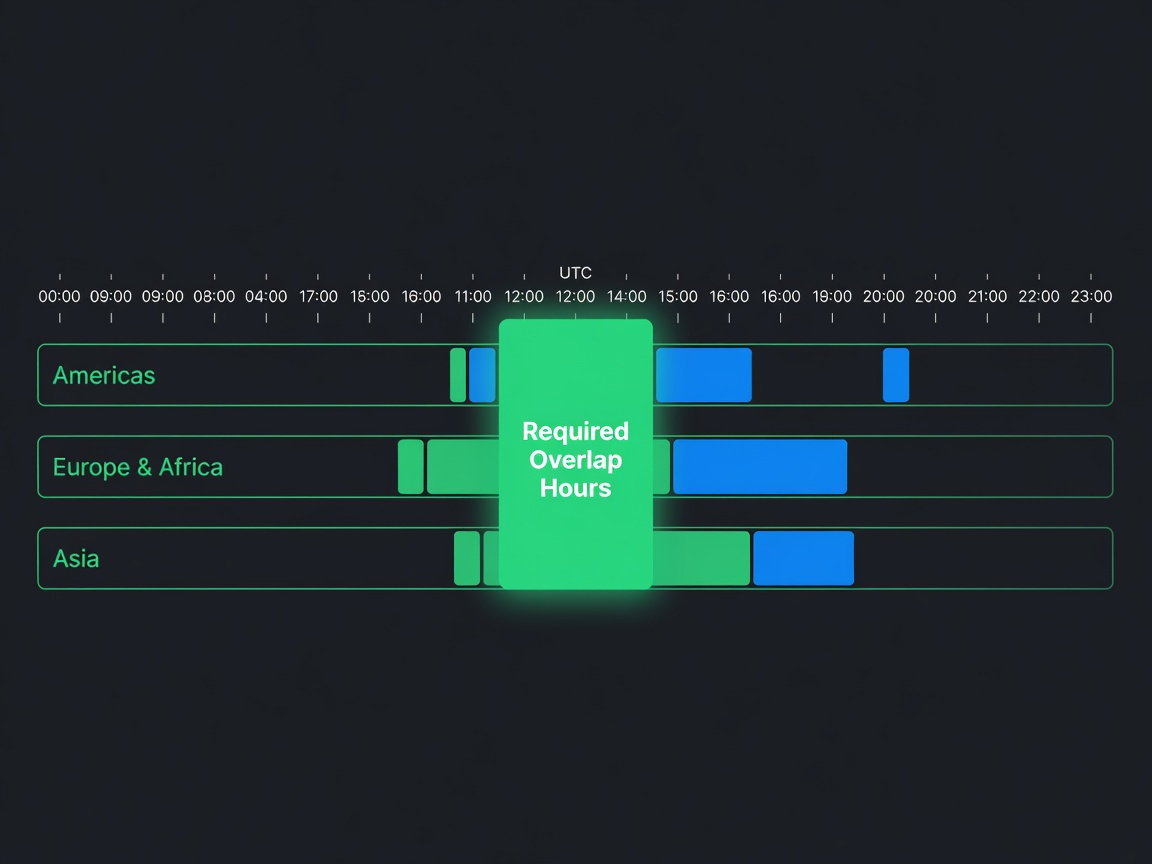
Work backwards from the customer or the codebase, not from a world map. Most teams I’ve seen do the opposite and end up with a beautiful spread of countries and a gaping hole between 02:00 and 07:00 UTC.
Define Required Overlap Hours
Ask a blunt question for each role: how many hours a day must this person be online at the same time as someone else? A copywriter might need two. A support agent on live chat needs all of them. An engineer in an on-call rota needs a defined shift. Anything that can run asynchronously, with written handovers and recorded walkthroughs, widens your talent pool enormously.
I like to write the number down in the job spec before anything else. It stops the “we’ll figure out hours later” argument, which is how teams end up with a 6am stand-up in Manila.
Group Regions by Time Band
Don’t think in countries. Think in bands. Use UTC as the anchor and sort regions into rough windows of roughly four hours, then check each against your core hours. For a London-based team, Western and Eastern Europe and West Africa sit within an hour or two, Latin America gives you the afternoon, and South and Southeast Asia gives you the morning handover. This guide to timezone alignment for global support teams goes deeper on shift design.
One trap: daylight saving. The UK and most of Europe shift clocks in March and October, the United States moves on different dates, and large parts of Asia and Africa don’t shift at all. Your overlap can quietly shrink by an hour twice a year. Use IANA zone names rather than fixed offsets in your scheduling tools, or you’ll be debugging calendar invites in November.
Match Channels to Regions
Channels have footprints. GitHub and developer Slack groups skew heavily towards tech hubs. LinkedIn is strongest across Europe, North America, India and the Gulf, thinner in some parts of Africa. Remote boards pull applicants from everywhere, with the loudest clusters in Latin America, Eastern Europe and South Asia. If you’re targeting a single band and the board is giving you the wrong one, use the region’s own communities instead. For African talent specifically, this employer’s guide to hiring SEO experts in Africa shows how regional channels differ from the usual suspects.
Which Channel Fits Your Role Type and Hiring Need?

Here’s the quick version, in a table, because this is one of the few places a table earns its keep.
Role type | Best first channel | Why | Watch out for |
|---|---|---|---|
Developers, data | GitHub, niche Slack | Visible work, quick signal | Slow relationship-building |
Designers | Dribbble, remote boards | Portfolio does the screening | Style mismatch |
Marketing, growth | Remote-first boards | High intent, wide pool | Volume of applicants |
Executives, specialists | LinkedIn outreach | Passive talent | Hours spent on messaging |
Startup generalists | Wellfound | Appetite for ambiguity | Equity-heavy expectations |
Many hires, many countries | Boards plus EOR | Speed and compliance | Platform fees add up |
Speed matters too. If you need one person in six weeks, a paid board listing will beat community sourcing. If you need a senior specialist in a niche, forget the board; go direct. And if you’re scaling a whole team, this look at remote hiring for scale-ups is worth a read before you commit to a single channel.
Attract Candidates With a Credible Remote Employer Profile

Good remote candidates have options. They also have a nose for vague listings.
Write Transparent Role Listings
Say what the job is. Say what a normal week looks like, who they’ll report to, and what “success in six months” means. Cut the “rockstar ninja” nonsense. Name the tools. If the role is fully remote with no office anywhere, say so plainly, and make clear whether it’s “work from anywhere” or limited to certain countries.
Publish Salary and Timezone Expectations
Publish the pay range. I know, I know. But a listed range filters out mismatches before anyone wastes an hour. Be honest about whether pay is localised or one global band, because candidates will compare notes in those Slack groups you’re trying to recruit from. State required overlap in plain hours, with a UTC reference, such as “available 13:00 to 17:00 UTC”.
Showcase Remote Culture
Show how you actually work. Do you write things down? Are meetings recorded? Is there a handbook? Candidates trust a public handbook, a team page with real faces, or a founder who writes about async habits far more than a careers page full of stock photos. This piece on building a high-performance remote team covers the cultural side properly.
Assess Global Candidates Without Bias or Bottlenecks

Interviews are where global hiring quietly goes wrong. Someone in Nairobi gets a call at midnight, someone in Lisbon gets one at lunch, and you wonder why the second candidate seemed sharper.
Rotate interview slots so the burden doesn’t fall on the same region. Use a paid, scoped work sample (two to three hours, not a week) that mirrors the real job, scored against a written rubric. Score blind where you can. Strip names and photos from the portfolio review, judge the work, then meet the person. Accents, camera quality and patchy connections aren’t competence signals, so don’t treat them as such.
And keep the process short. Strong candidates won’t sit through five rounds across three time bands. Three stages is plenty: a screen, the work sample with a debrief, and a final conversation with the manager and one peer.
Use EOR Platforms for Payroll, Compliance and Onboarding

Find the person first. Then bring in the EOR. Deel, Remote and RemoFirst are brilliant for the legal mess of cross-border hiring, but the convenience comes with ongoing fees, so I wouldn’t make one my primary sourcing channel. An EOR is the legal employer on paper while you direct the day-to-day work, which means you don’t need a local entity in every country. Remote’s overview of its Employer of Record service shows the workflow in detail.
Pay and Tax Setup
The EOR runs local payroll, withholds income tax and social contributions, and pays in the local currency. For scale, RemoFirst expanded to over 185 countries with flat monthly pricing, which gives you a rough benchmark when comparing quotes. Compare providers’ country lists too; this EOR market comparison from Sourcefit is a decent starting point.
Contracts and Local Law
Local contracts matter. Notice periods, statutory leave, probation rules and termination protections vary wildly from, say, Germany to Kenya. A template drafted in California won’t survive contact with either. The EOR supplies compliant contracts and handles data protection, including GDPR when you employ in Europe. One warning: classifying someone as a contractor to avoid this is a risk, because full-time, fixed-hours work looks like employment to most tax authorities.
Onboarding Logistics
Equipment, software access, a first-week plan, and a named buddy. Ship the laptop before day one, because nothing says “welcome” like a new hire staring at a courier tracking page. Schedule the first week inside their working hours, not yours.
For bulk hires across countries, this breakdown of the cheapest platforms for bulk remote hires will help you stress-test costs.
FAQ
Are job boards better than marketplaces for full-time remote hires? Yes, for permanent roles. Boards attract people looking for employment, while marketplaces attract people looking for projects.
How many overlap hours should a remote team have? Between two and four hours suits most knowledge roles. Live support or on-call work needs scheduled shift coverage instead.
Do I need an EOR for every country? No. If you already have a local entity, you don’t. If you don’t and you’re hiring one or two people in a country, an EOR is usually faster and safer than setting one up.
Is LinkedIn enough on its own? Rarely. It’s excellent for senior and passive candidates but thin in some regions, and it’s slow for volume hiring.
Can I pay everyone the same salary? You can, but be transparent about it. Many companies use regional bands. Whichever you choose, publish it.
Conclusion
Skip the gig platforms. Start with a remote-first board for intent, go straight to GitHub, Dribbble and niche communities for visible skill, use LinkedIn when you need someone senior who isn’t looking, and bring in an EOR once you’ve found your person. Decide your overlap hours before you write the listing, map regions by time band, and watch daylight saving like a hawk.
Get those few things right and the geography stops being a headache. It becomes an advantage, with someone awake and sharp at every hour that matters.
So, which time band is your biggest gap right now?