

What if you could scale your engineering team with senior-level developers while reducing your recruitment costs by 60%? You likely agree that the local hunt for affordable, high-performing engineers has become an exhausting, expensive uphill battle. Finding high-quality Ghana tech talent remote is no longer a “nice to have” strategy; it’s a competitive necessity for 2026. Ghana offers a unique combination of native English proficiency and a GMT time zone, making it the most frictionless entry point for companies that need to scale at high velocity.
This guide promises to show you why Ghana is the “Gateway to Africa” for remote tech talent and how to hire vetted experts in under 72 hours. We’ll break down the essential legalities of the Labour Act 2003, explain current salary benchmarks for senior roles, and provide a clear roadmap for seamless team integration. You’ll learn how to handle local requirements like SSNIT contributions while accessing a talent pool that’s already powering Google’s AI research in Accra. It’s time to stop settling for slow recruitment and start building with elite experts.
Key Takeaways
- Understand why Ghana’s tech landscape has evolved into a high-output hub that offers perfect cultural and operational alignment for global businesses.
- Identify the top-tier specialisms, including React and Mobile Development, that make Ghana tech talent remote experts a strategic asset for your 2026 growth.
- Learn how to significantly extend your business runway by accessing senior-level expertise at a much lower cost than traditional local hiring.
- Use a 72-hour hiring roadmap to bypass months of traditional recruitment and secure the top 1% of pre-vetted technical talent immediately.
- Discover the practical steps to ensure seamless team integration by focusing on time-zone advantages and essential soft-skill vetting.
Why Ghana is the Gateway for Remote Tech Talent in 2026
Ghana has quietly transformed into West Africa’s most reliable tech powerhouse. It’s no longer just an emerging market; it’s a matured ecosystem where global giants have already planted deep roots. For businesses looking for Ghana tech talent remote professionals, the appeal lies in stability. The country combines political peace with a high-output mindset that prioritises results over processes. With a median age of just 20.8, the workforce is naturally digital-native. These aren’t just people learning tech; they’re people who grew up with it. The national focus on STEM education is currently fuelling a talent pipeline of over 50,000 active developers, ensuring that the pool of experts is deep and constantly refreshing.
Beyond the raw numbers, the “Gateway” status comes from how easy it is to actually get work done. Unlike many regions where bureaucratic red tape or shaky connectivity can stall a project, Ghana’s digital infrastructure is robust and reliable. This creates an environment where ease of business isn’t just a buzzword; it’s the daily reality for hiring managers who need to scale quickly without the usual friction of international recruitment.
The GMT Advantage: Zero Time-Zone Friction
One of the biggest hurdles in remote work is the “lag” between sending a message and getting a reply. Because Ghana operates on GMT/UTC, there’s almost perfect alignment with the UK and Europe. You don’t have to worry about the “night shift” fatigue that often plagues outsourcing hubs in South Asia. Your team in Accra is awake, alert, and working the same hours as your team in London or Berlin. It creates a seamless extension of your office rather than a detached offshore unit.
Actionable Tip: Use this overlap to schedule your daily stand-ups at 10:00 AM GMT. It ensures everyone is synced up at the start of their productive day without anyone having to wake up at 3:00 AM or work through the night.
English Proficiency and Cultural Synergy
Communication is where most remote projects fail. Ghana is a native English-speaking nation, which immediately removes the friction of language barriers. You won’t spend half your meeting clarifying “what was meant” by a specific requirement. The professional culture in Accra is also highly aligned with Western business standards. This synergy means requirements gathering is sharper, expectations are understood from day one, and you’ll see a massive reduction in development “re-dos”. When you hire Ghana tech talent remote professionals, you’re getting experts who understand the nuances of your business goals as well as the code itself.
The Ghanaian Remote Talent Landscape: Skills and Specialisms
The outdated narrative that African tech is only for entry-level tasks is finally dead. In 2026, the market for Ghana tech talent remote professionals is defined by seniority and deep expertise. You’ll find developers who have led teams through complex cloud migrations and designers who understand the nuances of global user psychology. This isn’t just a pool of coders; it’s a reservoir of strategic thinkers who build products meant to scale. The growth is supported by sustained tech innovation in Ghanaian education, ensuring a steady flow of experts who are ready for the global stage from day one.
Several key tech stacks currently dominate the Ghanaian landscape, making it easy to find specific expertise for your project:
- JavaScript Ecosystem: React and Node.js are the gold standard here, used by almost every major startup in Accra.
- Python: Driven by a massive surge in data science and automated financial systems.
- Mobile Development: Flutter has become the preferred framework for building cross-platform apps that serve the West African market.
- Security-First Backend: The fintech boom has trained a generation of engineers who prioritise data integrity and encryption above all else.
Software Engineering Excellence
Ghanaian engineers are known for their adaptability. Many have been trained in elite environments like MEST Africa, where the curriculum blends technical mastery with business logic. This means when you hire a full-stack developer, you’re getting someone who understands how a database query affects the bottom line. To maintain high standards, we focus heavily on remote talent quality assurance, ensuring that every hire meets rigorous international benchmarks. If you’re ready to scale your engineering team, you can view our curated talent list to see these experts in action.
Product, Design, and Business Talent
Beyond the code, Accra is seeing a creative boom. Ghanaian Product Managers have become a favourite for UK-based startups because of their ability to handle complex requirements without constant supervision. They bridge the gap between technical teams and business stakeholders with remarkable ease. Similarly, UI/UX designers in the region are now winning international awards for their clean, user-centric approach. While you might also consider hiring remote product managers in neighbouring Nigeria, Ghana offers a unique cultural alignment that simplifies the management process for European teams.
Actionable Tip: When interviewing Ghana tech talent remote candidates, ask for a portfolio review that focuses on the “why” behind their decisions. Senior talent will be able to explain how their technical choices solved a specific business problem, which is the hallmark of a true expert.
The Economic Case: Quality Meets 60% Cost Savings
Building a high-growth startup is expensive. Most founders find that their biggest burn rate comes from the local hunt for senior engineers. By choosing to hire Ghana tech talent remote experts, you’re making a strategic decision to extend your runway without sacrificing the quality of your code. This isn’t about finding “cheap” labour. It’s about taking advantage of the lower cost of living in Accra compared to London or San Francisco. You get the same senior-level output for roughly 40% of the cost of a local hire.
Think about what a 60% saving actually means for your product roadmap. That reclaimed capital allows you to ship features faster or double your research and development budget. In many cases, the value-per-hour in Ghana exceeds that of traditional Eastern European hubs. While those regions are becoming increasingly expensive and crowded, Ghana remains a high-value market where your investment goes further. You aren’t just paying for someone to write lines of code; you’re paying for a strategic partner who understands your business goals. Companies that have already discovered this advantage by using a remote African talent platform are consistently outpacing competitors who remain locked into expensive local hiring cycles. For businesses looking to broaden their West African hiring strategy, exploring Nigerians developers remote hire options through Nigeria’s mature tech ecosystem can further amplify these cost and quality advantages.
Comparing Global Hiring Costs
Hidden costs are the silent killers of venture-backed companies. When you hire locally in the UK or the US, you aren’t just paying a salary. You’re paying for National Insurance, pension contributions, expensive office leases, and benefit packages that can add 30% to your total cost per head. Remote hiring in Africa eliminates these overheads entirely. You get elite, senior talent with none of the administrative bloat, allowing your business to remain lean and agile as you scale.
Infrastructure and Reliability in 2026
Reliability is often the first concern for managers looking at Ghana tech talent remote options. However, the “power and internet” myth is outdated. As of 2026, Ghana has reached a 69.8% internet penetration rate, with high-speed fibre optics common in major urban centres. Elite remote workers in Accra don’t rely on shaky home connections. They typically work from professional co-working spaces or have sophisticated home offices equipped with backup power solutions and secondary internet providers.
Actionable Tip: During the interview process, ask candidates about their “redundancy setup”. A professional remote expert should be able to tell you exactly how they stay online during a power cut or ISP failure. If they have a secondary internet source and a dedicated power bank for their router, you know you’re dealing with a serious professional who values uptime as much as you do.
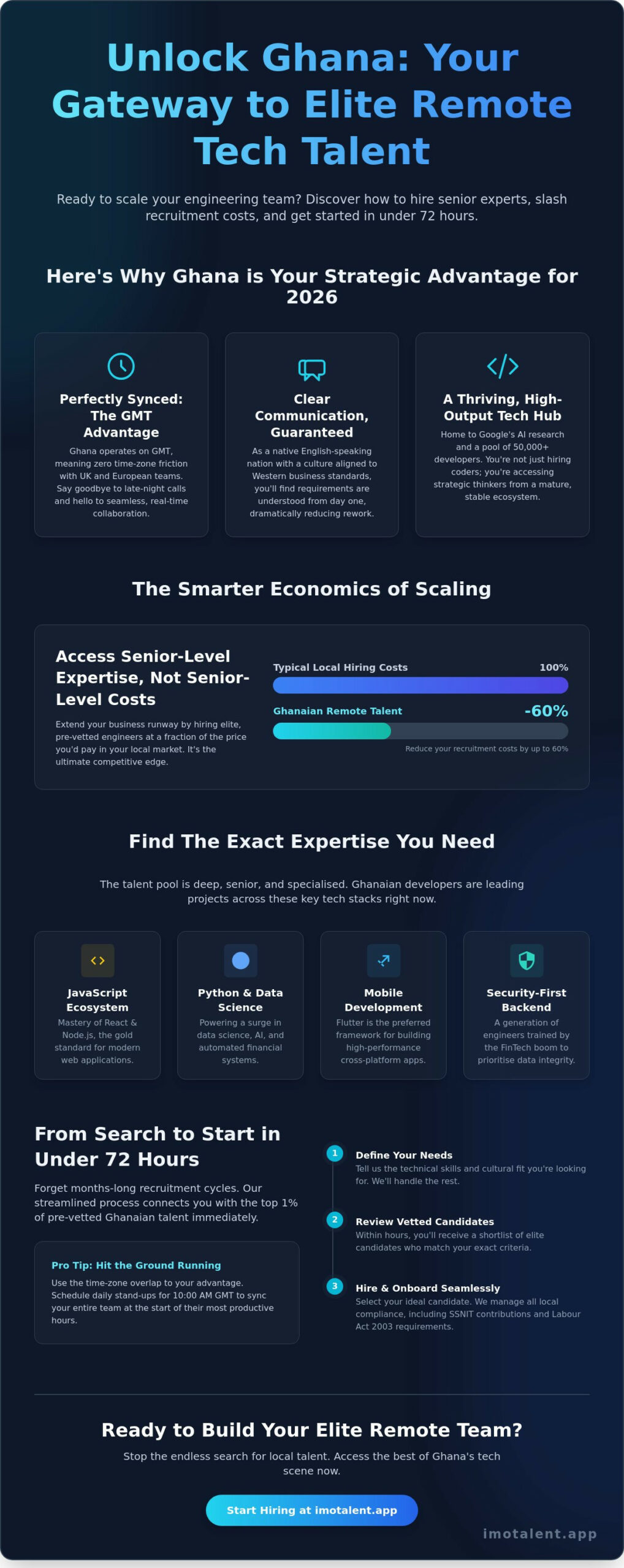
How to Hire Ghanaian Tech Talent in 72 Hours
Traditional recruitment is a slow, draining process that often takes three to six months to yield a single hire. In the fast-moving world of 2026, your business can’t afford to wait that long. By switching to a high-velocity model, you can secure Ghana tech talent remote experts in as little as 72 hours. This isn’t about rushing; it’s about removing the administrative friction that stalls growth. You need a system that moves at the same speed as your product roadmap.
The first step is to define the role with surgical precision. Don’t just list technical requirements. Focus on the specific soft skills that will allow a new hire to thrive within your unique team culture. Once you have a clear profile, you must bypass the noise of general job boards. Platforms like LinkedIn or Reddit often result in hundreds of low-quality applications that waste your time. Instead, use a vetted talent pool where the heavy lifting of screening has already been done for you. This allows you to move straight to a single, rigorous interview that tests both technical depth and culture fit. If the candidate clears this bar, you’re ready to issue an offer immediately.
Vetting for Technical and Soft Skills
Technical tests are only 50% of the puzzle. When you’re hiring remotely, “remote readiness” is just as critical as the ability to write clean code. We vet candidates for high-level communication, proactive problem-solving, and disciplined time management. A developer who can’t articulate their progress or manage their own schedule will eventually become a bottleneck. If you want to master the art of building a remote team, you must prioritise these behavioural traits alongside their GitHub portfolio.
Streamlining the Onboarding Process
Swift onboarding is the secret to building immediate trust. On day one, your new hire should have clear KPIs and a set of initial deliverables. This removes any ambiguity and lets them prove their value right away. You also need to handle international payroll and compliance without the usual headache. Using an Employer of Record (EOR) or a streamlined contractor model ensures you stay compliant with Ghana’s Labour Act 2003 while keeping your focus on scaling.
Actionable Tip: Set up a “Buddy System” for the first two weeks. Pair your new Ghanaian hire with a member of your local team. This creates a direct line for “silly” questions about internal tools or culture, which helps them integrate much faster than a standard orientation manual ever could.
Ready to skip the three-month wait and scale your team this week? You can hire vetted Ghanaian tech experts through our elite platform today.
Scaling with IMO Talent: Your Partner in Ghana
Navigating the West African talent market can be a complex task if you’re working without a local partner. Between understanding the Labour Act 2003 and verifying technical claims, the process often becomes a bottleneck for growing companies. IMO Talent simplifies the entire process by acting as your elite facilitator. We connect you with the top 1% of Ghana tech talent remote experts who are ready to hit the ground running. You don’t have to worry about the logistics. We’ve already done the heavy lifting so you can focus on building your product.
Our approach isn’t about just filling a seat. It’s about finding the perfect match for your specific tech stack and company culture. By using our 72-hour hire model, global brands are already reducing their recruitment cycles from months to days. This speed doesn’t come at the expense of quality. It’s the result of a highly refined system that prioritises excellence and operational readiness above all else. When you choose to partner with us, you’re choosing a high-velocity path to scaling your engineering team.
The IMO Talent Vetting Standard
We follow a precise 4-step recruitment process designed to eliminate risk. It starts with a broad application phase, followed by deep vetting, strategic matching, and finally, the hiring stage. Our vetting process is a rigorous filter that ensures operational readiness from day one. We don’t just look at code; we look at how a developer communicates and solves problems under pressure. To ensure long-term success, we also offer a talent management subscription. This service focuses on retention and ongoing support, making sure your new hire stays motivated and aligned with your goals long after the contract is signed.
Ready to Scale Your Team?
The case for hiring in the “Gateway to Africa” is clear. You get access to senior-level developers at a 60% lower cost, zero time-zone friction thanks to GMT alignment, and a workforce that is natively English-speaking. It’s time to stop settling for slow, expensive local recruitment cycles that drain your resources. Whether you need JavaScript experts, Python developers, or award-winning UI/UX designers, the talent you need is waiting in Accra. The future of remote work is here, and it’s more accessible than ever.
Actionable Tip: Before your first consultation, list your “non-negotiables” for the role. Knowing exactly which technical and soft skills are essential allows us to find your perfect Ghana tech talent remote match even faster.
Take the leap and start building with the best. You can find your next remote expert in Ghana with IMO Talent and see the difference that elite matchmaking makes for your business growth.
Secure Your Competitive Edge in the West African Tech Hub
The global race for technical excellence doesn’t have to be a battle of high burn rates and slow recruitment cycles. Ghana offers a unique blend of GMT alignment and native English proficiency that eliminates the typical friction of remote work. By tapping into Ghana tech talent remote professionals, you aren’t just reducing your hiring costs by 60%. You’re gaining access to a pre-vetted network of the top 1% of African experts who are ready to integrate with your team immediately.
Stop settling for months of uncertainty on traditional job boards. Whether you need senior developers, product managers, or award-winning designers, the Gateway to Africa provides the stability and seniority your startup needs to scale in 2026. It’s time to build faster, smarter, and more efficiently with a 72-hour placement turnaround. Take the first step toward a high-velocity engineering team today. Your next elite hire is closer than you think.
Hire vetted Ghanaian tech talent in 72 hours with IMO Talent
Frequently Asked Questions
Is Ghana tech talent remote work reliable regarding internet and power?
Yes, remote work in Ghana is highly reliable when you hire top-tier professionals. Most elite talent operates from modern co-working hubs or home offices equipped with solar backup systems and secondary fibre-optic lines. While infrastructure varies, senior experts prioritise uptime as a non-negotiable part of their professional service. You should always confirm a candidate’s redundancy setup during the interview to ensure they can maintain 99% availability regardless of local utility shifts.
What are the typical working hours for developers in Ghana?
Ghanaian developers typically work a standard 40-hour week, usually between 08:00 and 17:00 GMT. Because Ghana stays on Greenwich Mean Time year-round, there’s perfect alignment with the UK and most of Europe. This eliminates the need for late-night shifts or delayed responses. It’s a significant advantage for teams that rely on real-time collaboration and daily stand-ups to keep their development cycles moving at high velocity without any time-zone friction.
How does the cost of hiring in Ghana compare to the UK or US?
Hiring in Ghana typically offers a 60% reduction in total employment costs compared to local UK or US recruitment. This saving comes from the lower local cost of living rather than a compromise on quality. You also bypass expensive overheads like National Insurance, office space, and complex benefits packages. According to 2026 data, a senior engineer in Accra earns between GHS 144,000 and GHS 290,000 annually, providing exceptional value for high-level technical expertise.
Do I need to set up a local entity in Ghana to hire remote talent?
No, you don’t need a local legal entity to hire Ghana tech talent remote experts. Most international companies use an Employer of Record (EOR) to handle payroll, tax compliance, and local social security (SSNIT) contributions. Alternatively, you can engage talent as independent contractors. Using an EOR is the most efficient route for 2026, as it ensures you comply with the Labour Act 2003 without the administrative burden of setting up a foreign branch.
What tech stacks are most common among Ghanaian developers?
The most prevalent tech stacks in Ghana include JavaScript (specifically React and Node.js), Python, and Mobile Development using Flutter. The region’s thriving fintech sector has also produced a high volume of backend engineers specialised in secure financial systems and API integrations. You’ll find that most senior Ghana tech talent remote professionals are comfortable working across the full stack, having been trained in adaptable, high-growth environments that mirror Western startup cultures.
How does IMO Talent ensure the quality of the candidates?
We use a rigorous 4-step vetting process that filters for both technical mastery and “remote readiness”. This includes technical assessments, deep-dive interviews, and cultural fit evaluations to ensure every candidate is operationally ready from day one. We don’t just look at their code; we verify their communication skills and ability to manage complex projects independently. This ensures you only ever see the top 1% of professionals available in the West African market.
Can I hire for non-tech roles like Design or Marketing in Ghana?
Yes, Ghana has a massive pool of senior design and business talent. We specialise in placing high-level UI/UX designers, product managers, and digital marketing experts alongside our technical roles. Many of these professionals have experience working with international brands and understand the nuances of global user psychology. If you need to scale your entire remote operation, Accra is a matured hub for diverse, high-output talent across multiple disciplines including design and business placement.
What is the notice period for remote workers in Ghana?
According to the Labour Act 2003, notice periods depend on the specific terms in the employment contract. For most senior remote roles, a one-month notice period is the industry standard. However, this can vary based on the duration of the engagement and the level of seniority. We recommend clearly defining these terms in your initial agreement to ensure both parties have a transparent roadmap for any potential transitions or team scaling activities.