
What if your next senior hire wasn’t just a budget-friendly alternative, but the highest-performing member of your entire global team? You aren’t alone if you’re feeling the weight of local talent shortages and the rising burden of UK National Insurance. It’s frustrating to watch scaling plans stall because the elite African remote talent you need feels out of reach or difficult to vet. You want to grow, but you don’t want to risk cultural misalignment or poor communication in the process.
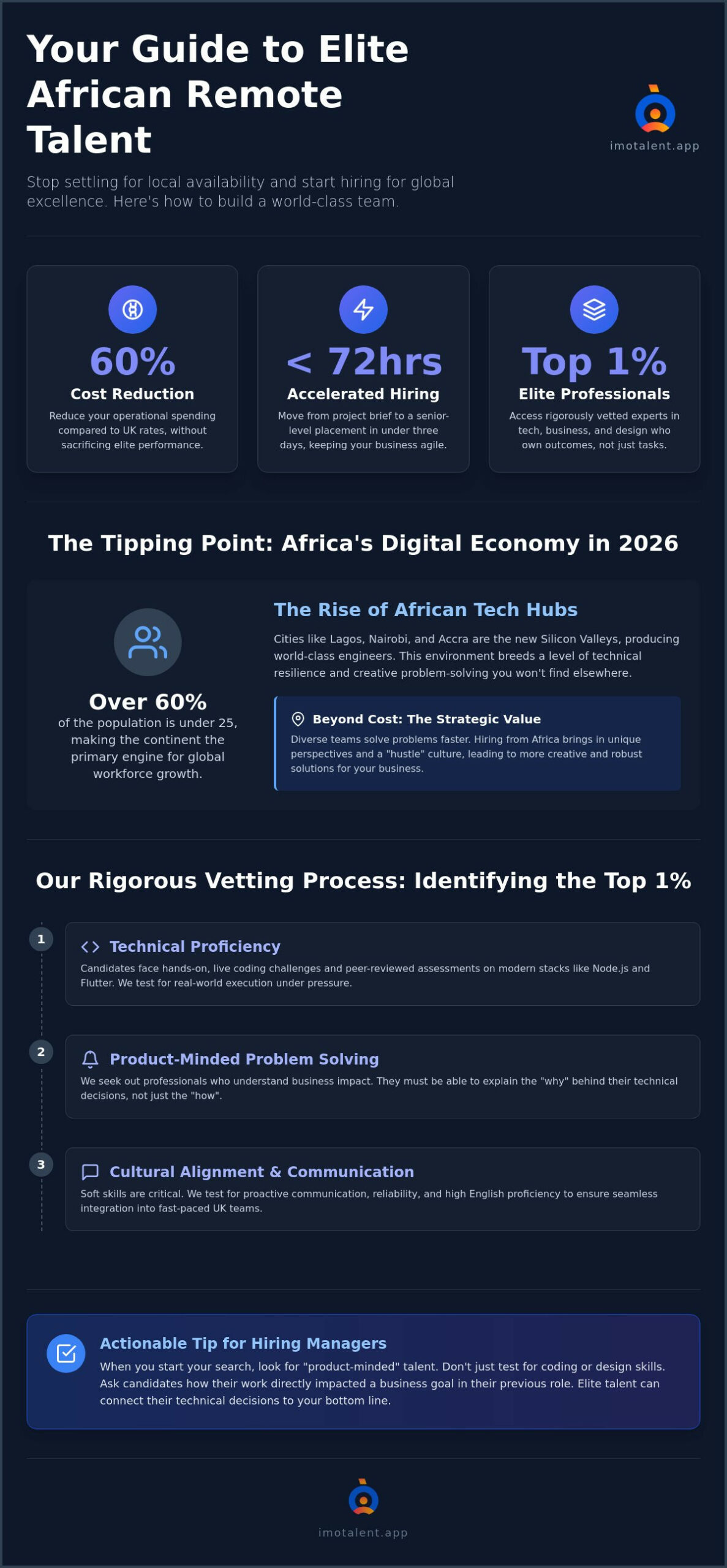
This guide reveals how to access the top 1% of professionals to reduce your hiring costs by 60% without compromising on technical excellence or speed. By focusing on a rigorously vetted network, you can bypass the traditional recruitment slog and maintain a high-performance culture. We’ll walk you through the strategic frameworks for identifying world-class experts in tech, business, and design. You’ll also learn the exact steps to go from an empty seat to a senior-level placement in under 72 hours, ensuring your business stays agile and ready for 2026. It’s time to stop settling for local availability and start hiring for global excellence.
Key Takeaways
- Learn why 2026 marks the tipping point for the African digital economy and how it offers a unique advantage for your global scaling plans.
- Discover the multi-layered vetting process used to verify and secure elite African remote talent for your most specialised roles.
- Understand how to reduce your operational spending by 60% compared to UK rates while maintaining elite performance standards.
- Get actionable advice on managing remote teams across time zones to ensure your new hires integrate seamlessly into your company culture.
- See how you can accelerate your growth by moving from a project brief to a senior-level placement in just 72 hours.
What is Elite African Remote Talent and Why Does it Matter in 2026?
When we discuss elite African remote talent, we aren’t referring to the broad pool of freelancers found on generic job boards. We’re talking about the top 1% of professionals across tech, design, and business. These are individuals who have survived rigorous vetting and possess the same technical depth as senior staff in London or New York. By 2026, the African digital economy has reached a critical tipping point. With over 60% of the population under 25, the continent has become the primary engine for global workforce growth. You aren’t just looking for “extra hands” anymore. You’re looking for the competitive edge that keeps your company agile.
The old model of “outsourcing” is dead. In its place is the era of the integrated remote team member. Global leaders have realised that treating remote hires as external vendors creates friction and slows down shipping speeds. Today, elite professionals from across Africa are becoming core parts of global engineering and product teams. They don’t just execute tasks; they own outcomes. This shift allows you to bridge the specialised skills gap that is currently stalling so many UK tech firms, all while maintaining the highest possible standards of delivery.
The Rise of African Tech Hubs
Cities like Lagos, Nairobi, and Accra have evolved into high-velocity tech ecosystems. These aren’t just regional centres; they are the new Silicon Valleys. This modern explosion in innovation is deeply rooted in a long history of technological achievement in Africa, stretching back centuries. Today, that legacy continues through massive investment in tech education and infrastructure. These regions are producing world-class engineers because the talent there is used to solving complex problems with limited resources. That environment breeds a level of technical resilience that you simply won’t find in more comfortable markets.
Beyond Cost: The Strategic Value of Divergent Perspectives
Smart hiring managers are prioritising African talent for more than just the 60% cost reduction. They’re doing it for the “hustle” culture and the unique problem-solving lenses these professionals bring. Diverse teams solve problems faster because they don’t all think the same way. An engineer in Nairobi might approach a scalability issue differently than one in Manchester, leading to more creative, robust solutions. This adaptability is a massive asset when you’re trying to innovate in a crowded global market.
When you start your search, look for “product-minded” talent. Don’t just test for coding ability or design skills. Ask candidates how their work directly impacted a business goal in their previous role. Elite talent will be able to explain the “why” behind their technical decisions, not just the “how”.
The Rigorous Vetting Process: How We Identify the Top 1%
Standard CV screening is effectively obsolete for remote hiring. In a global market, a polished resume is just a starting point, not a guarantee of performance. You’ve likely seen it before: a candidate looks perfect on paper but fails to deliver once they’re inside your Slack channel. To secure elite African remote talent, you need a vetting process that values proof over promises. This requires a multi-layered approach that strips away the fluff and tests for real-world execution. We don’t just look for people who can do the job; we look for the top 1% who can do it better than anyone else in your current time zone.
Technical Proficiency and Problem-Solving
Technical vetting must be hands-on. It’s not enough to know someone “knows” React or Python. We put candidates through live coding challenges and peer-reviewed assessments to see how they handle pressure. We focus on modern stacks like Node.js and Flutter because that’s what’s driving innovation in 2026. Beyond the code, we evaluate “product-mindedness”. This means we look for engineers and designers who understand how their technical choices affect your bottom line. If they can’t explain why a specific architecture helps your business scale, they aren’t elite talent. They’re just technicians.
Cultural Alignment and Communication
Soft skills are often the “make or break” factor in remote success. You need professionals who can jump into an agile, fast-paced UK environment without a hitch. This starts with English proficiency. With South Africa and Kenya ranking 13th and 19th globally on the EF English Proficiency Index, the baseline is high, but we push further. We test for proactive communication and reliability. Can they manage their own schedule? Do they ask the right questions before a bottleneck happens? If you want to skip the trial and error of traditional hiring, you can find your next hire through a platform that specialises in vetted African professionals.
Scaling at speed requires “ready-to-hire” talent pools. You don’t have three months to wait for a traditional recruitment cycle to finish. By maintaining a pre-vetted network, we can move a senior-level professional from a brief to your boardroom in just 72 hours. This isn’t about rushing; it’s about having the rigorous work already done so you can focus on growth. When the vetting is this deep, the risk of a “bad hire” virtually disappears.
When interviewing remote talent, replace “tell me about a time” questions with “show me how you would” scenarios. Give them a real problem your team faced last week and ask them to talk through their solution in real-time. This reveals their thought process and communication style more accurately than any prepared anecdote.
The Economic Reality: Africa vs. UK and US Talent Costs
The numbers don’t lie. Hiring a senior developer in London often requires a six-figure budget once you factor in base salary and benefits. When you look at elite African remote talent, the equation changes entirely. You can secure a professional from the top 1% of the market for a fraction of that cost. For example, a senior developer in a hub like Lagos typically earns between $36,000 and $96,000 per year. In the UK, a comparable role would easily command £85,000 or more, before you even consider employer-side costs. This isn’t about finding “cheap” labour. It’s about a geographical price gap that allows you to hire the absolute best in one market for the price of a mid-level hire in another.
The 60% cost reduction we often discuss is a conservative estimate. The real savings are hidden in the overheads you no longer have to pay. When you hire remotely in Africa, you bypass UK National Insurance contributions, pension matching, and expensive private health insurance schemes. You also eliminate the cost of office space, which in central London can cost upwards of £5,000 per desk annually. By removing these burdens, your capital goes much further. You’re paying for pure output and expertise, not for the privilege of an empty chair in a glass building.
Calculating the Real ROI of Remote Hiring
Understanding the cost of hiring developers in US vs Africa is essential for any scaling business in 2026. Beyond the base salary, the impact of zero employer-side taxes on your bottom line is massive. Every pound you save on National Insurance or office equipment can be reinvested into faster product iterations or marketing spend. This creates a compounding effect. You aren’t just spending less; you’re moving faster because your budget allows for a larger, more specialised team than your local competitors can afford.
Operational Efficiency: The 72-Hour Hiring Advantage
Slow hiring is a silent killer of momentum. An empty seat in your dev team doesn’t just mean work isn’t getting done; it means your existing team is burning out trying to cover the gap. A traditional recruitment cycle in the UK takes about three months from the first job post to the first day on the job. Our curated network turns that three-month slog into a three-day sprint. By accessing a pool of elite professionals who are already vetted and ready to start, you maintain high velocity and keep your product roadmap on track. Speed is a competitive advantage that you simply can’t ignore.
Audit your total cost of employment for your last three local hires. Include recruitment fees, equipment, office space, and taxes. Compare this to the flat cost of a remote professional. You’ll likely find that the “savings” are enough to hire a second full-time specialist for your team.
Integrating and Managing Your Remote African Team
Many leaders fear that a remote team means a fragmented culture. That couldn’t be further from the truth. When you hire elite African remote talent, you’re gaining partners who are already accustomed to global standards. The key to success lies in the first 30 days. High-performing teams don’t just happen; they are built through deliberate onboarding and clear communication. One of the biggest advantages is the time zone overlap. Unlike hiring in Southeast Asia, West African countries like Nigeria and Ghana share a near-identical working day with the UK. This means you can have a “stand-up” meeting at 9:00 AM and everyone is actually awake and ready to go. Real-time collaboration isn’t a luxury; it’s a standard feature of this talent pool.
Communication Frameworks for Distributed Teams
You need to balance synchronous and asynchronous work. Real-time meetings (synchronous) are great for brainstorming, but deep work happens when people are left to focus (asynchronous). Use tools like Slack for quick chats and Jira for project tracking. We also recommend Loom for video walkthroughs. It saves hours of meeting time and provides a permanent record of instructions. Setting clear KPIs from day one is non-negotiable. Your team should know exactly what “success” looks like by the end of their first week. If you don’t define the target, you can’t expect them to hit it.
Retention Strategies: Keeping Your Best Talent
Hiring is only half the battle. Keeping your talent engaged is where the real ROI happens. We’ve found that managing remote African developers requires a specific focus on integration and professional growth. Elite professionals want to know they have a future with your company. Offer continuous development opportunities and regular performance feedback. This shows you’re invested in their career, not just their output.
Don’t let administrative hurdles slow you down. As of May 2026, countries like Nigeria have updated foreign currency policies that require specific naira settlement accounts. While these regulations might seem daunting, managed services handle the local compliance, payroll, and equipment logistics for you. This ensures your hires feel supported and secure while you focus on scaling. If you’re ready to build a high-velocity team without the management headache, you can start your hiring journey today.
Schedule a “culture sync” once a month that has nothing to do with work tasks. Use this time to share company wins, personal milestones, or local news from both the UK and Africa. Building these personal bridges is what turns a group of contractors into a unified, high-performance team.
Scaling with IMO Talent: Your Gateway to Elite Professionals
Scaling your global team shouldn’t feel like a second full-time job. You need a partner that acts as a confident gatekeeper to elite African remote talent, ensuring you only ever interview the best. IMO Talent simplifies the end-to-end recruitment journey by handling the heavy lifting of sourcing, vetting, and matching. We don’t just send you a list of names; we provide a curated selection of professionals who are ready to integrate into your workflow immediately. Our commitment to quality is absolute. We only work with the top 1% of the market because we know your business has no room for mediocrity. Realising that an African talent recruitment agency is your best growth move in 2026 is the first step toward true operational efficiency.
Our 4-step process is built for speed and precision. It starts with your talent brief, followed by our internal matching, a candidate review, and finally, the hire. We move from brief to boardroom in just 72 hours. This velocity is possible because we maintain an active, pre-vetted network across the continent. We’ve already done the hard work of verifying technical skills and cultural fit so you don’t have to. You get the talent you need without the traditional recruitment slog.
Tailored Solutions for Tech, Business, and Design
Accessing remote business and design talent in Africa is no longer a complex puzzle. Whether you’re a lean startup or an established scale-up, we provide customised matching based on your specific company culture. We look beyond the basic skill set to ensure your new hire shares your team’s energy and values. This bespoke approach ensures long-term retention and high-performance output from day one.
Start Your 72-Hour Hiring Journey Today
Submitting your first talent brief takes only a few minutes. Once we have your specific requirements, you can expect a candidate shortlist that hits the mark the first time. We value your time as much as you do, which is why we prioritise quality over quantity. You won’t be sifting through dozens of average profiles. You’ll be choosing between two or three exceptional ones. It’s time to stop searching and start scaling.
When you submit your talent brief, focus on the “first 90 days” goals. Instead of just listing software skills, define exactly what you want this person to achieve or build by month three. This helps us find the professional with the specific drive and experience needed for your current stage of growth.
Scale your team with elite African talent now and reclaim your time for high-level strategy.
Future-Proof Your Team with Global Excellence
The shift toward a global, distributed workforce isn’t just a trend; it’s the new standard for companies that want to stay ahead. By tapping into elite African remote talent, you’re securing a massive competitive advantage that your local competitors simply can’t match. You now understand how a rigorous vetting process identifies the top 1% of professionals, ensuring your technical and business standards are never compromised. Plus, with a 60% reduction in hiring costs and the ease of overlapping time zones, your operational efficiency will hit new heights without the usual management headaches.
Scaling doesn’t have to be a slow or risky process anymore. With dedicated talent management support, you can focus on your high-level strategy while we handle the complexities of global recruitment and compliance. It’s time to stop letting local talent shortages or high overheads hold back your product roadmap. Take the leap and transform your team’s output with professionals who are as ambitious as you are. You’re just days away from a stronger, more agile organisation.
Hire your next elite remote professional in 72 hours and start building your high-performance team today.
Frequently Asked Questions
Is the quality of African tech talent really on par with UK or US developers?
Top-tier African professionals compete on a global stage. Many have worked for international tech giants and possess the technical depth required for senior roles. This elite African remote talent is often more adaptable because they’ve built products in high-pressure environments. You aren’t sacrificing quality; you’re accessing a pool of experts who are used to solving complex problems with efficiency and creativity.
How do I handle payroll and legal compliance when hiring in Africa?
You don’t need to worry about local tax laws or complex regulations. Managed services handle everything from payroll to contract compliance. This removes the administrative burden of National Insurance and local benefits. If you’re hiring in Nigeria, for example, the platform manages the latest Central Bank remittance policies so your team gets paid on time without any legal friction on your end.
Which African countries are currently the best for sourcing remote talent?
Nigeria currently has the largest developer population on the continent, making it a powerhouse for tech. South Africa and Kenya are also top choices because they rank 13th and 19th globally for English proficiency. These hubs have established tech ecosystems and produce professionals who are ready to hit the ground running in fast-paced UK or US business environments.
What are the typical time zone differences when working with African professionals?
Working with West African talent is incredibly easy for UK businesses. Nigeria and Ghana are in the same time zone or just an hour apart, allowing for a full day of real-time collaboration. If you’re in the US, there’s a five to six hour overlap with Eastern Time. This makes it much simpler to manage than teams in Asia, where the time difference often kills momentum.
Can I hire for roles other than software engineering, such as design or marketing?
Absolutely. While tech is a major focus, there’s a huge surge in demand for non-tech roles. You can easily hire senior designers, marketing specialists, sales development representatives, and virtual assistants. These professionals bring the same high-performance standards and “hustle” culture to your business operations, allowing you to scale every department simultaneously without overstretching your budget.
What happens if a remote hire doesn’t work out?
Most elite platforms offer a replacement guarantee to protect your momentum. Because the vetting process is so rigorous, “bad hires” are rare, but having end-to-end management support means any issues are handled quickly. If a hire isn’t the right fit for your culture, a new pre-vetted professional can be introduced to ensure your project stays on track without a long recruitment gap.
How much can I realistically save by hiring remote talent from Africa?
You can realistically save 60% on your total hiring costs compared to hiring a UK or US equivalent. This isn’t just about the base salary; it’s the lack of employer-side taxes, office space costs, and equipment overheads. By hiring elite African remote talent, you’re getting a senior professional for the price of a junior local hire, allowing you to reinvest those savings directly into growth.
How long does the hiring process typically take with IMO Talent?
The process is designed for high velocity. With IMO Talent, you can move from submitting a talent brief to having a senior professional ready to start in just 72 hours. Since the network is already pre-vetted, you skip the three-month recruitment cycle. This speed allows you to respond to market changes instantly and keep your product development moving at a record pace.