

What if you could slash your engineering overheads by 60% without compromising on technical seniority or cultural alignment? In the UK’s current hiring market, finding elite developers who don’t demand a king’s ransom is becoming nearly impossible. You’ve likely felt the frustration of local recruitment cycles that take months and eat through your budget before a single line of code is even written.
The solution for 2026 is clear: you need to build a remote team with African talent. This isn’t about just cutting costs; it’s about gaining a competitive edge through high-velocity, pre-vetted teams that are ready to scale your organisation immediately. We’ll show you how to access senior experts from tech hubs like Lagos, Nairobi, and Cape Town while ensuring they integrate into your existing workflows within days.
In this article, we’ll break down the practical steps to secure top-tier talent, navigate the latest 2026 regulations like Kenya’s Class N Digital Nomad permit, and implement a framework that guarantees operational readiness. It’s time to stop overpaying for local scarcity and start leveraging global excellence through a structured, managed approach.
Key Takeaways
- Cut your operational overheads by 60% by tapping into Africa’s rapidly growing tech sector. You’ll see why this is the most cost-effective scaling solution for UK businesses in 2026.
- Master the process to build a remote team with African talent using a pre-vetted framework that delivers results in just 72 hours. Stop waiting months for local recruitment to catch up with your needs.
- Navigate the “Big Four” talent hubs to find senior professionals with the precise technical or creative skills you require. We’ll help you pinpoint exactly where to source your next lead developer or designer.
- Learn the secrets of seamless integration to ensure your new remote hires become a core part of your team culture. This includes practical tips on managing time zones and maintaining high velocity.
Why Africa is the Definitive Global Remote Hiring Solution in 2026
The way we think about global hiring has fundamentally changed. We’ve moved past the era of traditional outsourcing where tasks were tossed over a wall and forgotten. In 2026, the real winners are those who build a remote team with African talent by treating them as core, integrated members of the organisation. This shift is driven by a massive demographic surge. According to the broad overview provided by the Economy of Africa, the continent isn’t just growing; it’s becoming a powerhouse of tech-savvy, young professionals. It’s the world’s fastest-growing talent pool, and it’s ready to work.
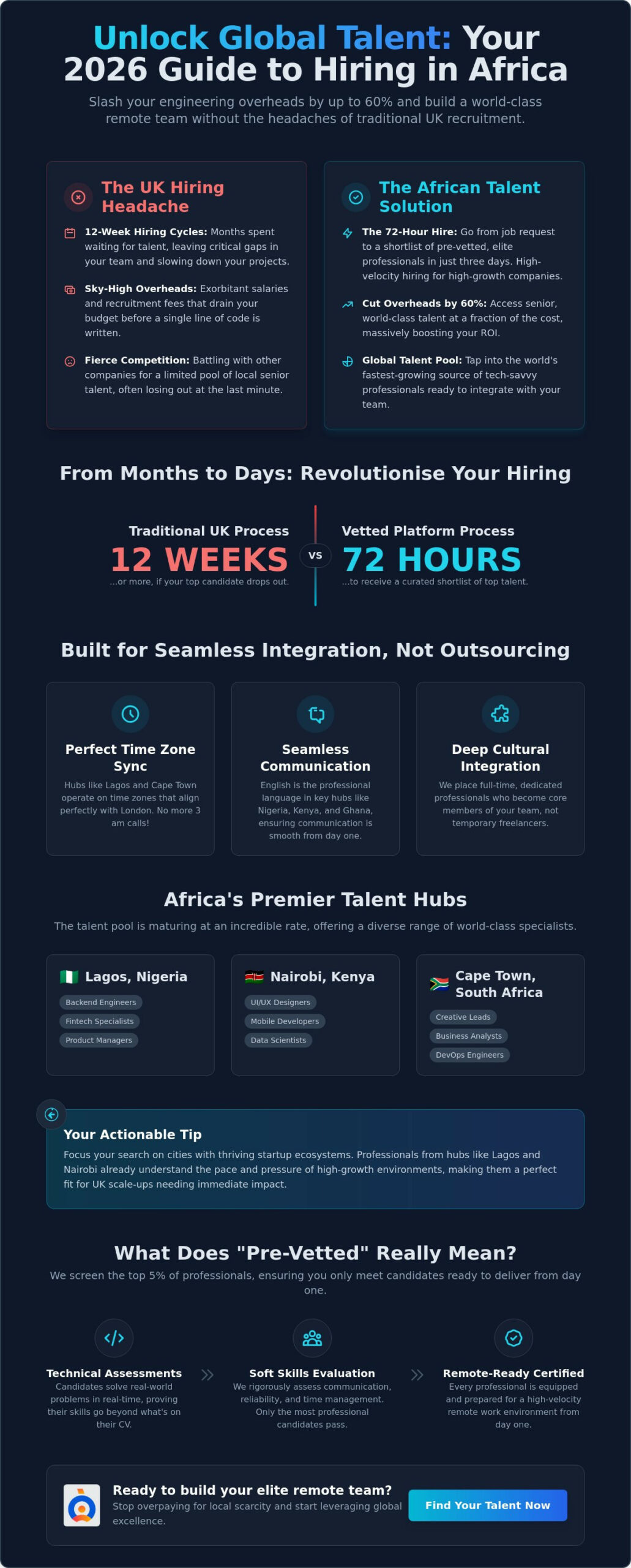
For UK business leaders, the logistics are almost too good to be true. Lagos and Cape Town operate on time zones that align perfectly with London. You won’t be waking up at 3 am to manage a team on the other side of the planet. English is the professional heartbeat of hubs like Nigeria, Kenya, and Ghana. Communication is seamless. Cultural nuances are shared. Integration happens in days, not months. It’s a high-velocity solution for a high-velocity market.
The Shift from Freelance Gigs to Integrated Teams
Relying on freelancers for your core product is a gamble. When you’re ready to scale, you need people who understand your vision and stay for the long haul. The old ‘gig’ model fails because it lacks accountability and continuity. IMO Talent specialises in placing dedicated, full-time professionals who live and breathe your company’s goals. This isn’t about surface-level task completion; it’s about deep integration that drives long-term project success. You get the stability of a local hire with the efficiency of a global reach. It’s about building a remote team with African talent that actually feels like part of your office.
The 2026 Talent Landscape: Beyond Just Coding
Africa is no longer just a source for backend engineers. We’re seeing a massive rise in world-class Product Managers, UI/UX Designers, and Business Analysts. Global companies are diversifying their remote hires because the talent pool is maturing at an incredible rate. It’s about finding the right specialist for the right role, whether that’s a creative lead or a data scientist.
Actionable tip: Focus your search on cities with thriving startup ecosystems. Hubs like Lagos and Nairobi produce professionals who understand the pace and pressure of high-growth environments. These candidates often have experience working in fast-moving tech environments, making them perfect for UK-based scale-ups looking for immediate impact.
The 72-Hour Hire: How Vetted Platforms Eliminate Recruitment Risk
Traditional recruitment is a slow, expensive bottleneck. In the UK, it’s common to wait twelve weeks to find a senior developer, only to have the candidate drop out at the last minute. This lag is a death sentence for high-growth companies. You can’t afford to wait three months to fill a critical gap in your tech stack. The reality of 2026 is that speed is your greatest asset. When you choose to build remote team with African talent, you aren’t just looking for cost savings. You’re looking for a way to bypass the hiring debt that slows down your entire organisation.
The secret lies in moving away from passive job boards. While the growth of Africa’s gig economy has created a massive supply of workers, quality varies wildly. This is where a managed framework changes the game. IMO Talent pre-screens the top 5% of African professionals, ensuring they are ready to hit the ground running. We’ve compressed the hiring cycle from months to just 72 hours. You submit a request, and within three days, you have a curated shortlist of qualified experts ready to interview.
What Does “Pre-Vetted” Actually Mean?
Vetting is the process of rigorous background and skill checking. It’s about moving beyond what’s written on a CV. Our process involves deep technical assessments where candidates solve real-world problems in real-time. We also place a massive emphasis on soft skills. Communication, reliability, and remote-work readiness are non-negotiable for us. If a professional can’t articulate their logic or manage their time effectively, they don’t make the cut. This level of scrutiny ensures that when you build remote team with African talent, you’re only seeing the best of the best.
The Mechanics of High-Velocity Placement
High-velocity hiring isn’t about rushing; it’s about being prepared. We maintain a curated pool of talent across various tech stacks, from Python and React to specialised UI/UX roles. Our 4-step process is simple: you define the role, we match you with a shortlist, you interview the top picks, and the hire is finalised. It’s a seamless transition that gets your project moving immediately.
Actionable tip: Before the 72-hour window begins, clearly define your ‘must-have’ versus ‘nice-to-have’ skills. This allows for even more precise matching and ensures you don’t waste time interviewing candidates who don’t fit your core technical requirements. If you’re ready to see how this works in practice, you can explore our talent matching framework to find your next hire.
Navigating the African Talent Landscape: Hubs and Specialisations
To successfully build remote team with African talent, you have to move past the idea that the continent is a single, uniform market. It’s actually a mosaic of specialised hubs, each with its own unique technical strengths and professional culture. When you’re scaling a UK business, knowing where to look for specific roles can save you weeks of searching. It allows you to match the right regional expertise with your specific product needs without the guesswork of traditional recruitment.
The ‘Big Four’ tech hubs; Nigeria, Kenya, South Africa, and Egypt; dominate the landscape. However, their outputs are very different. If you need a backend engineer who can handle high-volume transactions, you look to Lagos. If you need a mobile-first developer who understands complex user journeys in emerging markets, Nairobi is your best bet. This regional nuance is what separates a standard hire from a strategic asset that drives your company forward.
Nigeria and Kenya: The Engines of Tech and Innovation
Nigeria is a global powerhouse for Fintech. The ecosystem there has produced some of the continent’s most successful startups, meaning the local talent is used to building robust, secure, and scalable backend systems. For UK firms looking to launch branded financial services, Gemba provides the necessary banking infrastructure to support such innovation. Kenya, often called the ‘Silicon Savannah’, remains the leader in mobile-first technologies and Agri-tech. Their developers have a deep understanding of lean, efficient coding for diverse environments. To dive deeper into these specific technical roles, you can explore how to Hire remote developers from Africa in our comprehensive 2026 guide.
South Africa and Ghana: Business and Design Excellence
South Africa offers a professional environment that mirrors the UK very closely. You’ll find elite financial analysts and business talent who are accustomed to established corporate standards and rigorous compliance. Ghana is rapidly becoming the go-to hub for creative design and customer-facing business development. The professional communication style in Accra is often described as warm and highly collaborative, making it ideal for UI/UX designers who need to work closely with your product team.
Actionable tip: Don’t just hire from one city. Integrating talent from both West and East Africa can prevent ‘groupthink’ during your product development phase. This diversity brings different perspectives on how users interact with technology, which is essential if you’re building a tool for a global audience. Mixing a Nigerian backend specialist with a Ghanaian UI designer creates a balanced team that is both technically sound and user-centric.
Maximising ROI: Managing Costs and Enhancing Retention
Hiring in the UK has become a financial challenge for most growing businesses. Between high salary expectations, National Insurance contributions, and the costs of maintaining a physical office, the overheads are staggering. The 60% saving rule isn’t just a marketing claim; it’s a structural reality for companies that choose to build a remote team with African talent. By tapping into these markets, you can secure senior technical expertise for a fraction of the cost you’d pay in London or Manchester, without sacrificing the quality of your output.
However, the real return on investment comes from long-term stability. If you try to hire at the absolute bottom of the market, you’ll face high turnover and “hiring debt” that eventually costs more than the initial saving. Paying competitive local rates in cities like Lagos or Nairobi ensures loyalty. These salaries, while significantly lower than UK averages, provide a high standard of living for professionals in Africa. This creates a powerful incentive for them to stay, grow, and innovate within your organisation for years to come.
Managing compliance and payroll across borders is the primary hurdle that stops many firms from going global. You don’t want to spend your time navigating Nigerian tax law or South African employment regulations. A managed talent solution handles these complexities for you. It allows you to scale your team without the need to set up a local legal entity in every country where you hire.
The True Cost of a Remote Hire
A remote hire involves more than just a monthly salary. You need to factor in high-spec equipment, reliable internet stipends, and the software needed to manage a distributed team. These “hidden” costs can quickly add up if you’re managing them manually. IMO Talent’s management framework simplifies this by handling the administrative heavy lifting, ensuring your team has everything they need to stay productive. For a full breakdown of keeping your team engaged, check out our guide on Remote worker retention in Africa.
Building Long-Term Loyalty
Retention is where the real profit is made. Every time a developer leaves, you lose institutional knowledge and spend thousands on a replacement. To prevent this, offer clear career paths and professional development opportunities. Being part of a global team is a massive motivator for top-tier African talent; it signals that their skills are world-class and valued on an international stage.
Actionable tip: Treat your remote team as a core part of your company culture. Include them in “all-hands” meetings, celebrate their wins publicly, and ensure they have the same access to leadership as your local staff. When you build a remote team with African talent, you aren’t just buying hours; you’re investing in people. Ready to scale your operations? Start building your high-performing team today.
Scaling Your Team with IMO Talent: Your Implementation Blueprint
You’ve seen the data and explored the hubs. Now, it’s time to talk about execution. Building a global department isn’t just about finding one person; it’s about creating a repeatable system for growth. When you choose to build remote team with African talent, you need a framework that moves as fast as your business. We’ve stripped away the traditional recruitment fluff to give you a high-velocity blueprint that works.
The process starts with a precision brief. You’ll work with an IMO Talent specialist to define your technical needs and cultural requirements. We don’t just look for “a developer”; we look for the specific specialist who fits your 2026 growth goals. Within 72 hours, you’ll receive a curated shortlist of pre-vetted professionals. These candidates have already passed our rigorous technical and soft-skill assessments, so you can skip the basic screening and move straight to final validation.
Your interviews should focus on team fit and high-level problem-solving. Since the technical groundwork is already done, you can spend your time ensuring the candidate aligns with your vision. Once you’ve made a choice, our integration framework handles the transition. We don’t just drop a hire into your lap and disappear. We provide ongoing performance monitoring and managed support to ensure maximum retention and productivity from day one.
Onboarding for Immediate Impact
Onboarding is where the relationship is won or lost. You need your new hire to feel like a core part of the team, not a distant contractor. Set clear KPIs immediately so they understand exactly what success looks like in your organisation. We recommend using a structured approach to bridge the gap between West Africa and the UK. For a step-by-step guide, follow our checklist for Onboarding remote African professionals. The first 90 days are about support and documentation. The more clarity you provide, the faster they’ll start delivering high-value code or designs.
The Future of Your Global Workforce
The real power of this model is its scalability. Once you’ve successfully integrated your first hire, adding a second or third becomes significantly easier. You aren’t just filling a gap; you’re building a world-class department. IMO Talent acts as your strategic growth partner, handling the administrative and compliance hurdles while you focus on shipping products. It’s a high-velocity, low-friction way to scale your operations without the traditional overheads of UK-based expansion.
Actionable tip: Create a “Source of Truth” document for your remote team. This should include all your internal processes, communication protocols, and project goals. It reduces “slack time” and allows your African talent to work autonomously and effectively. Ready to start? Build your high-performance remote team with IMO Talent and secure your competitive edge for 2026.
Secure Your Competitive Edge for 2026
Scaling a business in the UK doesn’t have to be a battle against rising costs and talent scarcity. You now have the blueprint to bypass traditional recruitment bottlenecks and tap into the world’s fastest-growing professional pool. By choosing to build remote team with African talent, you’re gaining more than just a cost advantage; you’re securing elite expertise that aligns with your time zone and company culture.
We’ve shown you how a managed framework eliminates the risk of bad hires and ensures your new team members hit the ground running. You can access the top 5% of African talent and see placements in under 72 hours. This approach allows you to reduce hiring costs by up to 60% while maintaining the technical seniority your projects demand. It’s time to stop settling for slow local cycles and start building for the future.
Build your high-performance remote team with IMO Talent and take your organisation to the next level today.
Frequently Asked Questions
Is hiring remote teams from Africa legally compliant for UK businesses?
Hiring from Africa is fully compliant for UK firms when managed correctly. Most companies use Employer of Record (EOR) services or hire professionals as independent contractors. EORs are particularly effective because they handle all local tax, payroll, and statutory benefits. This allows you to scale without the legal headache of setting up a foreign entity or navigating complex local labour laws yourself.
How does the 72-hour placement process work at IMO Talent?
Our high-velocity process starts with a precision brief where we define your technical and cultural needs. Because we maintain a curated pool of pre-vetted experts, we can bypass the traditional sourcing stage. We match your requirements against our existing network and deliver a shortlist of qualified candidates within three days. This allows you to move from a vacancy to an interview almost immediately.
What technical stacks are most common among African developers?
You’ll find deep expertise in JavaScript, Python, and PHP across the major hubs. JavaScript frameworks like React and Node.js are dominant, alongside robust backend experience in Laravel and Django. Since many African ecosystems are mobile-first, there is also a high concentration of specialists in Flutter and React Native. These developers are accustomed to building lean, high-performance applications for diverse user bases.
How do you handle the time difference between Africa and the UK or US?
Time zone alignment is one of the strongest arguments for hiring from Africa. Most major tech hubs in West and South Africa are either on the same time as the UK or within a two-hour window. This ensures a full day of overlap for real-time collaboration. For US-based firms, the overlap typically covers the morning hours, which is perfect for daily stand-ups and synchronous planning sessions.
What is the average cost saving when hiring a senior developer in Africa?
UK businesses typically see a 60% reduction in total hiring costs compared to local recruitment. When you build remote team with African talent, you aren’t just saving on base salaries. You also eliminate costs related to London office space, National Insurance contributions, and expensive local recruitment fees. These savings allow you to hire two or three senior developers for the price of one in the UK.
Can I hire for non-tech roles like Design or Business Development?
Yes, we place elite professionals in various non-technical disciplines including UI/UX Design and Product Management. The African talent pool is rich with creative and strategic minds who have scaled products in some of the world’s fastest-growing markets. Whether you need a designer to overhaul your interface or a business development specialist to explore new territories, the expertise is readily available and pre-vetted.
What happens if a remote hire is not the right fit for my team?
While our vetting process minimises this risk, we provide managed support to handle any integration challenges. If a hire doesn’t meet your expectations during the initial period, we facilitate a swift replacement through our high-velocity pipeline. Our goal is to ensure your project momentum stays high, so we work closely with you to resolve fit issues before they impact your delivery timelines.
How does IMO Talent ensure the quality of its pre-vetted professionals?
We use a multi-stage vetting framework that only accepts the top 5% of applicants. This includes rigorous technical testing, live coding assessments, and deep-dive interviews focused on soft skills and remote-work reliability. This comprehensive screening ensures that when you build remote team with African talent, you are working with elite professionals who are technically proficient and ready to integrate into high-performing global teams.