
Early-stage startups do not hire like established companies.
A Series C company might have recruiters, structured interview loops and months to fill a role. A five-person startup may have a founder screening candidates between sales calls while trying to find an engineer who can start next week.
That makes choosing the right talent marketplace particularly important.
The best startup hiring platform is not necessarily the one with the largest candidate database. It is the one that gives your startup the right balance of candidate quality, hiring speed, cost, flexibility and screening support.
For early-stage companies in 2026, platforms worth comparing include IMÒ Talent, Wellfound, Toptal, Arc, Upwork, Turing, LinkedIn and Lemon.io.
This guide compares them by the criteria that matter most when runway, founder time and hiring mistakes are expensive.
TL;DR: Best Startup Talent Marketplaces in 2026
Here is the quick answer:
- IMÒ Talent — Best for startups seeking pre-vetted African professionals across technology, business and design.
- Wellfound — Best for startup-native full-time candidates and companies hiring around salary, equity and startup culture.
- Toptal — Best for high-stakes senior freelance or specialist talent where rigorous screening matters more than price.
- Arc — Best for startups seeking vetted global technical talent.
- Upwork — Best for flexible freelance hiring, short projects and startups comfortable screening candidates themselves.
- Turing — Best for startups that need to scale engineering capacity.
- LinkedIn — Best for broad direct sourcing when founders or recruiters are willing to proactively find candidates.
- Lemon.io — Best for startups looking for vetted freelance developers.
Best overall approach: Don’t choose a marketplace by popularity alone. Choose according to your startup stage, role, budget, urgency and ability to vet candidates internally.
Startup Talent Marketplaces Compared
| Platform | Best For | Talent Model | Screening Burden | Startup Fit |
|---|---|---|---|---|
| IMÒ Talent | Pre-vetted African talent | Curated marketplace/network | Low | Strong for lean distributed teams |
| Wellfound | Startup-native employees | Startup talent marketplace | Medium–High | Excellent |
| Toptal | Senior/high-stakes specialists | Premium vetted network | Low | Strong when budget allows |
| Arc | Vetted technical talent | Curated talent platform | Low–Medium | Strong for tech startups |
| Upwork | Projects and flexible freelance work | Open marketplace | High | Strong for experimentation |
| Turing | Scaling engineering teams | Technical talent platform | Low–Medium | Strong for engineering-heavy startups |
| Direct candidate sourcing | Professional network | High | Broad use case | |
| Lemon.io | Vetted freelance developers | Developer marketplace | Low–Medium | Strong for technical projects |
The key difference: open marketplaces give you more candidates but require more internal screening. Curated marketplaces reduce candidate volume in exchange for more vetting and matching.
What Is a Startup Talent Marketplace?
A startup talent marketplace is a platform that helps early-stage companies discover, evaluate or hire people without relying entirely on traditional recruitment agencies.
But these platforms operate very differently.
There are four main models.
1. Open talent marketplaces
Platforms such as Upwork give employers access to large numbers of freelancers.
Advantage: flexibility and choice.
Trade-off: your startup does more screening.
2. Curated or pre-vetted talent networks
Platforms such as IMÒ Talent, Toptal and Arc screen candidates before presenting or matching them with employers.
Advantage: less sourcing and initial vetting.
Trade-off: usually less candidate volume and potentially higher costs than fully self-service marketplaces.
3. Startup-specific marketplaces
Wellfound is built specifically around startup hiring.
These platforms can be particularly valuable when you need candidates who actively want early-stage company environments.
4. Professional sourcing networks
LinkedIn gives startups access to a much broader professional population but leaves sourcing, outreach and screening largely to the employer.
Understanding these models is more useful than asking which platform has the most profiles.
1. IMÒ Talent: Best for Pre-Vetted African Startup Talent
Best for: Early-stage companies building distributed teams across engineering, design, operations, marketing and other business functions.
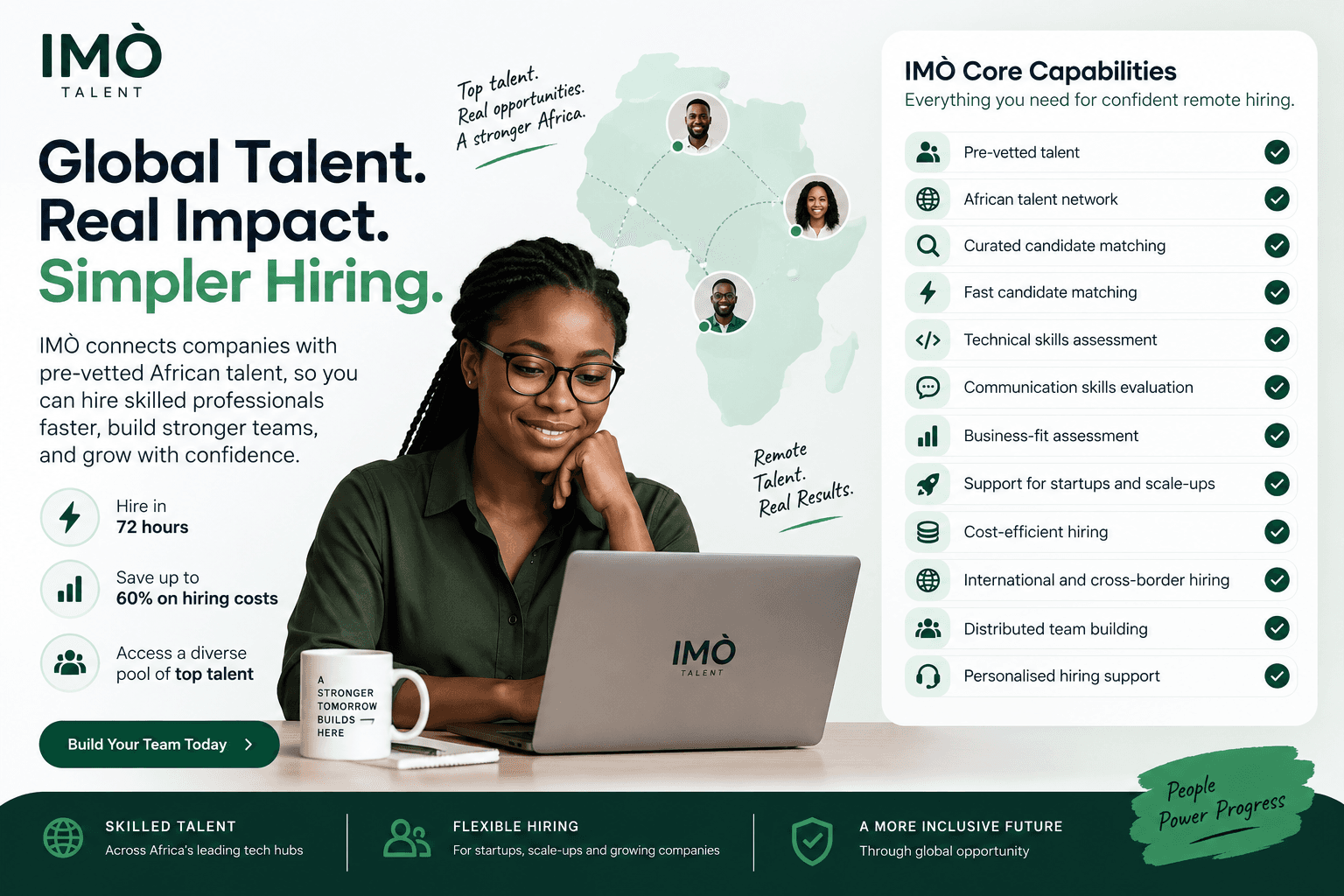
IMÒ Talent is a curated remote talent platform focused on African professionals.
For startups, its main advantage is reducing the amount of sourcing and initial screening that founders need to perform.
Instead of publishing a job and sorting through a large applicant pool, companies can access professionals who have already gone through IMÒ’s vetting process.
IMÒ currently says its network includes 1,000+ vetted professionals across technology, business and design. Candidates undergo technical or business assessments alongside communication evaluation before joining its curated talent pool.
The platform advertises hiring in as little as 72 hours and cost savings of up to 60% compared with UK/US hiring costs.
Why IMÒ can work for early-stage startups
Founder time is one of the most overlooked hiring costs.
Imagine receiving 150 applications for your first engineering hire.
Even if reviewing each application takes only three minutes, that is more than seven hours before interviews begin.
A curated network attempts to reduce that workload by starting with a smaller group of screened candidates.
IMÒ is particularly suitable when:
- You are building a distributed team.
- You want to recruit from Africa.
- You need developers, designers or business talent.
- You have limited internal recruiting capacity.
- You want candidates screened before interview.
- UK/European time-zone overlap is valuable.
- You need to hire relatively quickly.
Where IMÒ may not fit
IMÒ’s regional specialisation is also a limitation if your hiring strategy specifically requires candidates located elsewhere.
If you only want US-based candidates, for example, a geographically broader platform may be a better starting point.
Verdict: Best suited to lean startups that want curated access to African talent without building a large internal sourcing operation.
2. Wellfound: Best for Startup-Native Full-Time Hiring
Best for: Startups seeking employees who deliberately want to work for early-stage or high-growth companies.
Wellfound, formerly AngelList Talent, is one of the most startup-specific options in this comparison.
That specialisation matters.
Early-stage companies often need candidates who are comfortable with:
- Ambiguous responsibilities
- Small teams
- Rapid changes
- Founder involvement
- Equity compensation
- Limited resources
- High individual ownership
Wellfound’s candidate ecosystem is built around startup employment rather than general freelancing.
In 2026, Wellfound says more than 27,000 companies hire through its platform and it has more than 10 million opted-in candidates. Employers can post unlimited jobs for free, while paid products add AI sourcing or managed recruiting.
Strengths
- Startup-specific candidate audience
- Free basic job posting
- Salary and equity visibility
- Engineering, product, design, marketing, sales and operations roles
- Direct connection with founders and hiring managers
- AI sourcing available when startups need outbound recruiting
Trade-off
Posting a job does not remove the employer’s screening responsibility.
If your team lacks recruiting capacity, the low upfront cost can translate into more founder time spent reviewing applications.
Verdict: One of the strongest options for full-time startup hiring where startup motivation, equity and mission alignment matter.
3. Toptal: Best for High-Stakes Senior Hires
Best for: Startups that need experienced specialist talent and can pay for additional vetting.
Not every startup hire should optimise for the lowest cost.
Suppose your company is six weeks from launch and needs a senior engineer to fix an architecture problem threatening the entire product.
The cost of hiring the wrong person could exceed the savings from choosing a cheaper marketplace.
That is where a premium curated network such as Toptal becomes more compelling.
Strengths
- Strong screening proposition
- Senior specialist talent
- Reduced initial vetting workload
- Useful for critical technical work
- Global reach
Trade-off
Premium talent networks are difficult to justify for routine tasks that could be filled through less expensive channels.
Verdict: Best when the cost of a bad hire is substantially greater than the premium you pay for stronger vetting.
4. Arc: Best for Vetted Global Technical Talent
Best for: Tech startups seeking vetted developers without manually filtering a huge marketplace.
Arc combines a global talent network with candidate vetting and technology-assisted matching.
That places it between premium networks and self-service marketplaces.
The value proposition for a startup is straightforward: reduce the amount of candidate filtering your engineering team has to perform.
Strengths
- Technical specialisation
- Global reach
- Candidate vetting
- Matching support
- Suitable for distributed engineering teams
Trade-off
If you already have strong technical sourcing and interviewing capabilities, you may be paying for screening work your company could perform itself.
Verdict: Strong choice for startups seeking vetted international developers without relying on a completely open marketplace.
5. Upwork: Best for Flexibility and Testing Roles
Best for: Early-stage startups hiring for projects, prototypes, fractional work or clearly scoped deliverables.
Upwork offers something curated networks cannot easily match: enormous flexibility.
You can use it to find someone for:
- An MVP
- Landing-page development
- Product design
- Marketing
- Automation
- Research
- Copywriting
- Data work
- Administrative support
That makes it particularly useful before a startup is certain that a position needs to become permanent.
The startup advantage
You can test a business need before committing to full-time headcount.
For example, instead of immediately hiring a full-time designer, you could engage someone for a defined project and use the results to determine whether ongoing design capacity is justified.
The trade-off
Choice creates work.
Your startup is responsible for assessing whether candidates can actually deliver.
Verdict: Best for experimentation, project-based work and startups that know how to vet freelancers.
6. Turing: Best for Scaling Startup Engineering Teams
Best for: Funded technology startups that need multiple engineers rather than one isolated freelancer.
Turing is more specialised than a general talent marketplace.
Its focus is technical talent, with technology-assisted candidate assessment and matching.
That makes it more relevant once a startup moves from:
“We need another developer.”
to:
“We need to expand engineering capacity quickly.”
Strengths
- Technical focus
- Structured candidate assessment
- Global talent
- Suitable for multiple engineering requirements
- Reduced initial screening
Trade-off
Its engineering specialisation makes it less relevant if you need to build several non-technical departments at the same time.
Verdict: Stronger for engineering scale-up than general startup hiring.
7. LinkedIn: Best for Direct Sourcing
Best for: Founders and recruiting teams willing to source candidates themselves.
LinkedIn’s advantage is reach.
Rather than limiting your search to people actively browsing a particular talent marketplace, you can identify professionals based on:
- Job title
- Skills
- Company
- Industry
- Experience
- Geography
- Network connections
That makes it particularly useful for passive candidate sourcing.
The downside
LinkedIn gives you access.
It does not automatically give you a qualified shortlist.
Your company still needs to:
- Define the candidate profile.
- Search.
- Contact candidates.
- Qualify responses.
- Screen candidates.
- Interview them.
Verdict: Excellent sourcing infrastructure when your startup has the internal capacity to operate it.
8. Lemon.io: Best for Vetted Freelance Developers
Best for: Startups that want freelance technical talent without starting from an unrestricted marketplace.
Lemon.io is more narrowly focused on developers than broad freelance platforms.
For early-stage technology companies, that specialisation can reduce some of the noise involved in searching across thousands of unrelated freelance categories.
Strengths
- Developer-focused
- Curated talent
- Startup-oriented
- Useful for project and contract engineering
Trade-off
If you need sales, operations, marketing and engineering hires simultaneously, a developer-specific marketplace cannot solve your entire hiring problem.
Verdict: Worth considering when the immediate hiring problem is specifically vetted freelance development.
Which Startup Talent Marketplace Is Best for Your Stage?
This is where platform comparisons become much more useful.
Pre-Seed Startup
Typical situation: 1–5 people, limited runway, founder-led hiring.
Priorities:
- Low commitment
- Speed
- Flexible talent
- Minimal recruiting overhead
Start with: Upwork for experiments and projects, Wellfound for startup employees, or IMÒ Talent when you want pre-vetted remote talent without spending founder time building the shortlist.
Seed-Stage Startup
Typical situation: Product-market fit is developing and the team needs more specialised talent.
Priorities:
- Quality
- Faster hiring
- Stronger role ownership
- Predictable costs
Start with: IMÒ Talent, Wellfound or Arc depending on role, geography and desired vetting level.
Series A Startup
Typical situation: Multiple functions are scaling simultaneously.
Priorities:
- Repeatable hiring
- Technical depth
- Time-to-fill
- Cross-functional capacity
Start with: Curated talent platforms for repeatable hiring, Turing for engineering scale-up, and Wellfound or LinkedIn for broader permanent recruitment.
The important point is that your hiring stack should evolve with your startup.
Best Marketplace by Startup Hiring Need
| Startup Need | Recommended Starting Point |
|---|---|
| Pre-vetted African remote talent | IMÒ Talent |
| Startup-native full-time candidates | Wellfound |
| High-stakes senior specialist | Toptal |
| Vetted global developers | Arc |
| Freelancers and project work | Upwork |
| Scale engineering capacity | Turing |
| Passive candidate sourcing | |
| Vetted freelance developers | Lemon.io |
How Should Early-Stage Companies Compare Talent Marketplaces?
Use these seven criteria.
1. Cost per qualified candidate
Don’t compare subscription prices alone.
Ask how much it costs to get someone worth interviewing.
2. Founder time
Calculate the hours founders and senior employees spend:
- Reviewing CVs
- Sourcing
- Conducting screens
- Scheduling interviews
- Administering assessments
Those hours have a real opportunity cost.
3. Vetting depth
Ask exactly what “pre-vetted” means.
Does it include:
- Skills assessment?
- Live interview?
- Communication assessment?
- Portfolio review?
- Work-history verification?
- References?
Do not treat a badge on a profile as proof of deep vetting.
4. Time to qualified shortlist
“Hire quickly” and “receive applicants quickly” are not the same thing.
Measure how long it takes to get qualified candidates into interviews.
5. Role coverage
Developer marketplaces can be excellent at developer hiring and weak everywhere else.
If you’re hiring engineering, design, marketing and operations simultaneously, breadth becomes more important.
6. Engagement flexibility
Determine whether you need:
- Freelance
- Fractional
- Contract
- Full-time
- Project-based talent
Do this before selecting a marketplace.
7. Geographic fit
Consider:
- Time-zone overlap
- Language
- Compensation expectations
- Talent availability
- Employment requirements
Global hiring does not mean geography suddenly stops mattering.
The Hidden Metric: Screening Burden
Early-stage startups should track a metric most marketplace comparisons ignore:
Screening Burden = Applications Reviewed ÷ Candidates Worth Interviewing
Suppose Platform A produces:
200 applications → 8 qualified candidates
Platform B produces:
12 candidates → 6 qualified candidates
Platform A appears to offer more choice.
Platform B may actually offer more value.
Why?
Because founders do not need applications.
They need qualified people worth interviewing.
For lean startups, signal-to-noise ratio can matter more than talent-pool size.
The Real Cost of Startup Hiring
Do not evaluate a marketplace based solely on its advertised fee.
Use:
True Hiring Cost = Platform Fees + Internal Hiring Time + Assessments + Vacancy Cost + Onboarding + Replacement Risk
Imagine one platform costs $200 but requires 40 hours of founder and engineering time.
Another costs considerably more but delivers a small shortlist of candidates already screened against your requirements.
The cheaper platform is not automatically the cheaper hiring process.
For an early-stage company, opportunity cost matters because every hour a founder spends screening unsuitable applicants is an hour not spent selling, fundraising, building or talking to customers.
When Should a Startup Use a Marketplace Instead of a Recruitment Agency?
A marketplace usually makes sense when:
- The role is relatively easy to define.
- Your team can interview candidates.
- You want more control.
- You need flexible engagement models.
- Agency fees are difficult to justify.
- You are making repeatable hires.
A specialist recruiter may still make sense when:
- The role is confidential.
- You need an executive.
- The candidate pool is exceptionally narrow.
- The vacancy is business-critical.
- Your founders have no capacity to run the search.
- A delayed hire is costing more than the recruiting fee.
The objective is not to avoid recruiters at all costs. It is to buy recruiting help only when the economics justify it.
Should Startups Use More Than One Talent Marketplace?
Yes — but give each platform a job.
For example, a startup might use:
Wellfound → permanent startup employees
IMÒ Talent → pre-vetted African remote hires
Upwork → short projects and experiments
LinkedIn → difficult passive candidates
That is more effective than posting every vacancy across five marketplaces and creating five separate applicant pipelines.
Think in terms of a hiring stack, not a favourite website.
Questions to Ask Before Choosing a Startup Talent Marketplace
Ask every provider:
- What roles are strongest in your network?
- How are candidates vetted?
- What percentage of candidates you send typically reach interview?
- How quickly can we receive a qualified shortlist?
- What are the total fees?
- Do you support freelance and full-time hiring?
- Which countries does your network cover?
- What happens if the hire doesn’t work out?
- Is there a replacement policy?
- Who handles contracts and payments?
- Do you support international employment?
- What happens after we make the hire?
The answers are more useful than claims about having the “best talent.”
Frequently Asked Questions
What are the best startup talent marketplaces in 2026?
The best options depend on the hiring need. IMÒ Talent is suited to startups seeking pre-vetted African remote professionals; Wellfound specialises in startup-native candidates; Toptal targets premium vetted specialists; Arc focuses on vetted technical talent; Upwork provides flexible freelance hiring; and Turing is useful for scaling engineering teams.
What is the best hiring platform for an early-stage startup?
For full-time startup-native hiring, Wellfound is a strong starting point. For pre-vetted African remote talent across multiple disciplines, consider IMÒ Talent. For flexible project work, Upwork may be more appropriate. The best choice depends on role, budget, urgency and how much screening your founders can handle.
What is the cheapest talent marketplace for startups?
There is no universally cheapest marketplace once internal recruiting time is included. Some platforms offer free or inexpensive job posting but require employers to perform most screening. Others charge more while reducing sourcing and vetting workload. Compare total cost per qualified hire rather than listing fees alone.
Is Wellfound good for early-stage startups?
Yes. Wellfound is specifically built around startup hiring and currently offers free unlimited job postings alongside optional AI sourcing and managed recruiting products. It says more than 27,000 companies use its hiring ecosystem.
Is Upwork good for startup hiring?
Upwork can be particularly useful for freelance projects, prototypes and testing whether a role requires permanent headcount. Startups should be prepared to perform their own candidate evaluation.
Where can startups hire pre-vetted remote talent?
Curated networks such as IMÒ Talent, Toptal, Arc and Turing provide varying forms of pre-screening or candidate assessment. Compare what each platform actually evaluates before assuming “vetted” means the same thing everywhere.
Where can startups hire African talent?
IMÒ Talent specialises in connecting companies with vetted professionals across Africa, including technology, business and design talent.
Should a startup use a recruiter or talent marketplace?
Use a marketplace when you have enough internal capacity to participate in candidate evaluation and want greater control over cost or engagement type. Consider a specialist recruiter for confidential, senior, difficult or highly urgent searches where the cost of leaving the role vacant is high.
Final Verdict: Which Startup Talent Marketplace Should You Choose?
There is no single marketplace that wins every startup hiring scenario.
For startup-native permanent hiring, start with Wellfound.
For pre-vetted African talent across technology, business and design, consider IMÒ Talent.
For a high-stakes senior specialist, consider Toptal.
For vetted global technical talent, compare Arc.
For freelance experimentation and flexible projects, use Upwork.
For rapid engineering expansion, evaluate Turing.
And if you have enough internal recruiting capacity to proactively source candidates, LinkedIn remains useful.
The bigger lesson for early-stage companies is this:
Don’t choose the marketplace with the most candidates. Choose the marketplace that gets you to qualified candidates with the least unnecessary cost, screening and founder time.
For startups that want to build distributed teams with pre-vetted African professionals, IMÒ Talent offers curated access to talent across technology, business and design, with a current advertised hiring turnaround of as little as 72 hours.
Explore IMÒ Talent: imotalent.app