
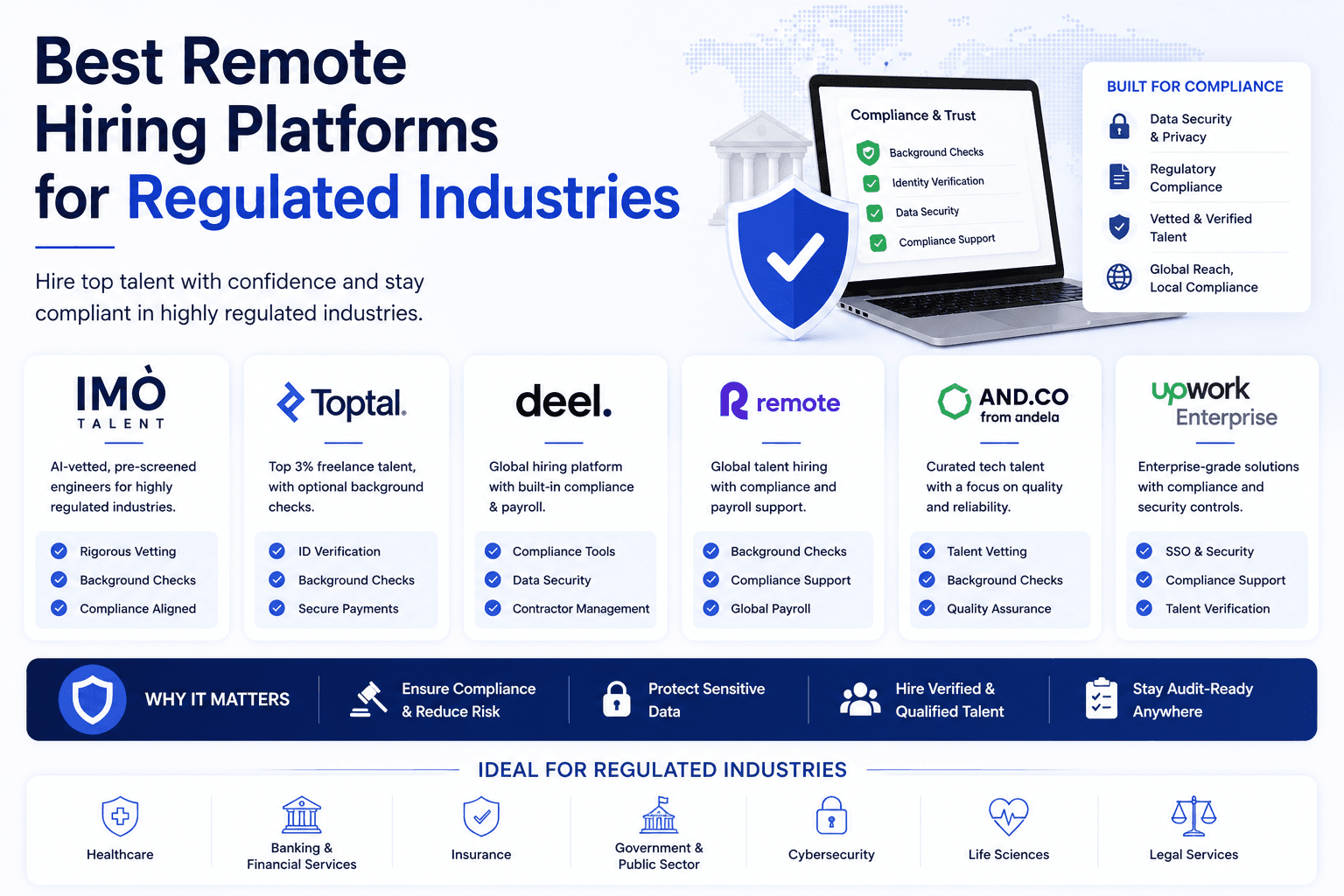
If you’re hiring for a fintech firm, a healthtech startup, or anything touching patient data, insurance records, or financial transactions, the standard “post a job, pay a fee, done” approach to remote hiring will get you into trouble fast. The best remote hiring platforms for regulated industries aren’t the ones with the flashiest dashboards. They’re the ones with owned legal entities, verifiable audit trails, and compliance infrastructure built for jurisdictions where a misclassified contractor or a mishandled data transfer can trigger real fines. For 2026, that shortlist comes down to five names worth taking seriously: Remote, Rippling, Deel, Oyster HR, and G-P.
I’ve spent enough time picking apart these platforms to know the marketing copy rarely tells you what actually matters. Compliance isn’t a checkbox feature, it’s a structural decision baked into how each provider operates in-country. Some own their legal entities outright. Others lean on third-party partner networks, which sounds fine until there’s a dispute and nobody can tell you who’s actually liable. That distinction alone should shape your shortlist before you even look at pricing.
Remote
Remote built its reputation on something almost boringly simple: it owns its own legal entities in the countries where it operates, rather than renting compliance infrastructure from local partners. For regulated industries, this matters more than most buyers realise at first glance. When a healthtech company in the UK hires a data engineer in Portugal through a platform using third-party partners, there’s a handoff between the platform and the local partner, and every handoff is a place where liability gets murky and IP protection gets weaker.
Remote sidesteps that by controlling the entire employer of record chain itself. That’s a genuine differentiator if you’re operating under strict internal security policies, or if your legal team asks pointed questions about who’s actually accountable when an employment contract needs amending mid-cycle. The platform covers over 90 countries and handles global payroll, benefits administration, and tax compliance without routing anything through outside vendors.
Where it falls short: pricing sits on the higher end compared with some remotecom alternatives, and smaller teams sometimes find the onboarding process more rigid than platforms built for speed. But rigidity, in this context, often just means process discipline. If you’re weighing this against a broader field of remotecom competitors, it’s worth reading through what pre-vetted remote professionals actually look like across industries before locking in a provider.
- Ownership: Full in-country legal entities, no third-party handoff risk
- Compliance depth: Independent compliance certification across 90+ countries
- Trade-off: Higher cost, slower onboarding for smaller teams
Rippling
Rippling takes a different angle entirely. Instead of positioning itself purely as an EOR, it bundles global payroll and international hiring with IT management, HRIS, and device provisioning into one system. That combination sounds like scope creep until you’re the finance manager trying to onboard a remote hiring manager’s new hire in Singapore who also needs a laptop shipped, Slack access provisioned, and payroll running by the fifteenth.
For regulated industries, the appeal isn’t just convenience. It’s that Rippling treats “regulated” broadly, not just as a legal classification but as an internal security posture. Financial services firms and healthtech companies often have IT compliance requirements just as strict as their employment law obligations, and Rippling is one of the few providers that manages both domestic and international workers inside a single platform without forcing you to stitch together separate tools.
The limitation is that Rippling’s strength is also its complexity. Teams that only need straightforward EOR services sometimes find themselves paying for HR operations and IT tooling they don’t use. It’s worth comparing this against platforms built specifically for startup hiring solutions if your compliance needs are narrower than enterprise-scale.
- Integration: Unified HRIS, IT, and payroll in one workflow
- Security fit: Strong for companies with internal IT compliance mandates
- Trade-off: Can feel overbuilt for teams needing only basic EOR
Deel
Deel’s whole pitch is velocity. Onboarding that takes competitors a week often happens within one to two business days on Deel, and its Contractor of Record feature has become something of an industry reference point for converting contractors into full-time employees without tripping misclassification wires. That last part matters enormously in regulated markets, where authorities have gotten sharper about spotting companies that use “contractor” status to dodge employer obligations.
Reviewers consistently rate Deel as the most feature-rich of the bunch, and I’d agree, its all-in-one suite covers EOR, contractor management, and global payroll under one roof. The catch, and it’s a fair one, is that the platform can feel bloated if you only need one localised service. You end up paying for breadth you’re not using.
For regulated industries specifically, the Contractor of Record mechanism is the standout. It gives you a documented, defensible paper trail showing exactly how a worker’s classification was determined, which is precisely the kind of audit-ready evidence a compliance officer wants to see during a labour inspection. If you’re scaling a technical team quickly, it’s worth cross-referencing this against guidance on bulk remote hiring frameworks before committing to volume.
- Speed: Onboarding within 1–2 business days
- Classification protection: Contractor of Record reduces misclassification risk
- Trade-off: Feature bloat for companies needing narrow, single-country support
Oyster HR
Oyster HR built its name on something that sounds soft until you actually price it out: ethical, fair employment practices for distributed teams. The platform’s localized statutory benefits are genuinely competitive, matching or exceeding what in-office roles typically offer in a given country, which becomes a serious recruiting advantage when you’re trying to pull senior talent away from established local employers.
For regulated industries hiring globally, Oyster’s clean interface belies a fairly sophisticated compliance engine underneath. Local tax compliance and country-specific benefits packages are handled without the operational burden falling back onto your internal HR team, which matters if your organisation doesn’t have in-house legal experts fluent in labour law across a dozen jurisdictions.
The trade-off is scale. Oyster is strong for mid-sized, remote-first companies but doesn’t quite match G-P’s depth in the most legally complex or restrictive markets. If your hiring plans lean toward Africa or other high-growth talent regions, it’s worth reading how elite platforms differentiate their vetting process before assuming any single EOR covers every region equally well.
- Employee experience: Competitive, localised statutory benefits
- Compliance ease: Reduces HR operational burden for cross-border hiring
- Trade-off: Less depth in highly restrictive or complex jurisdictions
G-P (Globalization Partners)
G-P is the veteran here, and it shows. This is the platform enterprises turn to when they’re entering jurisdictions where a single compliance mistake carries real financial strain, think Middle Eastern labour law, or certain Asian markets with strict data residency rules. Their in-house legal expertise runs deeper than most competitors, largely because they’ve been doing this longer and have weathered more edge cases.
For CEOs and finance managers overseeing international hiring at scale, that institutional depth functions as a safety net smaller EORs simply can’t replicate yet. G-P’s legal team isn’t just reactive, they’re proactively tracking employment law changes across regions and updating contract templates before those changes become compliance liabilities for clients.
The downside is cost and, frankly, agility. G-P moves at enterprise pace, which isn’t ideal if you’re a scale-up needing to hire fast. It’s a better fit once you’ve outgrown the flexibility phase and need the kind of legal coverage described in guides on remote hiring for scale-ups navigating high-velocity growth.
- Legal depth: Strongest in-house expertise for restrictive jurisdictions
- Track record: Longest-established EOR provider in the space
- Trade-off: Higher cost and slower pace suited to enterprise, not scale-ups
What Criteria Matter Most When Evaluating a Platform?
Compliance certification should be your first filter, not your last. Look specifically for independent compliance certification, ISO standards, and documented data security protocols, because in regulated sectors, a provider’s own marketing claims aren’t sufficient evidence during an audit. Ask directly whether the platform owns its legal entities or works through a vendor network, since that single fact determines who’s actually liable when something goes wrong with an employment contract.
Beyond entity ownership, look closely at API access and integration depth. If your finance manager needs payroll data flowing directly into your existing ERP without manual reconciliation, a platform lacking robust API support becomes an operational bottleneck rather than a solution. Also check how each provider handles contractor-to-employee conversion, since regulated industries face outsized scrutiny on worker classification, and a platform that can’t document that transition clearly leaves you exposed.
| Evaluation Criteria | Why It Matters for Regulated Industries |
|---|---|
| Owned legal entities vs. partner network | Determines liability and data control |
| Independent compliance certification | Provides audit-ready proof, not just claims |
| API and HRIS integration | Reduces manual data handling errors |
| Contractor of Record capability | Prevents misclassification penalties |
| Local benefits administration | Affects talent retention in competitive markets |
Which Red Flags Signal a Platform Isn’t Compliance-Ready?
Vague answers about entity structure are the first warning sign. If a sales rep can’t clearly explain whether the platform owns its legal entities in your target country or subcontracts through a third-party provider, that ambiguity will bite you eventually. Ask pointedly, and if the answer meanders, walk.
Another red flag: platforms that can’t produce documentation for how they handle data residency requirements, especially relevant for healthtech and fintech companies subject to GDPR or similar frameworks. If customer support can’t point you to a data processing agreement or explain where employee data physically sits, that’s not a minor gap, that’s a structural risk.
Watch also for providers with thin support during onboarding. Regulated industries often need expert support fielding jurisdiction-specific questions in real time, not a generic FAQ page. If a platform’s sales support team can’t answer basic questions about employment contracts in your target country during the sales process, don’t expect better once you’re a paying customer. It’s worth reading how rigorous vetting processes reduce hiring risk before assuming every provider handles regional verification equally well.
How Do You Switch Providers Without Disrupting Payroll or Compliance?
Switching EOR or payroll providers mid-cycle is genuinely one of the riskiest operational moves a company can make, and the answer is: overlap, don’t leap. Run both providers in parallel for at least one full payroll cycle before fully decommissioning the old one. This gives you a chance to catch discrepancies in tax withholding, benefits enrolment, or contract terms before employees feel any disruption.
Before switching, audit every existing employment contract and confirm the new provider can assume those obligations without requiring employees to sign entirely new agreements, which can trigger unwanted tax events in some jurisdictions. Loop in legal experts early, particularly if you’re moving from a partner-network model like some remotecom alternatives use to an owned-entity structure, since the transfer of employer-of-record status isn’t always instantaneous.
Communication matters more than people expect. Employees notice when payroll processing hiccups or benefits lapse, even briefly, and in regulated industries where trust and retention are already fragile, a botched transition can undo months of goodwill. Building a clear onboarding process blueprint before the switch, not during it, saves you from firefighting later.
How Do Pricing Models Compare Across Platforms?
Pricing across these five platforms follows roughly similar structures, per-employee monthly fees for EOR services, percentage-based fees for contractor payments, but the actual dollar amounts and what’s bundled vary meaningfully. Remote and G-P tend to sit at the higher end, reflecting their owned-entity infrastructure and deeper legal coverage. Deel and Oyster HR generally price more competitively for contractor-heavy setups, while Rippling’s cost depends heavily on how many of its non-payroll modules you actually activate.
None of these providers publish fully transparent pricing without a sales conversation, which is mildly irritating but standard for the industry given how much pricing depends on country-specific tax and benefits obligations. My honest advice: request itemised quotes covering payroll, benefits administration, and contract management separately, rather than accepting a bundled number. That way you can actually compare like for like against alternatives.
Conclusion
There isn’t a single “best” platform here, and anyone claiming otherwise is selling something. Remote wins on entity ownership and IP protection. Rippling wins if your compliance needs stretch into IT and device management. Deel wins on speed and contractor conversion. Oyster HR wins on employee experience and benefits parity. G-P wins when you’re entering the most legally treacherous jurisdictions and need a seasoned legal team behind you.
The honest move is matching the platform to your actual regulatory exposure, not the one with the best homepage. If you’re hiring across multiple countries in finance or healthcare, prioritise entity ownership and audit trail depth over flashy onboarding speed. Speed doesn’t help you if you’re explaining a compliance gap to a regulator six months later.
FAQ
Do I need an Employer of Record if I’m only hiring contractors? Not strictly, but regulated industries face heightened misclassification scrutiny, so a Contractor of Record service, like Deel’s, still provides useful documentation even without full EOR employment.
Can one platform handle both EOR and contractor payments? Yes, most of the five platforms covered here, including Remote, Deel, and Rippling, support both employment types within a single platform, though pricing structures differ between the two service categories.
How long does it typically take to onboard a new remote hire through these platforms? Deel is generally fastest at one to two business days, while Remote and G-P, given their owned-entity infrastructure, sometimes take slightly longer due to more rigorous compliance checks upfront.
Is it cheaper to hire contractors instead of using an EOR in regulated industries? Often yes on paper, but misclassification penalties in regulated sectors can far outweigh any short-term savings, which is why proper contractor management and documentation matter more here than in less regulated fields.