Updated: August 2026
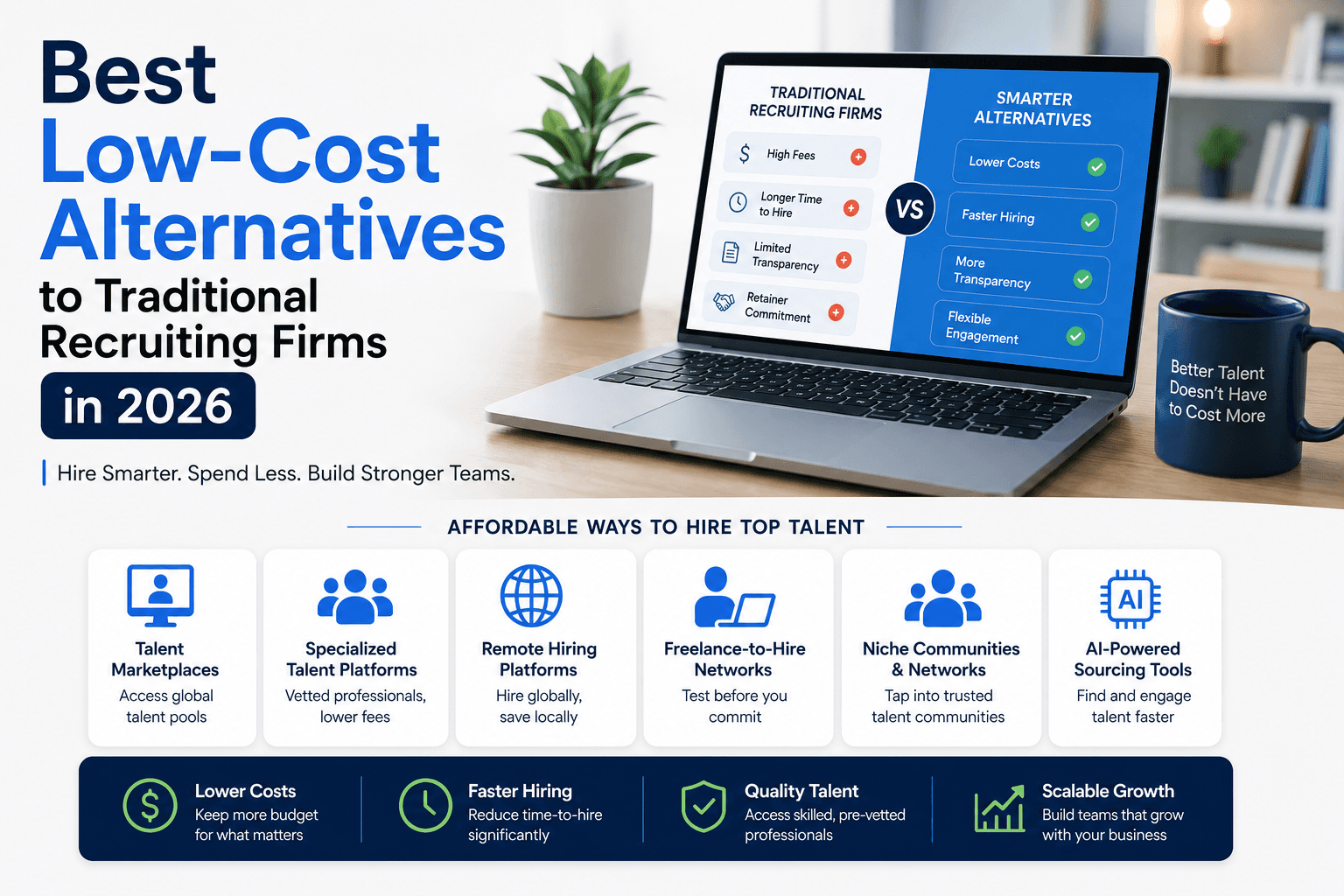
Traditional recruiting firms can save employers time, but their fee structure can become expensive, particularly for startups and small businesses making several hires a year.
The good news is that an agency is not your only option. Employee referrals, niche job boards and communities, talent platforms, direct sourcing tools, and fixed-fee or fractional recruiters can all reduce recruitment costs. The right choice depends on the role, hiring volume, urgency, internal recruiting capacity, and how difficult the candidate is to find.
TL;DR: What Are the Cheapest Alternatives to Recruiting Agencies?
If keeping recruitment costs low is your main priority, start with these options:
- Employee referrals: Usually one of the lowest-cost options when you already have a strong professional or employee network. Your main direct expense is typically the referral incentive.
- Niche job boards and professional communities: Often inexpensive compared with agency placement fees and particularly useful when you know where your target candidates spend time.
- Direct sourcing: Tools such as LinkedIn Recruiter Lite let smaller teams search for and contact candidates themselves. LinkedIn currently lists a single Recruiter Lite licence at $170/month or $1,680/year in USD, with regional pricing differences.
- Pre-vetted talent platforms: Useful when you want to reduce the internal work involved in screening candidates without moving to a conventional contingency recruiter.
- Fixed-fee or fractional recruiters: A middle ground for companies that need recruiting expertise but want a more predictable cost structure.
At a glance: The cheapest channel is not automatically the cheapest hire. Compare external fees + internal recruiter time + screening costs + vacancy costs + onboarding + the potential cost of a bad hire before deciding.
Why Look Beyond Traditional Recruiting Firms?
Traditional recruitment agencies typically handle sourcing, screening, candidate communication, and often salary negotiation.
That can be valuable when a role is urgent, confidential, highly specialised, or difficult to fill.
But startups and SMBs do not necessarily need that level of service for every vacancy.
For repeatable or easier-to-source positions, paying a substantial placement fee every time can make hiring unnecessarily expensive.
The better question is not:
“How do we stop using recruiters?”
It is:
“Which parts of recruitment do we actually need external help with?”
Once you answer that question, you can build a lower-cost hiring process around the areas where your internal team is capable and buy external support only where it adds value.
Low-Cost Recruiting Alternatives at a Glance
| Alternative | Cost Model | Best For | Internal Work Required | Main Trade-Off |
|---|---|---|---|---|
| Employee referrals | Referral incentive | Trusted candidates and repeat hiring | Medium | Limited reach |
| Niche job boards | Free or posting fee | Specialised candidate communities | High | Employer handles screening |
| Professional communities | Free or community-specific | Hard-to-find niche talent | High | Requires active sourcing |
| Direct sourcing tools | Subscription | Occasional or recurring direct hiring | High | Requires recruiting capability |
| Pre-vetted talent platforms | Platform/provider pricing | Faster access to screened candidates | Low–Medium | Smaller pool than open boards |
| Freelance-to-hire | Project/platform fees | Portfolio-driven roles | Medium | Employment conversion can be complex |
| Fixed-fee recruiter | Flat fee | Predictable recruitment costs | Low | Still more expensive than DIY sourcing |
| Fractional recruiter | Monthly retainer | Several vacancies without internal recruiter | Low–Medium | Ongoing monthly cost |
The key difference is who performs the recruitment work.
Cheap self-service channels save external fees by shifting sourcing and screening back to your company. Managed alternatives cost more because they remove some of that work.
1. Employee Referral Programs
Best for: Companies with employees or professional networks that overlap with the talent they need.
Employee referrals are one of the simplest alternatives to external recruiters.
Instead of paying a third party to find candidates, you encourage employees, advisers, investors, customers, and professional contacts to recommend people they already know.
A referral programme can work particularly well when employees understand both the position and your company.
How to make referrals work
Do not simply tell employees, “We’re hiring. Send us anyone good.”
Give them:
- A clear job description
- Essential skills
- Salary range where appropriate
- Location or time-zone requirements
- Examples of suitable backgrounds
- A clear referral process
- A defined incentive and payment trigger
You can also run a short referral sprint for important vacancies rather than leaving the programme passive all year.
Main advantage
Referral costs are predictable and do not increase automatically with the candidate’s salary unless you design the incentive that way.
Main limitation
Your network has limits.
Referrals become less effective when you need expertise that does not already exist within your employees’ professional circles. They can also narrow candidate diversity if companies repeatedly recruit from the same networks.
Best use: Make referrals your first sourcing channel for suitable roles, not your only channel.
2. Niche Job Boards and Professional Communities
Best for: Companies that know exactly what type of candidate they need.
A general job board gives you reach.
A niche community gives you relevance.
Instead of advertising everywhere, identify where people with the required skills already spend time.
Depending on the role, that could include:
- Remote-work job boards
- Industry associations
- Professional Slack groups
- Discord communities
- LinkedIn groups
- Alumni networks
- Developer communities
- Specialist newsletters
- Founder communities
The attached content brief calls this the “specificity strategy”: match the recruiting channel to where the desired candidate actually spends time.
Why this can reduce hiring costs
You avoid paying an intermediary to identify the candidate pool.
Your company posts or participates directly where qualified candidates are already concentrated.
Main limitation
You still need to:
- Review applications
- Assess candidates
- Conduct interviews
- Verify experience
- Coordinate hiring
A £200 job posting is not really a £200 hire if your team spends 50 hours screening unsuitable applicants.
Include internal recruiting time when comparing costs.
3. Direct Candidate Sourcing
Best for: Small companies that hire occasionally and have someone capable of managing recruitment internally.
Instead of waiting for candidates to apply, your team can identify and contact people directly.
LinkedIn is one obvious example.
As of August 2026, LinkedIn lists Recruiter Lite at $170 per month for one licence or $1,680 annually, with pricing varying by region. It includes more than 20 search filters and 30 InMail messages per month.
LinkedIn positions Recruiter Lite specifically for individuals or smaller teams making a relatively small number of hires.
A simple direct-sourcing process
- Define the candidate profile.
- Search using role, skills, location, seniority, and experience.
- Build a shortlist.
- Send personalised outreach.
- Screen interested candidates.
- Interview the strongest prospects.
The model can dramatically reduce external recruitment fees.
But there is a hidden cost: your time.
If nobody in the company has the capacity to source and screen candidates consistently, direct sourcing can become slow despite its low software cost.
4. Pre-Vetted Talent Platforms
Best for: Companies that want lower screening workload without using a traditional recruitment agency.
Pre-vetted talent networks sit between open job boards and conventional recruiting firms.
Instead of receiving hundreds of unfiltered applications, employers gain access to candidates who have already completed some form of assessment or screening.
This can reduce the internal time required for:
- CV filtering
- Initial qualification
- Skills screening
- Candidate sourcing
- Shortlisting
The exact level of vetting varies significantly between providers, so employers should ask what “vetted” actually means.
Where IMÒ Talent fits
IMÒ Talent is one example of this model, with a particular focus on connecting companies with vetted African professionals across technology, business, and design.
IMÒ currently says its network contains 1,000+ vetted professionals and that candidates are screened for technical skills, communication, and cultural alignment. It advertises hiring in as little as 72 hours and cost savings of up to 60% compared with UK/US hiring costs.
This is different from simply buying sourcing software.
The company is paying for access to a curated candidate pool and matching support rather than starting every search from an unrestricted applicant database.
Main advantage
You reduce some of the labour involved in finding and initially evaluating candidates.
Main limitation
A curated platform naturally has a narrower pool than an enormous open marketplace or general job board.
For extremely specialised positions, that may matter.
5. Freelance-to-Hire
Best for: Portfolio-driven roles where real work provides useful evidence of capability.
Another approach is to start with a legitimate short-term engagement and consider permanent employment later if both parties want it.
This can work for roles such as:
- Developers
- Designers
- Writers
- Marketing specialists
- Data professionals
The advantage is straightforward: you get evidence from actual work.
A portfolio tells you what someone has produced previously. A well-designed paid project lets you see how they communicate, respond to feedback, meet deadlines, and solve problems with your team.
The important caveat
Do not disguise a full-time job as freelance work merely to avoid employment obligations.
Worker classification and employment requirements vary by country. If the relationship becomes permanent employment, use the appropriate contractual and payroll structure.
Also check marketplace conversion terms before moving a freelancer off-platform.
Best use: Treat the initial project as a genuine paid engagement with defined scope, not an extended unpaid interview.
6. Fixed-Fee Recruiters
Best for: Businesses that want professional sourcing but dislike percentage-based placement fees.
Traditional contingency recruitment often links the recruiter’s fee to the successful candidate’s salary.
Fixed-fee recruitment changes that model.
Instead, you agree on a defined price for filling the position.
This can make costs easier to forecast, particularly for higher-salary roles where percentage-based fees become expensive.
What to check before signing
Ask exactly what the fee includes:
- Candidate sourcing
- Screening
- Interviews
- Reference checks
- Job advertising
- Replacement guarantees
- Candidate assessment
- Offer management
Two recruiters advertising the same fixed price may provide very different levels of service.
Main advantage
Predictable cost.
Main limitation
You still need to assess whether the provider’s sourcing quality justifies paying more than a self-service hiring channel.
7. Fractional Recruiting
Best for: Growing companies with several vacancies but not enough hiring volume for a permanent internal recruiter.
A fractional recruiter works with your business for part of their time, usually for an agreed monthly fee or scope.
Think of the model as renting recruiting capacity rather than paying separately for every successful placement.
A fractional recruiter might handle:
- Candidate sourcing
- Screening
- Pipeline management
- Interview coordination
- Hiring-manager support
- Recruitment reporting
This becomes particularly useful when hiring volume increases.
If you have four or five open roles, repeatedly paying individual placement fees may be less attractive than having one recruiter manage the entire pipeline.
Main limitation
The cost continues while the engagement is active, regardless of whether every search produces a hire.
Define deliverables before signing.
Which Low-Cost Recruiting Alternative Should You Choose?
The best method depends on the hiring problem.
| Hiring Situation | Recommended Starting Point | Why |
|---|---|---|
| One straightforward role | Referrals + niche job board | Low external cost |
| Hard-to-find technical specialist | Niche community + vetted talent platform | Better candidate relevance |
| Several hires per year | Direct sourcing + referrals | Reusable internal capability |
| Need candidates quickly | Pre-vetted talent platform | Screening already completed |
| Portfolio-driven position | Paid project/freelance-to-hire | Evaluate actual work |
| Several simultaneous vacancies | Fractional recruiter | Dedicated recruiting capacity |
| Senior specialist search | Fixed-fee specialist recruiter | More sourcing support |
| International remote hiring | Talent platform + appropriate employment/compliance solution | Separates talent sourcing from employment infrastructure |
There is no universal cheapest option.
The best channel is the one that produces an acceptable hire at the lowest total cost, not necessarily the lowest advertised fee.
Calculate the Real Cost of Each Hiring Channel
A useful comparison is:
Total Hiring Cost = External Fees + Advertising + Internal Recruiting Time + Assessments + Vacancy Cost + Onboarding Costs
For example, suppose:
- Job advertising costs $300.
- Your team spends 30 hours sourcing and interviewing.
- Internal recruiting time is valued at $50/hour.
- Assessments cost $200.
Your apparent $300 hiring channel actually costs at least $2,000 before vacancy and onboarding costs:
$300 + (30 × $50) + $200 = $2,000
Now compare that figure with a managed alternative.
This is a more useful calculation than comparing a $300 job advertisement directly with a recruiter fee while pretending internal labour is free.
Decision Matrix: Which Option Fits Your Business?
| Situation | Budget | Urgency | Internal Hiring Capacity | Recommended Option |
|---|---|---|---|---|
| Early-stage startup, occasional hire | Low | Low–Medium | High | Referrals + niche boards |
| Startup needing technical specialist | Medium | Medium–High | Medium | Pre-vetted talent platform |
| Company making recurring hires | Medium | Medium | High | Direct sourcing stack |
| Company with 3–5 vacancies | Medium | High | Low | Fractional recruiter |
| Senior or specialised hire | Medium–High | High | Low | Fixed-fee specialist recruiter |
| Very urgent, business-critical executive | High | Very high | Low | Specialist recruiting/search firm |
This decision framework reflects the central thesis of the original brief: role type, hiring volume, and urgency should determine the alternative you choose rather than price alone.
When Should You Still Use a Traditional Recruiting Firm?
Avoid turning “agency-free hiring” into a rule.
Sometimes paying a recruiter is economically sensible.
Consider the cost of failure.
Ask:
Is the agency fee greater than the cost of leaving this position vacant or hiring the wrong person?
Imagine a business-critical leadership role remains empty for three months and delays revenue, product delivery, or an expansion.
Saving money on the recruitment fee may become irrelevant.
A specialist agency can still make sense when:
- The position is confidential.
- The candidate pool is extremely small.
- The hire is business-critical.
- You need executive search expertise.
- Your internal team has no sourcing capacity.
- The vacancy is already creating substantial financial damage.
- Speed matters more than recruitment cost.
The content brief correctly identifies this as an important counterweight to a purely cost-driven argument: for a critical, urgent role with a high cost of failure, an agency can ultimately be the cheaper choice.
How to Build a Low-Cost Hiring Stack
You do not need to select one recruitment method for every vacancy.
A better approach is to build a hiring stack.
Step 1: Start With Your Lowest-Cost Relevant Channels
Try employee referrals and appropriate niche communities.
Step 2: Add Direct Sourcing
Search proactively rather than depending entirely on applications.
Step 3: Add Pre-Vetted Talent When Screening Becomes the Bottleneck
If your problem is not finding applicants but finding qualified applicants, a curated talent platform can reduce screening work.
Step 4: Escalate Difficult Searches
Use fixed-fee, fractional, or specialist recruitment when internal channels cannot fill the role efficiently.
This creates a simple escalation model:
Referrals → Niche Channels → Direct/Curated Sourcing → Managed Recruitment
Instead of automatically sending every vacancy to an agency, increase recruiting spend only when the difficulty of the hire justifies it.
Frequently Asked Questions
What is the cheapest alternative to a recruitment agency?
Employee referrals, professional communities, and low-cost job boards are usually among the cheapest channels because employers handle most of the sourcing and screening themselves. However, internal staff time should be included when calculating the real cost per hire.
Are job boards cheaper than recruitment agencies?
They can have substantially lower upfront fees because employers generally pay for advertising rather than a percentage of the successful candidate’s salary. The trade-off is that the employer usually handles screening, interviewing, and candidate management.
Are pre-vetted talent platforms cheaper than recruitment agencies?
They can be, depending on the platform and role. Their main advantage is reducing some of the sourcing and screening work associated with open job boards while avoiding aspects of the conventional agency model.
What is the best recruitment method for a startup?
Startups should usually combine channels rather than rely on one. Referrals and niche communities can handle low-cost sourcing, while pre-vetted networks or specialist recruiters can be added for difficult or urgent roles.
Is LinkedIn cheaper than using a recruiter?
For companies capable of sourcing candidates internally, it can be. LinkedIn currently lists Recruiter Lite at $170 per month for a single licence in USD, although regional pricing varies. Your company must still account for the employee time spent searching, contacting, and screening candidates.
When should I use a recruiting agency instead?
Consider an agency when the position is highly specialised, confidential, extremely urgent, or expensive to leave vacant. In those situations, the additional recruitment cost may be justified by specialist sourcing capability or faster access to candidates.
How can small businesses reduce cost per hire?
Start with referrals, targeted job boards and direct sourcing. Standardise your screening process, track the time employees spend recruiting, and use external providers selectively for vacancies where internal sourcing is ineffective.
What should I compare when choosing a hiring platform?
Compare total cost, vetting depth, candidate quality, time-to-hire, geographic coverage, employment model, replacement terms, internal workload, and post-hire support. Advertised price alone does not show the full cost of hiring.
Build a Hiring Stack, Not an Agency List
Traditional recruiting firms still have a place, but they do not need to be the default for every vacancy.
Start with the least expensive channel capable of producing the quality you need. Use referrals and niche communities where they work. Build direct-sourcing capability for repeat hiring. Use pre-vetted platforms when screening becomes a bottleneck, and bring in specialist recruiting support when the difficulty or urgency of the role justifies the additional cost.
For companies looking beyond traditional agencies, IMÒ Talent provides access to vetted African professionals across technology, business, and design, with tailored matching and a stated hiring turnaround of as little as 72 hours.