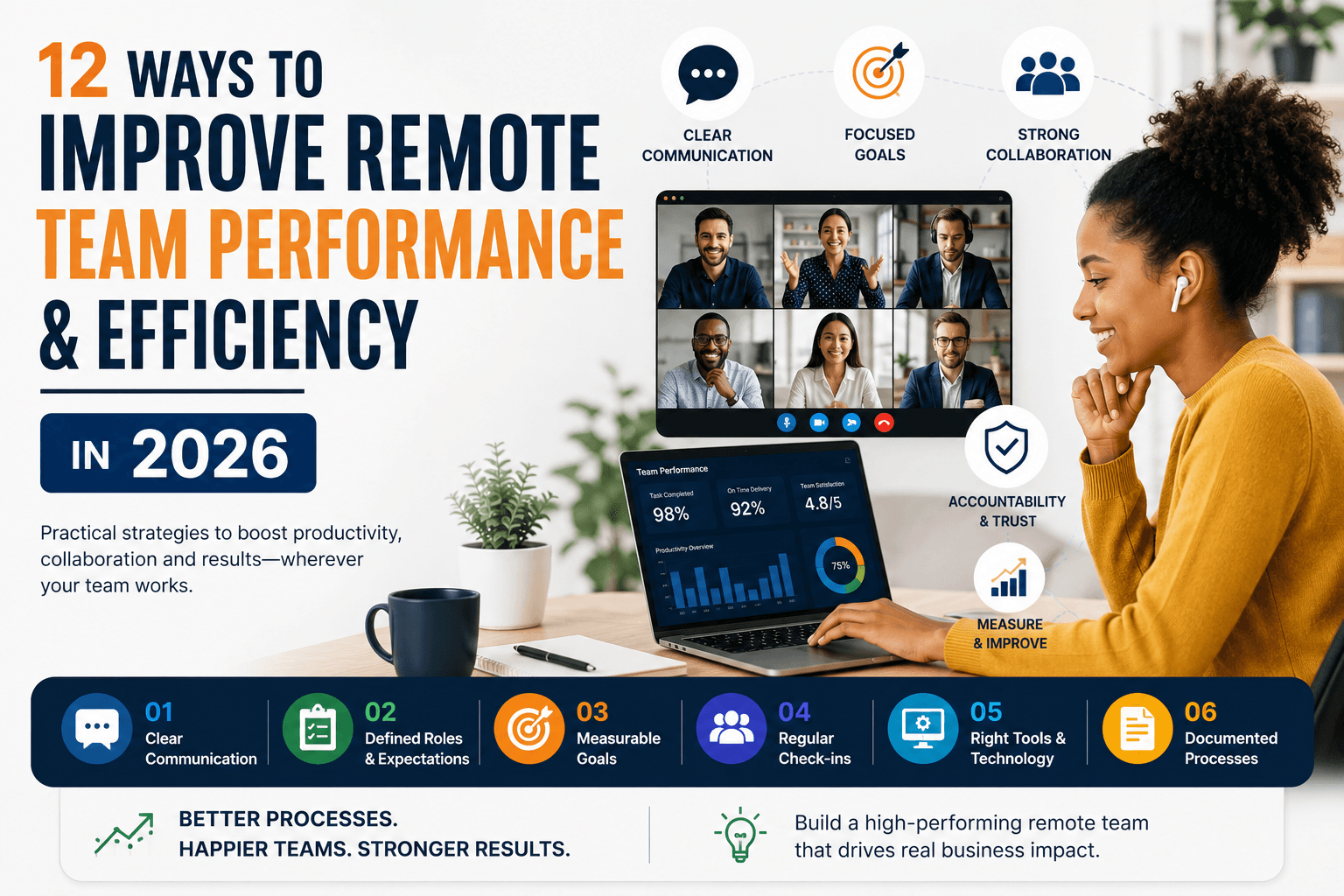
Managing a remote team effectively requires more than giving employees laptops, communication tools and the freedom to work from home. Without clear processes, remote teams can struggle with communication gaps, unnecessary meetings, unclear responsibilities and difficulty tracking progress.
To improve remote team performance, focus on clear communication, measurable goals, documented processes, effective technology, regular feedback and outcome-based performance management. The goal is not to monitor every hour employees work. It is to create a working environment where people know what they need to accomplish, have the resources to do it and can collaborate without unnecessary friction.
Quick Answer: How Can You Improve Remote Team Performance?
Here are 12 practical ways to improve remote team performance and operational efficiency:
- Establish clear communication channels.
- Define roles and expectations.
- Set measurable goals and outcomes.
- Hold purposeful check-ins.
- Support flexible and asynchronous work.
- Use the right remote collaboration tools.
- Document important processes.
- Measure meaningful performance metrics.
- Reduce unnecessary meetings.
- Encourage healthy work boundaries.
- Invest in professional development.
- Review and improve remote workflows regularly.
The most effective remote teams combine autonomy with accountability. Employees should have flexibility in how they work while remaining accountable for clearly defined results.
What Is Remote Team Performance?
Remote team performance refers to how effectively a distributed team achieves its goals while working from different locations.
High performance is not simply about completing more tasks.
A strong remote team consistently produces quality work, meets important deadlines, communicates effectively, collaborates across locations and uses company resources efficiently.
Managers should therefore evaluate performance using outcomes rather than online presence.
Useful indicators can include:
- Project completion rates
- Quality of work
- Customer satisfaction
- Response and resolution times
- Revenue or sales targets
- Deadline adherence
- Employee engagement
- Team retention
- Error or rework rates
- Achievement of role-specific goals
The right measurements depend on the team’s function.
A customer support team should not necessarily have the same KPIs as a software engineering or marketing team.
Why Is Remote Team Performance Important?
Remote work can give companies access to talent beyond their immediate location and allow employees greater flexibility.
But distributed work also changes how teams communicate and collaborate.
In an office, employees can quickly ask a colleague a question or notice when a project is becoming stuck. Remote teams need more intentional systems for sharing information and identifying problems.
Poor remote operations can lead to:
- Unnecessary meetings
- Communication delays
- Duplicated work
- Unclear ownership
- Missed deadlines
- Information silos
- Employee disengagement
- Slow decision-making
Improving remote performance means removing these obstacles without creating excessive monitoring or bureaucracy.
Here are 12 ways to do it.
1. Establish Clear Communication Channels
Effective remote work starts with clear communication.
When employees do not know where or how information should be shared, conversations become scattered across email, direct messages, meetings and different applications.
Create simple rules for communication.
For example:
| Communication Need | Suitable Channel |
|---|---|
| Urgent issue | Instant message or call |
| Project discussion | Project management platform |
| Formal announcement | Email or company communication channel |
| Complex discussion | Video or voice call |
| Project documentation | Shared knowledge base |
| Non-urgent update | Asynchronous message |
The specific tools matter less than the rules around using them.
Your team should know which channels are appropriate for urgent requests, project updates, documentation and general conversation.
Action: Create a short communication guide that explains which channel employees should use for different situations.
2. Set Clear Roles and Expectations
Remote employees should not have to guess what they are responsible for.
Clearly define:
- Role responsibilities
- Project ownership
- Expected outcomes
- Deadlines
- Decision-making authority
- Communication expectations
- Escalation procedures
When responsibilities overlap, explicitly identify who owns the final decision.
For important projects, you can use a responsibility framework such as RACI to identify who is Responsible, Accountable, Consulted and Informed.
Clarity reduces duplicated work and prevents important tasks from being ignored because everyone assumes someone else owns them.
Action: Review every team member’s responsibilities and identify areas where ownership is unclear.
3. Set Measurable Goals and Outcomes
Remote performance should be measured primarily by results rather than visible activity.
Set goals that employees can understand and measure.
SMART goals: Specific, Measurable, Achievable, Relevant and Time-bound can provide a useful framework.
Instead of:
“Improve customer service.”
Use something more measurable, such as:
“Reduce average first-response time from eight hours to four hours by the end of Q4 while maintaining the team’s customer satisfaction target.”
Good goals answer three questions:
- What are we trying to accomplish?
- How will we know whether we accomplished it?
- When should it be completed?
This gives remote employees greater autonomy while maintaining accountability.
Action: Replace vague performance expectations with measurable outcomes.
4. Hold Regular but Purposeful Check-Ins
Remote teams need opportunities to discuss progress, challenges and priorities.
That does not mean every problem requires a meeting.
Use regular team and one-to-one check-ins for conversations that benefit from real-time interaction.
A useful one-to-one might cover:
- Current priorities
- Progress since the last meeting
- Blockers
- Decisions required
- Feedback
- Workload
- Professional development
- Support needed from the manager
Avoid turning check-ins into status-reporting sessions when the same information could be provided asynchronously.
Meetings should help people solve, decide or discuss, not simply prove that work is happening.
Action: Audit recurring meetings and remove those without a clear purpose.
5. Support Flexible and Asynchronous Work
Remote teams may operate across different cities, countries and time zones.
Expecting everyone to be online simultaneously throughout the day can eliminate much of the flexibility remote work provides.
Asynchronous work allows employees to contribute without requiring an immediate response.
This works best when teams:
- Document decisions
- Provide context with requests
- Set realistic response-time expectations
- Record important information
- Use shared project systems
- Identify necessary overlap hours
Some synchronous communication will still be necessary.
The goal is to distinguish between work that genuinely requires everyone at the same time and work that does not.
Action: Establish core collaboration hours if needed, then allow greater flexibility outside them.
6. Use the Right Remote Collaboration Tools
Technology should make work easier, not create additional work.
Remote teams typically need tools for:
- Messaging
- Video conferencing
- Project management
- File sharing
- Documentation
- Calendar management
- Password management
- Collaborative editing
Common categories include tools such as Slack or Microsoft Teams for communication, Zoom or Google Meet for calls, and platforms such as Asana, Trello, ClickUp, Monday.com or Jira for project management.
However, more tools do not automatically create a more productive team.
Too many applications can fragment information and create additional notifications.
Before adding another tool, ask:
What problem does this solve that our existing systems cannot solve effectively?
Action: Audit your technology stack and remove duplicate or rarely used tools.
7. Document Important Processes
Remote teams depend heavily on accessible information.
If employees need to ask a colleague every time they want to complete a recurring task, the process is difficult to scale.
Create a central knowledge base for important information such as:
- Standard operating procedures
- Onboarding guides
- Company policies
- Project documentation
- Templates
- Frequently asked questions
- Brand guidelines
- Technical instructions
- Meeting decisions
- Role responsibilities
Documentation should explain enough for another qualified team member to complete the task without relying entirely on the person who created the process.
Keep documents current. Outdated documentation can create as much confusion as having none.
Action: Identify the five questions your team repeatedly asks and document the answers first.
8. Measure Meaningful Performance Metrics
Remote managers need visibility into performance, but measurement should focus on meaningful outcomes.
Avoid treating activity as productivity.
Metrics such as mouse movement, hours online or the number of messages sent can create misleading incentives.
Instead, choose KPIs connected to actual business results.
Examples of Remote Team KPIs
| Team | Possible KPIs |
|---|---|
| Sales | Revenue, qualified opportunities, conversion rate |
| Customer Support | Resolution time, CSAT, first-response time |
| Marketing | Qualified leads, conversions, campaign performance |
| Engineering | Delivery reliability, quality, incidents |
| Recruitment | Time to hire, offer acceptance, quality indicators |
| Operations | Cycle time, error rate, process completion |
| Customer Success | Retention, expansion, customer health |
Combine quantitative metrics with qualitative assessment.
Not everything valuable can be reduced to a single number.
Action: Limit each role to a small number of KPIs directly connected to its responsibilities.
9. Reduce Unnecessary Meetings
Meeting overload can significantly reduce focused work.
Remote teams are particularly vulnerable because managers sometimes replace physical visibility with frequent calls.
Before scheduling a meeting, ask:
- Is a decision required?
- Does this require real-time discussion?
- Could the information be shared in writing?
- Does everyone invited need to participate?
If the purpose is simply to distribute information, an asynchronous update may be more efficient.
For meetings that are necessary:
- Create an agenda.
- Invite only necessary participants.
- Start and finish on time.
- Record decisions.
- Assign action items and owners.
Action: Give employees permission to decline meetings where their participation is not necessary.
10. Encourage Breaks and Healthy Work Boundaries
Working remotely can blur the distinction between work and personal time.
Without a commute or physical office closing time, employees may find themselves checking messages late at night or remaining available longer than necessary.
Managers can help establish healthier boundaries by:
- Defining reasonable communication expectations
- Respecting employees’ working hours
- Avoiding unnecessary after-hours messages
- Encouraging regular breaks
- Making leave genuinely usable
- Watching for persistent workload problems
Flexibility should not become permanent availability.
Managers should also model the behaviour they expect. If leaders routinely send non-urgent requests late at night and expect immediate replies, employees may feel pressure to remain connected.
Action: Define when employees are expected to respond and when responses can wait.
11. Invest in Professional Development
Remote employees still need opportunities to develop.
Without informal office interactions, remote workers may have fewer opportunities to learn by observing colleagues or joining spontaneous conversations.
Make development intentional.
Options include:
- Online courses
- Mentorship
- Job shadowing
- Internal workshops
- Cross-functional projects
- Certifications
- Conference attendance
- Peer learning sessions
- Regular career conversations
Professional development should connect to both employee goals and business needs.
Managers can use one-to-one meetings to discuss what employees want to learn and which new responsibilities could help them develop those skills.
Action: Give each employee at least one clear development objective alongside performance goals.
12. Review and Improve Remote Workflows Regularly
Processes that worked when your company had five remote employees may not work when it has 50.
Treat remote operations as something that needs continuous improvement.
Periodically ask:
- Which processes take too long?
- Where are projects becoming blocked?
- Which meetings are unnecessary?
- Where is information difficult to find?
- Which approvals slow work down?
- Which tasks are being repeated manually?
- Where are responsibilities unclear?
Ask employees for input because they experience these processes every day.
Then prioritise improvements based on impact rather than attempting to redesign everything simultaneously.
Action: Conduct a quarterly remote-workflow review and choose one or two operational problems to improve.
How to Measure Remote Team Performance
A useful remote performance framework combines four areas.
1. Results
Is the team achieving its goals?
Measure output, quality, deadlines and relevant business outcomes.
2. Efficiency
How efficiently is work moving through the organisation?
Look at cycle times, delays, duplicated work and unnecessary manual processes.
3. Collaboration
Can employees get the information and support they need?
Look for communication bottlenecks, unclear ownership and cross-team problems.
4. Team Health
Is your way of working sustainable?
Consider engagement, retention, workload and recurring employee feedback.
Looking at all four gives managers a more useful picture than simply tracking hours worked.
A Simple Remote Team Performance Scorecard
Use a monthly or quarterly scorecard to identify where improvements are needed.
Rate each area from 1 (needs significant improvement) to 5 (strong).
| Area | Score |
|---|---|
| Goal achievement | /5 |
| Quality of work | /5 |
| Deadline reliability | /5 |
| Communication | /5 |
| Collaboration | /5 |
| Process efficiency | /5 |
| Documentation | /5 |
| Employee engagement | /5 |
| Customer outcomes | /5 |
| Total | /45 |
The score should start a conversation rather than become an automatic judgment of employees.
If documentation scores poorly, for example, the solution may be to improve company processes rather than demand more output from individual employees.
Common Remote Team Performance Mistakes
Measuring Hours Instead of Results
Being online for eight hours does not necessarily mean eight productive hours of work.
Define expected results and measure those instead.
Scheduling Too Many Meetings
Meetings interrupt focused work. Use synchronous meetings when discussion or decision-making genuinely benefits from them.
Using Too Many Tools
Every additional platform creates another place employees need to check. Keep your technology stack as simple as your operations allow.
Leaving Responsibilities Unclear
Remote employees cannot rely on informal office conversations to resolve every ambiguity.
Document ownership and expectations.
Expecting Immediate Responses
Not every message is urgent. Establish response expectations that allow employees to focus.
Ignoring Time Zones
International remote teams need deliberate scheduling. Rotate inconvenient meeting times where possible rather than repeatedly placing the burden on the same employees.
Micromanaging
Constant monitoring can reduce autonomy without improving results.
Give employees clear expectations, appropriate resources and accountability for outcomes.
How to Improve Remote Team Efficiency in 30 Days
You do not need to redesign your entire organisation at once.
Week 1: Audit
Review communication channels, meetings, tools, responsibilities and major workflow problems.
Week 2: Clarify
Document role ownership, communication rules, team goals and performance expectations.
Week 3: Simplify
Remove unnecessary meetings, duplicate tools and avoidable approval steps.
Week 4: Measure
Establish a small set of relevant KPIs and ask employees what is still slowing them down.
At the end of the month, choose the next one or two bottlenecks to address.
Frequently Asked Questions About Remote Team Performance
How do you improve remote team performance?
Improve remote team performance by establishing clear responsibilities, measurable goals, effective communication systems, accessible documentation and regular feedback. Give employees enough autonomy to manage their work while holding them accountable for agreed outcomes.
How do you increase productivity in a remote team?
Focus on removing obstacles rather than increasing employee monitoring. Reduce unnecessary meetings, clarify priorities, improve documentation, automate repetitive work and measure results rather than online activity.
How do you manage remote employees effectively?
Set clear expectations, communicate consistently, provide the right tools and judge performance against agreed outcomes. Regular one-to-one meetings can help managers identify blockers and provide feedback without micromanaging employees.
What are the best KPIs for remote teams?
The best KPIs depend on the team’s function. Examples include revenue, conversion rates, project completion, customer satisfaction, response times, error rates and deadline adherence. Choose metrics directly connected to the employee’s responsibilities.
How often should remote teams meet?
There is no universal number. Teams should meet when real-time discussion, collaboration or decision-making provides more value than asynchronous communication. Avoid creating meetings solely to demonstrate activity.
How do you manage remote teams across different time zones?
Use asynchronous communication for work that does not require immediate interaction, document important decisions and establish reasonable overlap hours when necessary. Rotate inconvenient meeting times when teams are distributed across widely separated time zones.
How can managers keep remote employees engaged?
Provide meaningful work, clear goals, useful feedback, development opportunities and regular communication. Employees should understand how their work contributes to broader company objectives.
How do you measure remote employee productivity without micromanaging?
Measure agreed outcomes rather than constant activity. Use role-specific KPIs, project milestones, work quality, customer outcomes and deadline performance instead of relying on screen monitoring or online status.
What tools do remote teams need?
Most remote teams need tools for communication, video meetings, project management, documentation and file sharing. The exact products matter less than having clear rules for where information belongs and avoiding unnecessary duplication.
What is the biggest challenge in managing remote teams?
The challenge varies by organisation, but unclear communication, weak documentation and poorly defined responsibilities can create significant problems because remote employees have fewer opportunities to resolve ambiguity through informal in-person conversations.
Build a High-Performing Remote Team
Remote team performance does not come from adding more meetings, more software or more employee monitoring.
It comes from creating clear systems.
Define what success looks like. Give employees the tools and information they need. Document important processes, remove unnecessary friction and measure meaningful outcomes.
Companies also need the right people to make those systems work.
IMÒ Talent connects businesses with skilled remote African professionals across technology, business, design and other functions.
Whether you are expanding an existing distributed team or making your first remote hire, focus on finding people with the skills, communication ability and accountability needed to succeed in a remote environment.